

Servier Acquires KER-0193, a Novel Oral Small Molecule for Fragile X Syndrome, in $450M Deal

Servier
International Pharmaceutical Manufacturers
On September 8, 2025, the French pharmaceutical giant Servier(Servier)Reached a Final Acquisition Agreement with UK Innovative Biotech Company Kaerus Bioscience, Servier willAcquire the global development and commercialization rights of the latter's investigational new drug KER-0193.. This drug targets Fragile X Syndrome (FXS) — a rare but highly debilitating hereditary neurodevelopmental disorder, for which there is currently no targeted therapy approved worldwide.
According to the agreement,The total value of this transaction can reach 450 million US dollars., including the upfront payment and subsequent tiered payments tied to development phases and commercialization milestones.
KER-0193: Modulating BK Channels to Restore Neuronal Excitability Homeostasis
FXS is the most common single-gene hereditary cause of autism spectrum disorder (ASD), affecting approximately 1 in every 7,000 males and 1 in every 11,000 females globally.[1]。Patients' brain neurons are continuously overexcited due to genetic defects, causing symptoms such as intellectual disability, behavioral abnormalities, and social function deficits.
Current clinical interventions for FXS focus primarily on behavioral support or symptom management., including ADHD stimulant medications, anti-anxiety/depression drugs, and behavioral therapy, but these methods can only alleviate surface symptoms and are unable to correct the abnormal neuronal electrical activity caused by the loss of FXR1 gene function.
KER-0193 as an oral small molecule drug,Restoring Neuronal Excitability Homeostasis by Targeting BK (Large Conductance Calcium-Activated Potassium) ChannelsBK channels are central elements for regulating electrical activity and can inhibit neuronal hyperexcitability through calcium-activated potassium ion efflux. This drug specifically prolongs the open time of BK channels, enhancing potassium ion efflux, acting as an "electrical activity stabilizer" for overactive neural networks.
The Phase I clinical trial published in March 2025 showed,KER-0193 Demonstrates Good Safety and Tolerability in 56 Healthy Volunteers, with Clear Pharmacokinetic CharacteristicsThe同期Pharmaco-EEG sub-study confirmed that the drug can enter the central nervous system and affect the electroencephalographic activity in abnormal areas of the cerebral cortex, providing critical evidence for mechanism validation.The drug has currently received dual designations from the FDA as an orphan drug and a rare pediatric disease drug.,ServierPlan to launch the U.S.-Europe Phase II clinical trial in 2026, further verify its efficacy and safety in FXS patients.
A Relay from "Lightweight Innovation" to "Big Pharma Strategy"
Kaerus BioscienceFounded in 2016 and incubated by the European venture capital firm Medicxi,It is a lightweight innovation company focused on rare neurodevelopmental disorders.Kaerus's strategy is highly focused — almost all R&D resources are bet on KER-0193. Kaerus' pipeline shows that, apart from this core asset, other candidate projects based on ion channel mechanisms are still being explored, but have not yet entered the clinical stage.
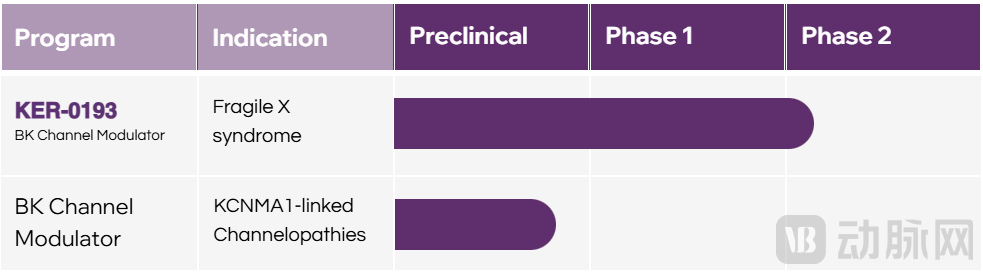
Overview of Kaerus Pipeline
This "single asset + focused strategy" enables enterprises toEfficiency through FocusOnce a candidate drug is taken over by a large pharmaceutical company, it can not only speed up the clinical progress but also allow the team to realize capital returns. This transaction is an important milestone for Kaerus in realizing the value transformation of its R&D achievements.
The succeeding Servier, on the other hand, is a company of a completely different scale and positioning.Founded in 1954, Servier, headquartered in France, is a global pharmaceutical group held by a foundation., what makes it special is that the majority of profits are reinvested into research and development and business expansion. Over the course of nearly 70 years of development,Servier has long been deeply engaged in the fields of cardiovascular and metabolic diseases, and in recent years has gradually shifted its research and development focus to oncology.
Since 2025, Servier has completed multiple transactions in succession.: Invested $210 million to acquire the development rights of IDEAYA's PKC inhibitor, purchased Black Diamond's oncology candidate drug, and this time, the acquisition of KER-0193 for a maximum price of $450 million marks its first layout in the field of neurology.
This move not only provides Servier with an entry point into the rare neurological disorders field but also signifies that the "three pillars" of its 2030 strategy—oncology, cardio-metabolic/venous diseases, and neurology & immuno-inflammation—are gradually being implemented.
From Kaerus to Servier, this deal is essentially an innovation relay:The former relies on focused innovation to complete early risk validation, while the latter leverages capital and global development capabilities to push it into broader clinical and market applications.
BD Paradigm Driven by Strategy, Regulation, and Technology
This transaction is driven by the combined forces of strategy, regulation, and technology.
As competition in traditional treatment areas becomes saturated,Large pharmaceutical companies are increasingly inclined to seek breakthroughs in differentiated fields such as rare neurological diseases.KER-0193 has received FDA Orphan Drug and Rare Pediatric Disease designations, which can shorten the approval process, extend market exclusivity, and provide research and development subsidies, reducing development risks. More importantly, its layered chain of evidence from mechanism validation to animal experiments and then to human electroencephalogram (EEG) studies has laid a solid foundation for entering Phase II clinical trials.
This deal sends three signals.First, early mechanism validation becomes a key value anchor.Kaerus Directly Proves Drug Entry into the Brain and Modulation of Abnormal Electrical Activity via EEG in Phase Ⅰ Trials; This Type of Quantifiable Evidence Chain is Highly Valued by Regulatory Agencies and Investors, Becoming a Core Criterion for Determining Whether an Asset Can Advance to the Next Stage.
Secondly, BD has become an "accelerator" for startups.Under limited resources, pushing assets to reach the milestone of "mechanism-proven and clinically feasible," and then achieving value amplification through mergers and acquisitions, is increasingly becoming a mature pathway.
Third, the commercial logic of rare diseases is being strengthened.Although the number of patients is limited, the unmet needs are extremely high. Coupled with the support of orphan drug policies, a unique balance is formed between investment and returns.
This is also instructive for other innovative teams:Rather than blindly laying multiple pipelines, it is better to focus on quickly validating the core mechanism and then achieving the transformation of results through BD transactions.This approach may be more strategically efficient than "casting a wide net."
Returning to the acquisition itself, the total transaction value of $450 million not only reflects the potential value of KER-0193 but also highlights the strategic alignment between Servier and Kaerus. Looking ahead, the therapy addresses significant clinical needs, benefits from a favorable regulatory environment, and faces limited competition.In the field of rare neurological diseases, it is expected to become the next hot spot in biopharmaceutical BD.It can be foreseen that the model of "mechanism validation + early clinical trials + accelerated mergers and acquisitions" will continue to advance in the field of neurological rare disease treatment.
References:
[1]Hunter J, Rivero-Arias O, Angelov A, Kim E, Fotheringham I, Leal J. Epidemiology of fragile X syndrome: a systematic review and meta-analysis. Am J Med Genet A. 2014 Jul 164A(7): 1648-58.