

Chineo Medical's '3-in-1' T Cell Therapy Significantly Extends Survival in Advanced Biliary Tract Cancer Patients, According to Cell Reports Medicine Study
Chineo
Developer of Tumor and Immune Disease Therapeutics


Text by Wang Cong
Editor | Wang Duoyu
Typesetting │ Shuicheng Wen
CAR-T CellsThe clinical success in hematologic malignancies has reversed the perception that cancer is incurable. Inspired by this, CAR-T cell therapy was hoped to achieve a breakthrough in solid tumor treatment. However, clinical trials on solid tumors have shown that although CAR-T is relatively safe, its efficacy is far inferior to its performance in hematologic cancers. Additionally, TCR-T, NK cells, and other cell therapies targeting solid tumors have not achieved significant breakthroughs.
T Cell Therapy for Solid Tumors Faces Three Key Challenges: 1) Antigen Heterogeneity; 2) Tumor Microenvironment Suppressing T Cell Function; 3) Difficulty in Culturing Sufficient Non-Exhausted T Cells In Vitro.
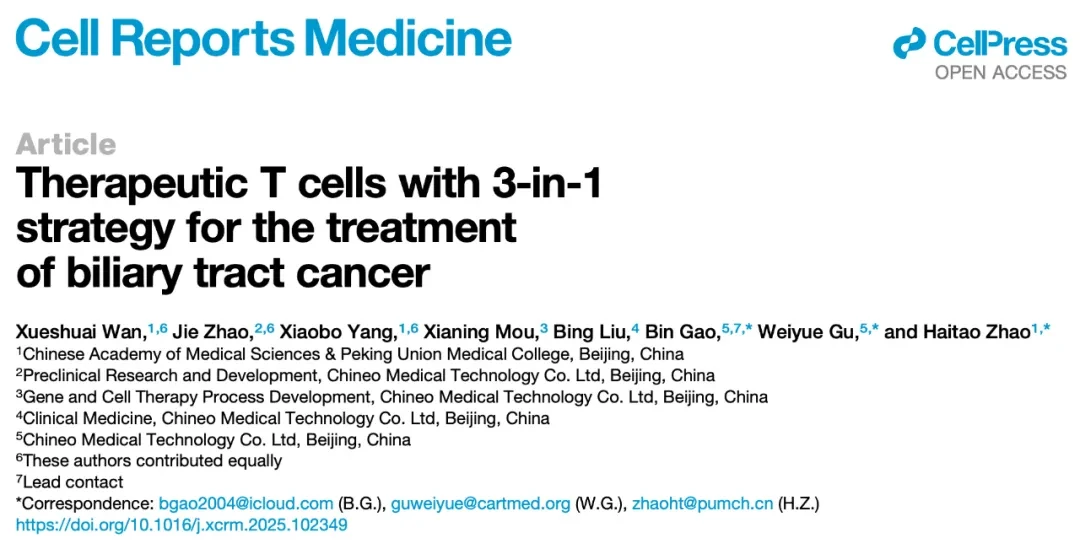
September 18, 2025In ChinaChinese MedicineChinese Academy of Medical Sciences & Peking Union Medical CollegeHaitao Zhao、ChineoGu Wei Yue、Gao BinAs co-corresponding authors, in a Cell Press journalCell Reports MedicinePublished an article titled:Therapeutic T cells with 3-in-1 strategy for the treatment of biliary tract cancerResearch Paper.
The study developed a three-in-one strategy to produce therapeutic T cells——Super-circulating Tumor-Infiltrating Lymphocyte-like Cells(Super Circulating TIL-like Cell, abbreviated asScTIL), and use it forBiliary Tract CancerThe treatment demonstrated safety and significantly extendedSurvival Period of Patients with Advanced Biliary Tract Cancer.
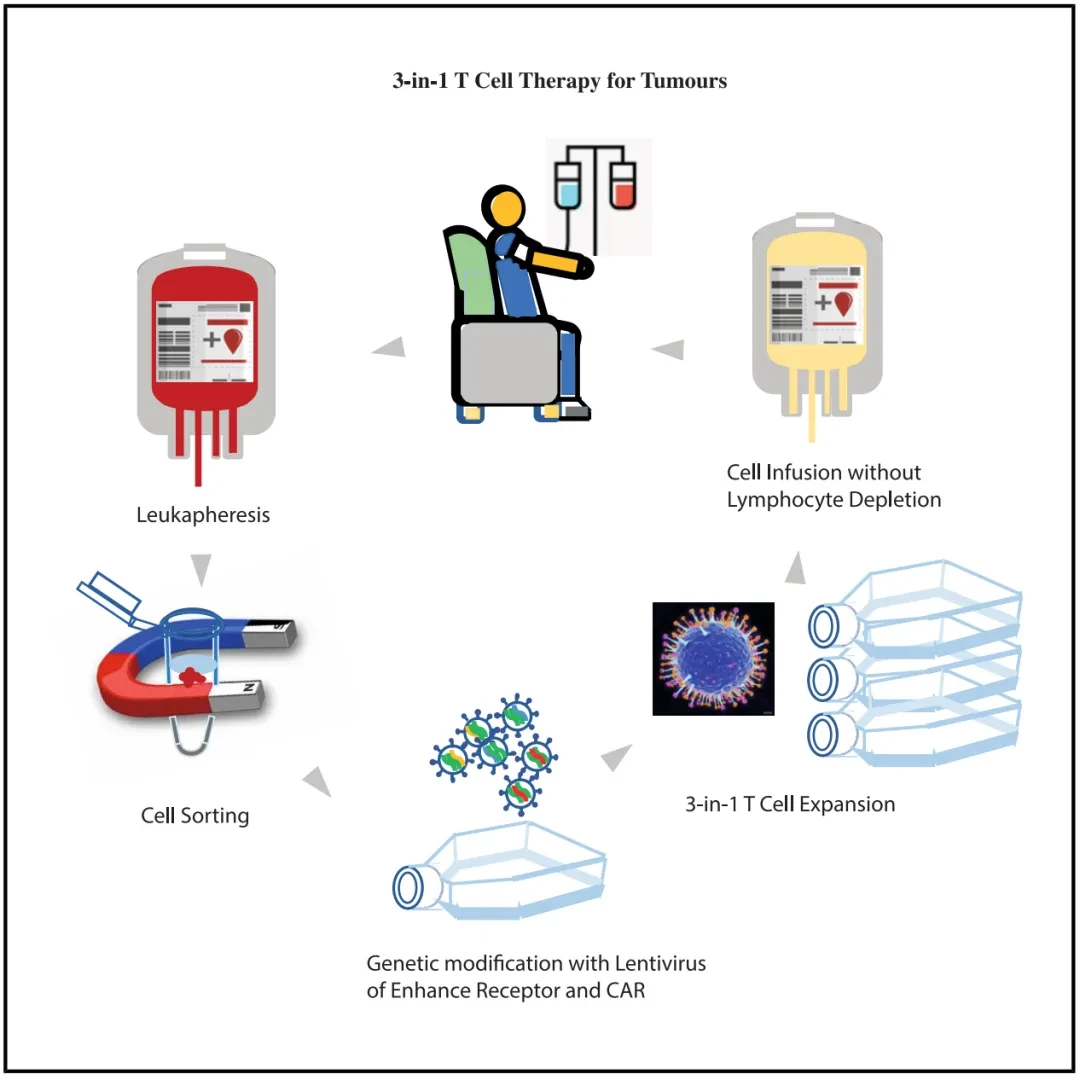
To address the three major obstacles faced by T cell therapy in solid tumors, the research team adopted aThree-in-OneStrategy for ProductionSuper-circulating Tumor-Infiltrating Lymphocyte-like Cells(Super Circulating TIL-like Cell, abbreviated asScTIL)——
1、Isolation of PD-1 from Peripheral Blood of Cancer Patients+T Cells(cTIL), which can function like tumor-infiltrating lymphocytes(TIL)Identify heterogeneous tumors in the same way;
2. Use of Enhanced Receptors(PD-L1 Receptor Plus CD28 Activation Fragment)Modify cTIL to reverse the tumor microenvironment(TME)The inhibitory effect;
3. Co-expression of expansion factors and anti-CD19 CAR enables ScTIL to rapidly expand to sufficient numbers in vivo through B cells.
This three-in-one strategy produces ScTIL that effectively kills tumor cells both in vitro and in vivo. Clinically, in 10 patients with advancedBiliary Tract Cancer(BTC)The patient received ScTIL treatment; the results showed that, at an appropriate dose or in the normal B-cell group,(5/10)In China, the median overall survival of ScTIL monotherapy(OS)18.3 months, superior to first-line treatment options for biliary tract cancer(OS approximately 12 months)。ScTIL TherapyNo need for chemotherapy preconditioning and IL-2, better safety, no reliance on surgical materials, shorter production cycle.
The Core Findings of the Study:
Three-in-OneScTIL, through PD-1+T Cell Enhancement Receptor(ER), PD-1/CD28 and anti-CD19 CAR modifications;
ScTIL can effectively kill tumor cells both in vitro and in vivo, demonstrating strong anti-tumor activity.
In selected patients with biliary tract cancer, the median overall survival of ScTIL reached 18.3 months, surpassing standard therapies.
ScTIL skips chemotherapy preconditioning/IL-2, requires no surgical materials, and is safer and faster.
Overall, the study shows that,ScTIL significantly extendedThe survival period of patients with advanced biliary tract cancer indicates that ScTIL is a promising therapy for future biliary tract cancer treatment, bringing new hope to cell therapy for solid tumors.
https://www.cell.com/cell-reports-medicine/fulltext/S2666-3791(25)00422-7










PointIn View, Convey Your Taste