Disclaimer: Due to limited proficiency, errors are inevitable, and some information may not be the latest. Comments pointing out any inaccuracies are welcome. This article is only an introduction to medical and health-related drugs, not a recommendation of treatment plans (if involved); it does not constitute any investment advice.
On September 23, 2025, Atsena Therapeutics, a clinical-stage gene therapy company, announced the completion of dosing for adult patients in Part B of the LIGHTHOUSE study. The LIGHTHOUSE study is a Phase I/II/III clinical trial designed to evaluate the efficacy of subretinal injection of ATSN-201 in treating X-linked retinoschisis (XLRS). Based on the preliminary data assessment from the adult patient cohort, dosing for pediatric patients is expected to begin in Q4 2025, pending approval from the Data Monitoring Committee.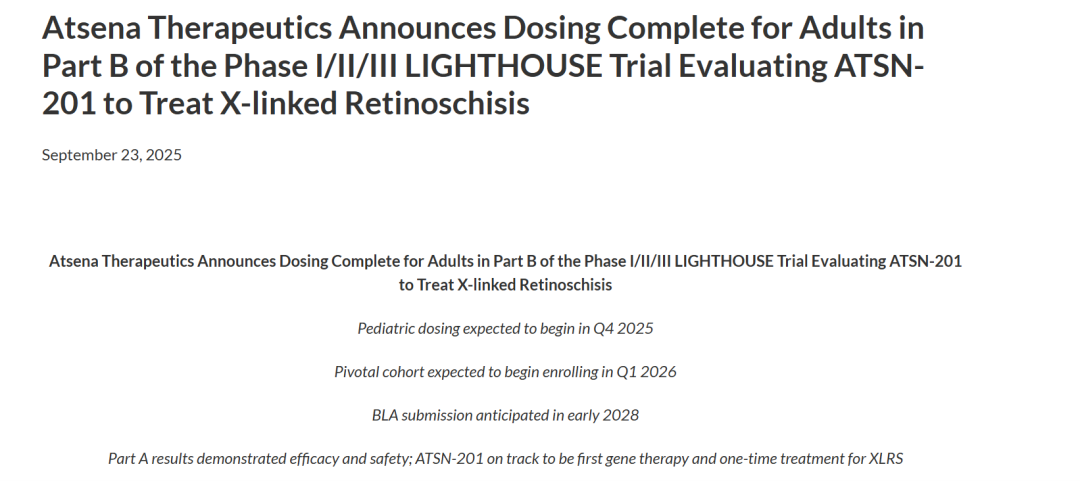 The novel diffusive capsid AAV.SPR used in ATSN-201 can spread laterally beyond the subretinal injection site, enabling safe and effective gene delivery to the central retina (in patients with XLRS, schisis cavities are predominantly located in the central retina). Previous studies have shown that AAV.SPR can effectively deliver payloads to cone cells overlying the fovea at clinical doses without the need for surgical dissection and without triggering inflammation.This best-in-class gene therapy candidate has been granted Regenerative Medicine Advanced Therapy (RMAT), Fast Track, Rare Pediatric Disease, and Orphan Drug designations by the U.S. Food and Drug Administration (FDA).The ongoing I/II/III phase LIGHTHOUSE trial evaluation consists of three parts (A, B, and C) and six cohorts. The I/II phase includes cohorts 1-3 (Part A) and cohorts 4-5 (Part B), while the remaining cohort 6 (Part C) will serve as the III phase of the study.Part B of the ongoing multicenter clinical trial is evaluating a total of 9 adult patients and 3 pediatric patients with XLRS. Adult patients are divided into three groups: low-dose group, high-dose group, and control group. Patients in the control group will be observed for one year after discontinuation of treatment, with the option to continue receiving treatment thereafter. In July 2025, the U.S. Food and Drug Administration (FDA) agreed to expand this study into a pivotal trial.And support its Biologics License Application (BLA), expected to be submitted in early 2028.ATSN-201 is the first gene therapy for XLRS to demonstrate efficacy and a favorable safety profile in a Phase I/II trial: Most patients showed improved retinal structure (closure of macular schisis), with clinically meaningful improvements in microperimetry, best-corrected visual acuity, and low-luminance visual acuity. After at least one year of follow-up, ATSN-201 was well-tolerated, with no serious adverse events reported.If approved, ATSN-201 will become the first gene therapy approved for XLRS.Kenji Fujita, MD, Chief Medical Officer of Atsena Therapeutics, stated: "Dosing for all adult patients in Part B has been completed, and follow-up is ongoing. Preliminary safety data remains favorable, with early structural and functional readings, including improvements in foveal schisis and retinal sensitivity, consistent with the positive signals observed in Part A. These findings will support the initiation of pediatric dosing, a critical next step in evaluating the full therapeutic potential of ATSN-201 in the XLRS patient population.""Atsena Therapeutics CEO Patrick Ritschel stated, 'The completion of adult dosing in Part B of the LIGHTHOUSE study marks a significant milestone in our advancement of ATSN-201 through the pivotal trial pathway. The FDA's endorsement of our trial design underscores the growing momentum of this program. In the absence of any approved therapies, we remain committed to bringing this potential first-in-class and best-in-class gene therapy to XLRS patients as quickly and rigorously as possible.'"Source of the article: Company announcement
Mastering CAR-T Therapy, Stem Cell Therapy, Gene
Therapy,Comprehensive Information on Oncolytic Viruses and Nucleic Acid Drugs