

Domestic Innovative Drug BD Strategies Evolve: Key Players Like Keyi Pharma, Hengrui, and BeiGene Pioneer New Outbound Licensing Models

Novatim
Innovative Drug Developer for Tumor Immunotherapy
Promising new drugs produced in China are beginning to gain more market negotiation space.
On September 27, Novatim announced a strategic partnership with U.S.-based biopharmaceutical company VRise Therapeutics. The two parties signed an exclusive licensing agreement for the Indian market regarding KQ-2003, the world’s first dual-targeted CAR-T cell therapy product with enhanced parallel targeting (targeting BCMA/CD19).
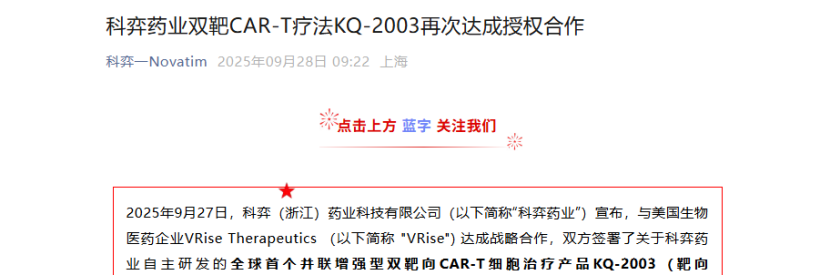
Not only that, but two months ago (July 22), Novatim reached a strategic cooperation with U.S.-based biopharmaceutical company ERIGEN regarding KQ-2003. The latter will obtain exclusive development, registration, and commercialization rights for KQ-2003 in regions outside Greater China (excluding India, Turkey, and Russia).
Industry analysts believe that this "staged authorization" BD model, which allows for "multiple monetizations," is sparking a new wave of Chinese-produced drugs going global. By identifying suitable partners for products based on the characteristics of different regional markets, development risks can be shared and value maximized. R&D strength serves as the "hard bargaining chip" at the negotiating table, while innovation at the source is the key factor supporting this strategy.

Novatim Explores Multiple Avenues for "Monetization"
It is reported that Novatim, founded in 2018, is an innovative pharmaceutical company focusing on the research and development and clinical application of novel drugs for cancer immunotherapy. The company has established three core technology platforms: a bifunctional antibody platform, a nano bispecific ADC platform, and an enhanced dual-target CAR-T platform, with over 10 self-developed potential FIC/BIC pipelines. Its promising R&D pipelines include China's first βγ-biased PD-1/IL-2 fusion protein, the world’s first nano bispecific ADC, and an enhanced dual-target CAR-T with parallel design.
KQ-2003 is an innovative therapy developed by Novatim based on its enhanced dual-target CAR-T platform. With a parallel structural design and optimized signaling domain, it significantly improves the persistence and anti-tumor activity of CAR-T cells while reducing the risk of recurrence associated with traditional CAR-T therapies. It is expected to provide a strong complement to areas where traditional CAR-T treatments fall short.
Currently, the therapy is in the Phase I/IIa clinical trial stage in China. In December 2024, clinical research data presented at the 66th American Society of Hematology (ASH) Annual Meeting showed that KQ-2003 achieved an overall response rate (ORR) of up to 100% in patients with relapsed/refractory multiple myeloma (rrMM), demonstrating significant efficacy and durable responses.
According to the terms of the collaboration, Novatim will receive an upfront payment and milestone payments during the R&D, registration, and commercialization stages through this partnership with VRise. In addition, Novatim will also be entitled to tiered royalties ranging from high single-digit to double-digit percentages based on the net sales of KQ-2003 within the licensed territory.
VRise will obtain the exclusive rights for the development, registration, and commercialization of this product in the Indian region. In addition to advancing the indication for relapsed/refractory multiple myeloma, VRise also plans to explore the clinical and commercial potential of KQ-2003 in treating autoimmune diseases in India.
Notably, prior to this, Novatim had reached a licensing agreement with Erigen. Novatim will receive a near-term development milestone payment of $15 million and is eligible for milestone payments totaling up to $1.32 billion across the research, registration, and commercialization phases. Based on the net sales of KQ-2003 within the licensed territory, Novatim will also be entitled to sales royalties of up to $800 million.
In addition to obtaining the development and commercialization rights for the product in Greater China (excluding India, Turkey, and Russia), Erigen will also acquire the key patent structure and sequence of KQ-2003 to develop a "universal CAR-T cell therapy." The rights to this universal product in Greater China will be retained by Novatim.
Industry insiders pointed out that the two licensing deals further confirm the recognition of KQ-2003's development potential and market value. Moreover, unlike the traditional model of bundling all overseas rights to a single giant, this strategy can match each product with the most suitable partner based on the product’s characteristics and indications, achieving optimal resource allocation. Its BD transaction model also provides new insights for the industry.

Shift in BD Model for New Drugs Produced in China
Similar to Novatim, Hengrui Medicine has also exhibited analogous behavior.
On September 25, Hengrui Medicine reached an agreement with Glenmark Specialty to grant a paid license for its proprietary Class 1 innovative drug, Recombinant Trastuzumab (SHR-A1811), to the latter.

This cooperation grants an exclusive, paid license for development and commercialization rights globally, excluding mainland China, the Hong Kong Special Administrative Region, the Macao Special Administrative Region, Taiwan region, the United States, Canada, Europe, Japan, Russia, Armenia, Azerbaijan, Belarus, Kazakhstan, Kyrgyzstan, Moldova, Tajikistan, Turkmenistan, and Uzbekistan.
What has drawn industry attention is that, excluding sales royalties, the maximum transaction value of Hengrui’s deal this time reached $1.11 billion. However, the authorized regions, aside from the solid base of Greater China, do not include the more commercially valuable developed markets of Europe, America, and Japan, nor the important hub countries of Central Asia along the "Belt and Road," but instead only grant development rights for other emerging or secondary markets.
Industry analysis pointed out that Glenmark Specialty, the company Hengrui collaborated with this time, belongs to Glenmark Pharmaceuticals. The latter is a global research-driven pharmaceutical company headquartered in Mumbai, India, with businesses covering innovative drugs, generic drugs, and OTC fields. It focuses on therapeutic areas such as respiratory, dermatology, and oncology. With 11 world-class manufacturing facilities across four continents and operations spanning over 80 countries, Glenmark has strong capabilities that will help rapidly expand the international market for Recomblotuzumab beyond the aforementioned regions.
On the other hand, it is possible that Hengrui is also adopting a "multi-purpose strategy," potentially licensing these regions to other companies in the future. Notably, this transaction by Hengrui reflects its emphasis on the Central Asian market. It is understood that in recent years, China and the five Central Asian countries have elevated their cooperation in traditional areas such as investment, trade, transportation, and energy to a higher level. In 2024, the trade volume between China and Central Asia reached $948 billion, hitting a record high. With their geographical advantages, market potential, and favorable policy environments, the five Central Asian countries are gradually becoming a new blue ocean for China's novel drug exports.
In exploring the BD rights of domestically produced new drugs, BeiGene is also one of the leaders. Recently, BeiGene reached a new deal with Royalty, which differs from models like license out or newco. This transaction involves the transfer of "dividends" from future sales of an already marketed drug. In addition to accelerating the internationalization of domestically produced new drugs, this model also reflects the maturity and diversity of Chinese pharmaceutical companies in new drug development and rights management.
According to the Insight database, in 2024, there were approximately 110 BD deals for new drugs produced in China, with a disclosed total transaction value of $46.6 billion; in Q1 of 2025, 29 BD deals for new drugs produced in China were reached, with a disclosed total transaction value of $34.7 billion.
In-depth exploration reveals that Chinese pharmaceutical companies are no longer transferring core rights at low prices in outbound BD deals, but instead have more room for premium pricing. The industry widely acknowledges that the key support for these changes is the significant rise in the value of domestically produced new drugs, whose "gold content" is increasingly recognized by the global market. The continuous emergence of new models is an inevitable result of China's innovation transitioning from "pseudo-innovation" and "involution" to "true innovation."
Editor: Zhang Jieying
Layout Editor: Chen Shuwen
Reviewed by: Ma Fei, Zhang Song


www.yyjjb.com.cn
Insight into Industry Trends

"China Prescription Drug"
Academic Official Account
Focus on Pharmaceutical Academics and Evidence-Based Research

Terminal Official Account