Billions in BD Deals Ignite the Race for In Vivo CAR-T Therapies

Pregene
Cell Therapy Drug Developer

Gilead Sciences
Innovative Drug Developer, Distributor

The in vivo cell therapy track is exploding.
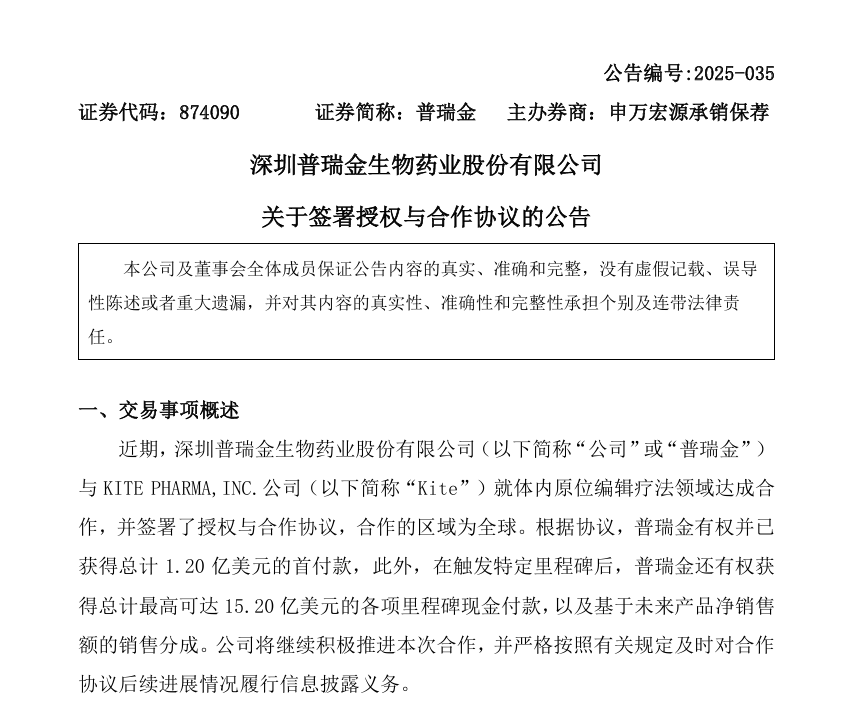
On October 16, Shenzhen Pregene Biopharma Co., Ltd. ("Pregene") reached a collaboration with Kite Pharma, Inc. ("Kite"), a subsidiary of Gilead Sciences, in the field of in vivo gene-editing therapy, and signed a licensing and collaboration agreement.
According to the agreement, Pregene has the right andHas received an upfront payment totaling $120 million,In addition, after triggering specific milestones, Pregene is also entitled to receive a total of up to 1.52 billion US dollars in various milestone cash payments, as well as sales royalties based on future product net sales.Total amount reached 1.64 billion US dollars (approximately 11.7 billion yuan).
To understand this collaboration, one must first understand Kite's situation.Kite AlthoughDespite having two major autologous CAR-T products, Yescarta and Tecartus, it still faces crises:
Autologous CAR-T Therapy Still Faces Ceiling Challenges. From leukapheresis, cold chain transportation, ex vivo genetic modification, cell expansion to reinfusion, the entire process takes weeks and costs hundreds of thousands of dollars. This "ultra-personalized" model greatly limits its production capacity, accessibility, and commercial potential. The number of patients it can treat is ultimately limited.
Moreover, more than 10 CAR-T products have been approved globally, indicating fierce competition. At the same time, new technological approaches such as universal CAR-T (UCAR-T) and CAR-NK continue to pose challenges. Kite must find its next growth curve before its current advantages are exhausted.
Previously, the focus of the cell therapy industry was mainly on UCAR-T, which involves using cells from healthy donors to prepare universal products. However, UCAR-T faces inherent challenges such as host-versus-graft reaction (HvG) and graft-versus-host disease (GvHD), which are forms of immune rejection.
Against this backdrop, in-situ generation within the body provides an optimized and more disruptive solution.It skips the complex in vitro cell manipulation in traditional cell therapy., directly moving the "pharmaceutical factory" into the patient's body. For Kite, this is not only a technological layout but also a strategic bet on the ultimate future form.
Public information shows that Pregene is a clinical-stage biopharmaceutical company dedicated to the discovery and development of novel cell therapies. It possesses industry-leading cell and lentivirus manufacturing processes and technologies. Leveraging its proprietary high-throughput CAR-T/CAR-NK/TCR-T drug optimization platform and proprietary cell and lentivirus manufacturing processes, Pregene is developing a robust pipeline of clinical-stage product candidates, including various autologous and allogeneic cell and gene therapies as well as biologic products.
This global collaboration between Pregene and Kite aims to support and accelerate the research and development of next-generation in situ editing therapies, focusing on optimizing the entire process from early discovery to clinical development to bring innovative therapies with potentially life-changing significance to patients more efficiently.
In situ editing in the body, simply put, involves delivering a "gene-editing toolkit" (for example, LNPs encapsulating mRNA encoding CAR and the CRISPR/Cas9 system) into the patient’s body via intravenous injection or similar methods. This "toolkit" is designed to precisely locate specific immune cells (such as T cells). Once inside the cell, the gene-editing tools integrate the CAR gene into the T-cell genome, thereby converting ordinary T cells on-site into CAR-T cells capable of recognizing and attacking cancer cells.
This means that the treatment can be mass-produced and standardized in factories like traditional chemotherapy drugs or antibody drugs, with controllable quality and significantly reduced costs. At the same time, the treatment process is greatly simplified, eliminating the need for patients to undergo complex leukapheresis and endure waiting periods. Treatment can be completed with a single or a few simple intravenous injections, greatly enhancing the patient experience and medical efficiency.
Globally, leading companies in the gene editing field, including Intellia Therapeutics and CRISPR Therapeutics, are actively making strategic moves. The success of Intellia's in vivo CRISPR therapy in treating transthyretin amyloidosis (ATTR) has already demonstrated the feasibility of using LNP to deliver gene editing tools to the liver.
Although in vivo therapies hold great promise, challenges remain severe, such as targeted delivery—how to precisely and efficiently deliver gene-editing tools to target T cells while avoiding "off-target" effects on other tissues or cells; immunogenicity—the delivery vehicles (such as LNPs or viruses) and the gene-editing proteins (such as Cas9) themselves may trigger immune responses in the human body, affecting efficacy and safety; dose control and repeated dosing—how to accurately control the number of CAR-T cells generated in vivo and whether repeated dosing can be safely performed are clinical issues that need to be addressed.
Pregene's collaboration with Kite comes at the eve of such a technological breakthrough. Whoever overcomes these bottlenecks first will gain control over the next generation of cell therapy.
Currently, as in vivo CAR-T gains increasing popularity, multiple multinational pharmaceutical companies have entered the field through acquisitions. For instance, in October 2025, BMS announced a $1.5 billion cash acquisition of in vivo CAR-T company Orbital Therapeutics. Orbital's core product, OTX-201, is an in vivo CAR-T therapy based on circular RNA, which can be delivered via lipid nanoparticles (LNP) to directly modify T cells within patients for the treatment of autoimmune diseases.
In August 2025, Kite acquired Interius Biotherapeutics for $350 million, positioning itself in in vivo CAR-T technology. Interius' INT2104 project is the world's first in vivo CAR-T therapy to enter human clinical trials, utilizing a lentiviral vector to modify T cells in vivo for the treatment of B-cell malignancies.
In June 2025, AbbVie acquired Capstan Therapeutics for $2.1 billion, obtaining its in vivo CAR-T project CPTX-2309 based on mRNA-LNP technology for the treatment of B cell-mediated autoimmune diseases. Previously, AbbVie also collaborated with Umoja Biotherapeutics to develop in vivo CAR-T therapy, demonstrating its continuous expansion in this field.
In March 2025, AstraZeneca acquired Esobiotec for $1 billion, obtaining its lentiviral vector platform technology and the in vivo CAR-T candidate drug ESO-T01 for multiple myeloma.ESO-T01, co-developed by Pregene, is currently undergoing an Investigator-Initiated Trial (IIT) in China for the treatment of multiple myeloma.
As numerous companies make their moves, it clearly points to the future direction of the industry: moving from "individualized, complex" ex vivo preparation to "standardized, pharmaceutical" in vivo treatment, heralding a more efficient and accessible new era of cell and gene therapy is accelerating.
Once the technology for in vivo cell therapy matures, its applications will go far beyond hematological tumors. It is expected to expand to solid tumors, autoimmune diseases, and more.Other Disease Areas in Urgent Need of Innovation`, providing new treatment options for more diseases that currently have no cure.`
The in vivo gene-editing therapy industry is at a critical juncture of transitioning from "scientific breakthrough" to "clinical application." Pioneers like Intellia have already paved the way, while the entry of giants and innovators such as Kite Pharma and Pregene signals the full-scale launch of a global race surrounding the next generation of cell and gene therapies. In the next five years, we will witness more exciting clinical data and the tremendous leap brought by this disruptive technology.


All articles reprinted by this official account are intended to convey more information, with clear attribution of sources and authors. Media or individuals who do not wish to be reprinted may contact us (cbplib@163.com), and we will immediately delete the content. All articles represent the views of the authors and do not reflect the position of this site.