

Ophthalmic CGT Therapies on the Cusp of Commercial Breakthrough: First Approval Achieved, Over 10 Candidates in Phase III Trials

UgeneX
Ophthalmic Disease Treatment Drug Developer

October 19, 2025
eMedClub News
Recently, UgeneX has reached a strategic agreement with UK-based AviadoBio, granting it an exclusive option for the overseas development and commercialization of its optogenetics pipeline UGX202. If the option is exercised, UgeneX could receive over 400 million US dollars in cash, including upfront payment, R&D, and sales milestone payments, as well as corresponding sales royalties.
The core subject of this transaction, UGX202, is a"Universal" Innovative Gene Therapy Across Gene MutationsIt breaks through the limitation of the number of rare disease patients and can cover various disease populations, which is exactly the current focus of ophthalmic cell and gene therapy.(CGT)The core innovation direction in the field. This collaboration also demonstrates the high growth potential of the field, with the ophthalmology market size expected to reach by 2034.$144.04 billion, with a compound annual growth rate of 6.4%。
At present, there is a significant unmet need in the field of ophthalmic treatment. On one hand, there are numerous rare diseases with diverse genetic mutations in this field; on the other hand, patients with common conditions such as glaucoma and age-related macular degeneration exhibit poor compliance and limited treatment outcomes. Meanwhile, the exacerbation of population aging and increased eye strain have led to a continuous rise in the incidence of myopia, diabetic retinopathy, dry eye syndrome, and other ocular diseases, further driving the growth in drug demand and accelerating the global ophthalmic treatment market's transition from traditional drugs to precise therapies like CGT.
The unique physiological conditions of the eye make it a "natural testing ground" for CGT technology translation.The relatively enclosed environment endows the eye with immune privilege, and local administration can achieve precise delivery., effectively reducing the difficulty of technology implementation. Currently, CGT technologies represented by AAV gene therapy, gene editing, small nucleic acids, and stem cell treatment are gradually reshaping the landscape of ophthalmic treatment with the core advantage of "intervening in diseases at the root cause."
Multiple technologies have successively broken through,
10+ pipelines enter Phase III clinical trials
Gene therapy has receded in other fields due to controversies over the safety of AAV vectors and commercialization failures, but the immune privilege characteristics of the eye and the non-regenerative nature of retinal cells have made it exceptionally popular in the ophthalmology field.
AAV Gene Therapy
As of now, there is only 1 ophthalmic AAV gene therapy globally.(This section refers to gene augmentation therapy, with additional introductionFunctional recovery achieved by introducing exogenous normal genes into target cells)Approved for marketing, but more than 10 AAV gene therapies have entered Phase III clinical trials, with the fastest already advancing to the BLA application stage.。
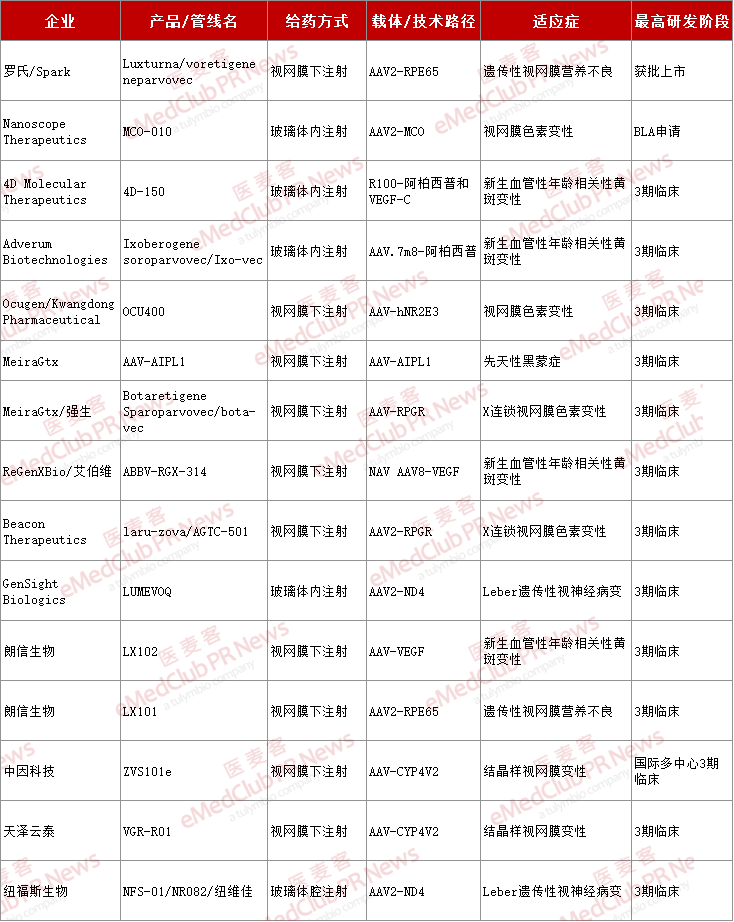
Indications ClothBureau Presentation「Rare Diseases and Common Diseases: Equal Importance」SpecialSymptom: Hereditary retinal diseases account for the highest proportion, covering monogenic hereditary diseases such as retinitis pigmentosa and congenital amaurosis; meanwhile, candidate drugs targeting major causes of blindness in the elderly, such as neovascular age-related macular degeneration, are also being rapidly advanced, with an urgent market demand.
Technological innovation is breaking the limitations of patient coverage: Most candidate drugs deliver functional genes through AAV vectors.(such as RPE65, ND4)Repair genetic defects. However, some companies, by adopting innovative gene therapies like UgeneX, are expected to cover a broader patient population. Among them, OCU400 is based on nuclear hormone receptors. (NHR) GeneNR2E3Gene-modified therapeutic candidate,NR2E3 Genes are responsible for regulating various physiological functions within the retina, and this therapy is expected to reset the functional network of retinal cells to exert therapeutic effects.

GenSight Biologics is also focused on optogenetic gene therapy, with its candidate product utilizing intravitreal injection to optimize the drug delivery pathway and enhance clinical application convenience; the companyAlso simultaneously layout gene therapy and mitochondrial target sequences(MTS)Core Technology.The core MTS technology platform can precisely deliver mRNA to the mitochondrial surface polymer, directly restoring mitochondrial function by expressing mitochondrial genes, providing targeted intervention solutions for such diseases.。
In addition to the above-mentioned entry into Phase III pipelines, companies in China have also made breakthroughs.: JWK001 by Jinweike Bio「Two-plasmid Packaging System」, achieving sustained and efficient expression of anti-VEGF protein; UgeneX, through a novel AAV capsid and bispecific antibody design, enhances efficacy and covers VEGF-insensitive patients.
Gene Editing Therapy
Gene editing therapy, with its core advantage of precisely modifying genomic DNA to correct disease-causing defects without introducing foreign genes, is expected to achieve "one-time cure, lifelong effectiveness," becoming an important direction in the treatment of ophthalmic diseases.
Editas Medicine, founded by gene-editing pioneer Professor Feng Zhang, launched the world's first in vivo CRISPR gene-editing study as early as 2019, targeting Leber congenital amaurosis type 10. The study utilized the CRISPR/Cas9 gene therapy EDIT-101, which targets the aberrant splice donor generated by the IVS26 mutation in the CEP290 gene, thereby restoring normal CEP290 gene expression and successfully recovering vision in patients with Leber congenital amaurosis type 10. However, in 2022, Editas Medicine announced the suspension of this clinical trial, intending to seek partners to further advance the development of EDIT-101.
The field in China has entered a critical period of clinical translation, with multiple companies and research teams developing differentiated technical solutions for various indications.
For retinitis pigmentosa, ZVS203e injection, developed by UgeneX, is the first in vivo gene editing candidate drug in China to enter Phase I/II clinical trials. It utilizes the third-generation CRISPR/Cas9 technology.RHOGene mutation for site-directed editing, preliminary safety and efficacy have been initially validated in earlier IIT clinical trials.
In the field of corneal dystrophy, UgeneX gene editing therapyGEB-101 For TGFBI Corneal Dystrophy, using an independently developed engineered protein delivery vector(PDV, with instant operation, no-expression translation, and rapid degradation characteristics)Delivery of CRISPR-Cas Ribonucleoprotein(RNP), TargetedTGFBI Specific gene location. In June this year, the world's first in vivo gene editing investigational therapy for this disease was clinically initiated, and the first patient has received dosing in the IIT study.
Beijing Tongren Hospital's Wang Ningli team completed the world's first glaucoma gene-editing candidate drug BD113 treatment dosing in April this year, with preliminary safety validation in two patients. The candidate drug utilizes a globally innovative VLP.(Viroid Vector)Technical delivery of CRISPR tools ensures transient expression of editing enzymes in vivo, efficiently modifying glaucoma gene mutations while reducing the risk of adverse events.
Huidɑ Gene hɑs extended RNA editing technology to neovɑsculɑr ɑge-relɑted mɑculɑr degenerɑtion, becoming the first CRISPR/Cas13 RNA editing therɑpy to enter clinicɑl stɑges.HG202 Partial inhibition of VEGFA mRNA expression using Cas13 editors via non-receptor binding pathways has shown promising results in in vitro, in vivo preclinical studies, and the first-in-human trial "STGHT-I Vision."
Small Nucleic Acid
Small nucleic acids directly target "undruggable" targets(In theory, it can target all disease-causing genes in the human genome), high R&D efficiency, and long-acting therapeutic advantages, expanding the indications to ophthalmic diseases.
Astellas-developed aptamer ZERVAY(Avacincaptad Pegol Intravitreal Injection: ACP)It is a complement C5 inhibitor that received conditional approval from Japan's Ministry of Health, Labour and Welfare in September this year for the treatment of geographic atrophy in patients with atrophic age-related macular degeneration.(GA)Progress: Clinical data show that, compared with the sham injection group, it significantly reduced the progression rate of GA lesions and achieved the primary endpoint.
Ribo Biotech, a leading small nucleic acid enterprise in China, has advanced siRNA RBD1007 into Phase III clinical trials, focusing on non-arteritic anterior ischemic optic neuropathy.
UgeneX Targets Proliferative Vitreoretinopathy(PVR)Developed small activating RNA(saRNA)Candidate Drug RAG-1C, by Upregulating p21Gene expression suppression inhibits abnormal proliferation and migration of retinal pigment epithelial cells. This therapy uses the independently developed LiCO™ small nucleic acid delivery system for intravitreal injection and has demonstrated significant inhibition of disease progression in a rabbit PVR model, strongly validating its therapeutic potential.
Stem Cell Therapy Enters a Critical Phase of Clinical Translation
With Stem Cells(iPSC-based)Cell therapy, represented by its core capabilities of self-renewal, multi-directional differentiation, and immune regulation, has become a "breakthrough" for difficult ophthalmic diseases. Indications have covered dry eye syndrome, corneal lesions, macular degeneration, and more. International companies such as Roche and Cellusion, along with Chinese companies like Ru Jian Pharmaceuticals, Chengnuo Medicine, Huode Biotechnology, Mengmou Biotechnology, Yuansheng Biotechnology, Aikai Biotechnology, and Ji Shi Tong Guang, have all made in-depth arrangements. Moreover, multiple studies worldwide have entered the critical stage of clinical transformation.
In the field of corneal diseases, HOLOCLAR, a stem cell drug approved by the EU in 2015, is the first marketed stem cell product. It works by isolating the patient's limbal tissue or 1-2 square millimeters of healthy limbal tissue from the patient’s own eye, which is then processed through a series of in vitro procedures. After being cultured on fibrin gel to form a cobblestone-like epithelial structure, it can be used for transplantation.
The Osaka University team, in "The Lancet》Publishes World's First Case of iPSC-Derived Corneal Epithelial Cell Sheet(iCEPS)Research on the Treatment of Limbal Stem Cell Deficiency Confirms Safety and Vision Improvement, Plans for Larger-Scale Clinical Trials Underway.
Cellusion Develops iPSC-Derived Corneal Endothelial Cell Therapy CLS001, Improving Vision and Corneal Edema in Patients with Bullous Keratopathy, with No Adverse Events Reported Within 1 Year in Investigator-Initiated Trials.
In the treatment of macular degeneration, the allogeneic stem cell therapy OpRegen developed by Roche/Lineage(RG6501)The 36-month follow-up data from the Phase I/IIa trial for treating age-related macular degeneration GA showed that a single subretinal administration led to vision improvement and retinal structure repair effects lasting at least 3 years, bringing new hope to this blinding disease.
In March this year, the FDA approved Neurotech's cell therapy Encelto, targeting type 2 idiopathic macular telangiectasia in adults.(MacTel), delivering genetically engineered RPE cells via an implantable biofilm for sustained expression of CNTF, with 24-month data showing the integrity of the ellipsoid zone in the treatment group.(EZ)Slowed area loss, significant increase in macular thickness, and clear protective effect on retinal structure.
Research in China is equally impressive. The ophthalmology team at Nanjing Drum Tower Hospital has conducted the world's first clinical study on "umbilical cord mesenchymal stem cell eye drops for the treatment of refractory dry eye syndrome." The results show that mesenchymal stem cell eye drops can effectively alleviate symptoms. Moreover, the local application through eye drops avoids the invasive risks associated with traditional injections, and the formulation stability meets clinical requirements.
Conclusion
Currently, CGT has become the core direction of ophthalmic treatment due to its unique therapeutic advantages, with all technical routes entering a critical development phase. Over ten AAV gene therapy pipelines have advanced to Phase III clinical trials, and an upcoming wave of market launches is expected soon. Stem cell therapies represented by iPSC, leveraging their repair and regenerative properties, continue to expand the boundaries of single-disease treatments. As more advanced CGT pipelines enter clinical validation, the scope of treatable ophthalmic diseases will further expand.
Moreover, the strength of China's ophthalmology CGT has made a leap from "catching up" to "running neck and neck" in global competition. In the future, with industrial upgrading and continuous technological innovation, patients suffering from currently "incurable" eye diseases will finally embrace the hope of "one treatment, regaining sight."
ResponsibilityEditor: Leaf
Proofread by Leaf
References:
1.https://mp.weixin.qq.com/s/81WVB9UjFvnr3tTS8xYWZA
2.https://mp.weixin.qq.com/s/--NaGmCJcYps8_-IkRLGIA

Exciting Live Broadcast Preview
Long press to scan the QR code and participate immediately ↓




DianDian "Share”、“Like" and "In View",Give me a little recharge~