

Two Major In Vivo CAR-T Deals Announced with Promising Clinical Data Across Oncology and Autoimmune Diseases

Pregene
Cell Therapy Drug Developer

Gilead Sciences
Innovative Drug Developer, Distributor

EsoBiotec
Developer of Immunocyte Therapy

October 22, 2025
eMedClub News
Recently, Pregene announced that it has reached a licensing and collaboration agreement with Kite, a subsidiary of Gilead Sciences, to support and accelerate the research and development of next-generation in situ editing therapies, providing more treatment options for patients in the fields of oncology, autoimmune diseases, and other areas in urgent need of innovation. According to the agreement, Pregene has obtained$120 millionThe upfront payment, after the triggering of specific milestones, Pregene is also entitled to receive a total amount of up to$1.52 billionMilestone cash payments and sales royalties based on future net product sales.

Gilead Sciences/Kite is a first-tier company in the cell therapy sector, with its representative products Yescarta and Tecartus achieving impressive sales since their market launch.Especially Yescarta, whose sales in the first half of this year have reached 779 million US dollars, with an estimated annual total exceeding 1.5 billion US dollars.It has established a sales advantage in the traditional CAR-T cell therapy track. However, competition in the track is intensifying, and the market for traditional CAR-T therapies is facing pressure from similar competing products, urgently needing to find new strategic directions.
As early as August this year, Kite acquired Interius, an in-vivo CAR-T company, for $350 million in cash, integrating Interius' in-vivo integration platform, which serves as the foundation for further breaking through the bottlenecks of traditional ex-vivo therapies. This collaboration with Pregene leverages the strengths of both parties and aligns with its strategic goals.「Expanding Next-Generation Therapies」Strategic needs,Forming a Dual-Drive Pattern of "Ex Vivo CAR-T for Revenue Growth, In Vivo Therapies for Future Expansion"。
Pregene is a clinical-stage biopharmaceutical company that has established a high-throughput CAR-T/CAR-NK/TCR-T drug optimization platform as well as proprietary cell and lentivirus manufacturing processes. Meanwhile, it has collaborated with EsoBiotec, which was acquired by AstraZeneca for 1 billion USD, to develop an in vivo BCMA CAR-T therapy called ESO-T01, which adoptsNanobody-targeted, Immune-shielded Lentiviral Delivery Vector。
The latest trial data of the candidate therapy showed that: as of April 1, 2025, four RRMM patients received a single infusion of ESO-T01,Objective Response Rate(ORR)Reach 100%, 2 cases achieved stringent complete remission(One of which had complete lesion resolution in 28 days), 2 cases achieved partial remission with negative minimal residual disease, and no pre-treatment chemotherapy was required, preliminarily verifying its therapeutic potential and safety.
This represents a technological upgrade and optimization for traditional viral vectors. Currently, China has become an important source of innovative drugs globally. As one of the leading players in the domestic in vivo cell therapy sector, this BD deal by Pregene also signifies that China's cell therapy technology is gradually gaining global recognition, marking a milestone.
And just a few days later, Sunshine Nuoh announced that it plans to contribute 15 million yuan of its own funds.Yuanma Zhiyao BiotechAn additional registered capital of 11.0556 million yuan will be injected. After the completion of the capital increase, the company will hold an 8.20% stake. This investment aims toAdvance the Strategic Layout of MetaCode Intelligent Drugs in the Fields of In Vivo CAR-T Cell Therapy and Nucleic Acid Drugs。
In Vivo CAR-T Clinical Data
Continuous progress in the in vivo CAR-T cell therapy field has also confirmed its popularity. Currently, multiple companies globally are focusing on the in vivo CAR-T sector for strategic development. Although in vivo CAR-T is still in its early stages, several companies have released clinical research data that preliminarily verifies the safety and efficacy of this therapy.
Hongxin Biotech
In September this year, Hongxin BioThe New England Journal of MedicinePublished a paper titled "In vivo CD19-CAR T-Cell Therapy for Refractory Systemic Lupus Erythematosus," globally unveiling for the first time the in vivo CAR-T candidate drug HN2301, based on mRNA-LNP, for the treatment of systemic lupus erythematosus.(SLE)The clinical trial research data of the patient. The publication of the paperMarks the official entry of In vivo CAR-T via mRNA-LNP pathway into the clinical research phase, with the first clinical validation achieved in humans.。
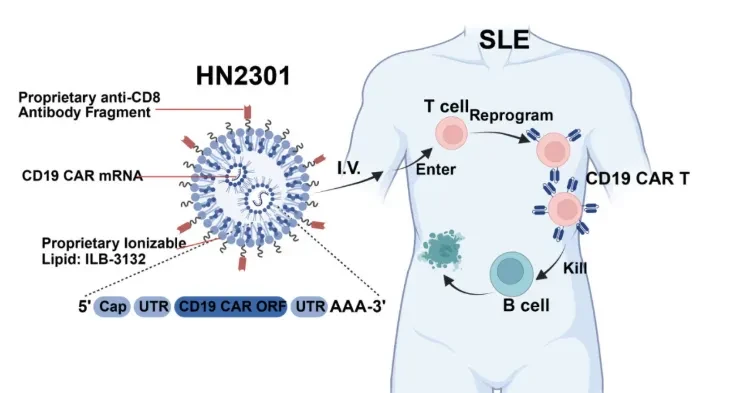
The core component of HN2301 is a proprietary ionizable amino lipid with independent intellectual property rights.(ILB-3132)Humanized CD8-targeting antibody fragments and Anti-CD19 CAR mRNA, administered intravenously without lymphodepletion.
First Patient Receives Low Dose(2 mg/dose)6 hours after a single dose,CAR-T reached 10% in peripheral blood, and peripheral B cell levels decreased to 10% of the pre-administration level.The second patient received three 2 mg doses, each spaced 48 hours apart. An increase in CAR-T cell production and a reduction in B cell levels were observed after each dose, but complete B cell depletion was not achieved.
Product Trial

6-well/24-well/100ml culture tank
New Product Trial Application
Event Time: September-October
From the 3rd patient, dose escalation was performed, with a single dose of 4 mg administered 2-3 times every 48 hours. CAR-T cells in peripheral blood...The peak was reached 6 hours after each infusion of HN2301, with the highest reprogramming ratio exceeding 60%, and then dropping to baseline levels within 2-3 days.CAR off-target expression on non-CD8+ T cells was less than 10%. Circulating B cells in the peripheral blood of patients who received a 4 mg dose were completely depleted within 6 hours after the first treatment, and the depletion lasted for 7-10 days. Additionally, HN2301 demonstrated good therapeutic potential in the 4th and 5th patients. Overall safety was favorable.
Jiyin Biotech
Last October, Pregene announced the IIT study results of its self-developed CD19-targeted in vivo CAR-T cell therapy. This candidate therapy is based on Pregene's proprietary VivoExpress technology platform, utilizing lentiviral delivery technology with excellent targeting and T-cell infection capabilities, and can effectively kill cancer cells.
The results of its IIT study showed that, one patient with high tumor burden of relapsed/refractory diffuse large B-cell lymphoma achievedComplete Remission(CR)And discharged from the hospital`, and no cytokine release syndrome of grade 2 or higher occurred`(CRS)Or Neurotoxicity(ICANS)Common side effects of CAR-T therapy.
Another patient treated for acute B lymphoblastic leukemia(B-ALL)The patient also successfully achieved CR, which isFirst Disclosure of Clinical Data on In Vivo CAR-T Therapy for Relapsed/Refractory B-ALL。
Interius
Interius's INT2104 targets and infects CD7+ T cells and NK cells via a lentiviral vector, transducing CAR transgenes to generate effector CAR-T cells and CAR-NK cells in vivo. The generated effector CAR cells will target CD20-positive B cells for the treatment of B-cell malignancies.
Interius launched the first clinical trial of INT2104 in 2024. As of the end of February 2025, three patients with non-Hodgkin's lymphoma have been enrolled. Preliminary data shows,One patient who received a higher dose had nearly all B cells depleted 6 days after infusion., and it has remained at a low level for three months.
Summary
The main indications for the in vivo CAR-T layout are tumors and autoimmune diseases. Some companies have already achieved CR.The current clinical data sample size is small, and larger-scale trials are still needed to verify the durability of the efficacy.As a blue ocean direction for CAR-T, the in vivo CAR-T has almost "synchronously" demonstrated its potential. This also implies that the subsequent development of this therapy does not need to wait until the oncology indications are fully matured before proceeding, and can rapidly iterate based on existing technological platforms. From the perspective of overall strategic layout, oncology indications are the "foundation" of in vivo CAR-T, while autoimmune indications represent the "growth driver."
Currently, international giants are accelerating their layout through acquisitions, such as Gilead Sciences/Kite acquiring Interius and AstraZeneca acquiring EsoBiotec; Chinese enterprises are breaking through by relying on technology and data. Jiyin Biotech and Hongxin Biotech have disclosed clinical results through independent research and development. The intensive layout of enterprises at home and abroad is pushing the track to transition from early exploration to clinical validation. The characteristics of in vivo CAR-T also mean that it is possible to achieve higher accessibility, advancing cell therapy to a new level.
Editorial Responsibility | Xun
Proofread by Xun
References:
1.Official Websites and Official WeChat Accounts of Various Companies

Exciting Live Broadcast Preview
Long press to scan the QR code and participate immediately ↓


DianDian "Share”、“Like"and"In View", charge me up a bit~"