Iaso Bio Announces Publication of Phase 1 Clinical Data for RD118, a Fully Human Anti-GPRC5D CAR-T Therapy, in Relapsed/Refractory Multiple Myeloma in Blood Journal

IASO Biotechnology
Cancer Treatment New Drug Developer


On October 22, 2025, IASO Bio announced today that Blood, a top journal in the international hematology field, published the latest clinical research results of its self-developed fully human GPRC5D-targeted CAR-T cell therapy product RD118 for the treatment of relapsed/refractory multiple myeloma (R/R MM).Research data shows that RD118 demonstrates significant efficacy and manageable safety in R/R MM patients who have relapsed after multiple prior treatments, offering new hope for these patients.
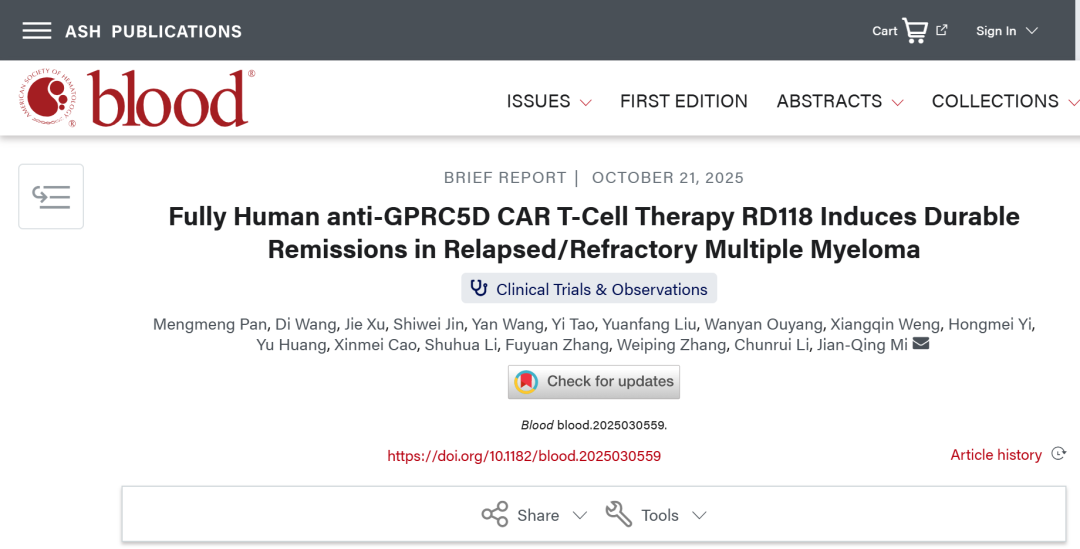
The article titled "Fully Human anti-GPRC5D CAR T-Cell Therapy RD118 Induces Durable Remissions in Relapsed/Refractory Multiple Myeloma" was published in Blood (Full text available at: https://doi.org/10.1182/blood.2025030559). This is an open-label, dose-finding phase 1 clinical study aimed at evaluating the safety and efficacy of RD118 in treating R/R MM. The study was conducted at Ruijin Hospital, affiliated with Shanghai Jiao Tong University School of Medicine, and Tongji Hospital, affiliated with Tongji Medical College of Huazhong University of Science and Technology (registered under numbers NCT05759793 and NCT05219721).
This study included 18 patients who received RD118 infusion, including 17 patients with R/R MM and 1 patient with relapsed primary plasma cell leukemia (pPCL) after complete remission. The median age of the 18 patients was 59.5 years, and the median number of prior treatment lines was 5. High-risk features included double-hit cytogenetic abnormalities (50%), triple-refractory status (50%), penta-refractory status (22.2%), and prior CAR-T therapy targeting BCMA (38.9%). After lymphodepletion conditioning, patients received doses of 1.0, 2.0, or 3.0×10 in the dose-escalation phase.6cells/kg RD118 cell infusion, or receive 2.0×10 in the expansion phase6cells/kg RD118 cell infusion. At a median follow-up of 17.0 months, the study results showed:
Efficacy
The overall response rate (ORR) was as high as 94.4%, with 72.2% of patients achieving complete response or stringent complete response (CR/sCR). Among 7 patients previously treated with BCMA-targeted CAR-T cell therapy, the ORR still reached 85.7%, with 5 cases (71.4%) achieving CR/sCR. All 3 patients with extramedullary disease and 1 patient with pPCL achieved sCR and remained in remission at the last follow-up. The median progression-free survival (PFS) was 18.2 months; the 12-month PFS rate and overall survival (OS) rate were 82.1% and 93.3%, respectively.
Safety
The incidence of cytokine release syndrome (CRS) was 88.9%, mainly grade 1-2, with only one patient experiencing ≥grade 3 CRS, which resolved rapidly after treatment. Only one patient developed grade 3 immune effector cell-associated neurotoxicity syndrome (ICANS), which resolved within 72 hours. No cerebellar toxicity or treatment-related deaths were reported.
Conclusion:The fully human targeted GPRC5D CAR-T cell therapy RD118 demonstrated significantly outstanding efficacy in R/R MM patients who had undergone multiple prior lines of treatment (including those who relapsed after prior targeted BCMA CAR-T therapy), with an overall response rate of 94.4%, a median progression-free survival of 18.2 months, and a manageable safety profile.