

Jiangxi's Centralized Procurement 'Three-Entry' Initiative Surges: 270% Spending Increase, 73.6% Coverage, Over 20,000 Participants

Qilu Pharmaceutical
Specialty Formulations and Active Pharmaceutical Ingredients (API) Developer
Editor: Zifei Yu
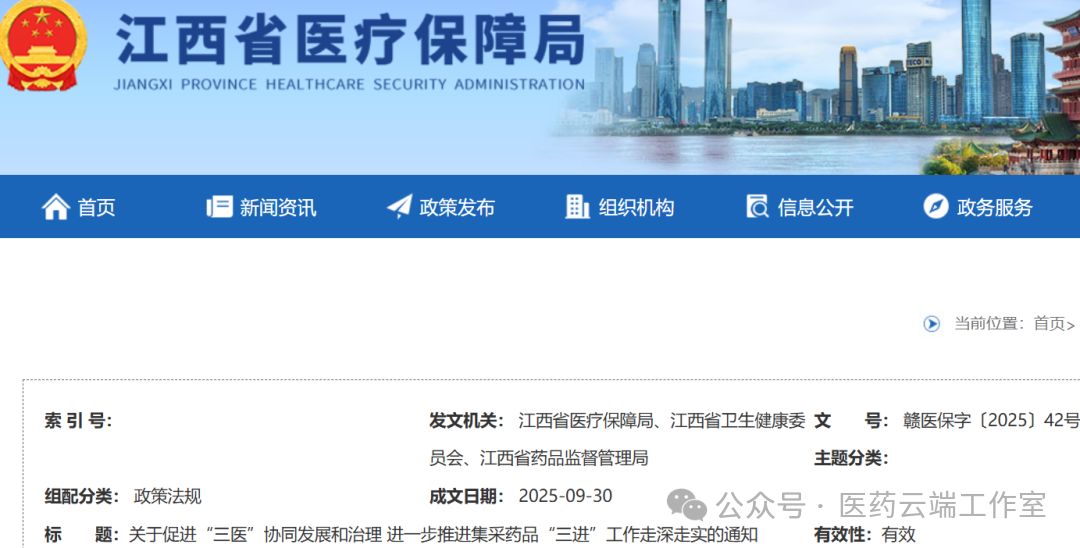
On October 14, the Jiangxi Provincial Medical Insurance Bureau, the Provincial Health Commission, and the Provincial Drug Administration jointly issued the "Notice on Promoting the Coordinated Development and Governance of the 'Three Medicals' and Further Advancing the 'Three Expansions' of Centralized Procurement Drugs to Deepen and Solidify the Work," which pointed out that,Strive to achieve a coverage rate of 70% or more for the "three-entry" units of centralized procurement drugs in medical institutions designated by the provincial medical insurance by the end of 2025, and reach over 80% by the end of 2026.The Notice will be implemented starting from September 30, 2025.
In fact, Jiangxi has exceeded the completion of all "Three Advances" targets and achieved very remarkable results.
Transaction amount nearly 140 million yuan, coverage rate exceeding 73%
Data disclosed by the Jiangxi Provincial Medical Insurance Bureau shows that as of September 30, 2025, compared with the end of 2024,The total transaction volume of "Three Entries" products on the provincial procurement platform is 245,748,700 tablets/pieces/bags/vials.Transaction amount nearly 140 million yuan(193,884,300 yuan, the amount and quantity of purchases made offline by "three-entry" units were not counted)Increase in the number of products covered28.43%, Increase in the procurement volume of varieties258.37%, Procurement amount increased277.58%。
According to statistics from the Jiangxi Provincial Medical Insurance Bureau, there are a total of 29,399 medical insurance designated grassroots medical institutions, private medical institutions, and retail pharmacies in the province.Of which, 21,642 voluntarily applied to participate.(including 14,518 grassroots medical institutions, 370 private medical institutions, and 6,754 retail pharmacies),Coverage rate 73.6%. The pre-set task of over 70% has been completed ahead of schedule and exceeded.
"The 'Three Entries' varieties have been included"Involving 670 varieties and 1,974 products from 586 enterprisesProduct, among whichIt is recommended to equip with 417 varieties of products from 428 enterprises, totaling 1,117 products.
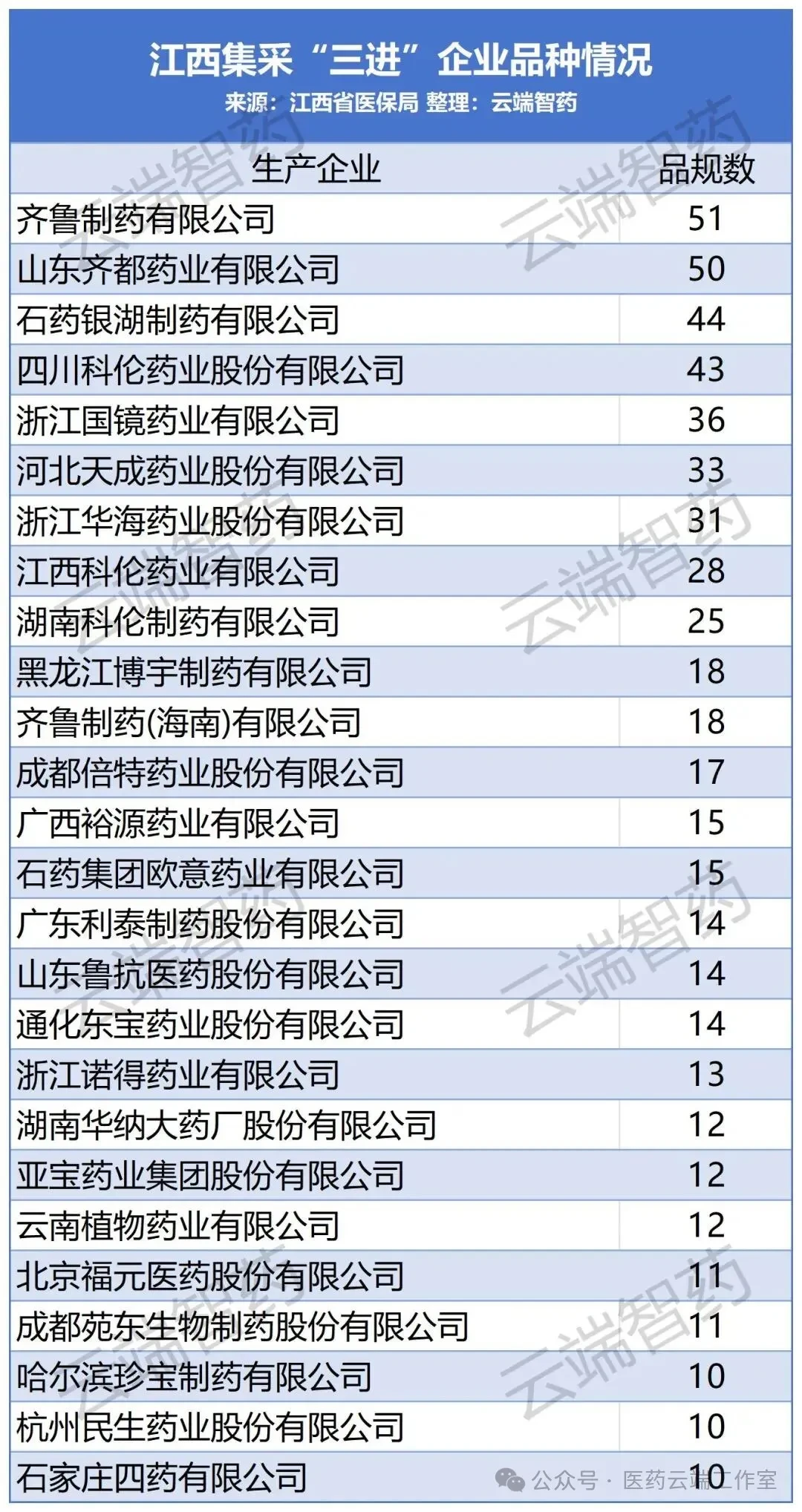
Products from 26 companies have more than 10 specifications.
According to statistics from the pharmaceutical cloud studio, based on the口径 of independent subsidiaries, the company with the largest number of product specifications included in Jiangxi's centralized procurement "three entries" is Qilu Pharmaceutical, with up to 51. It is closely followed by Qidu Pharmaceutical, with 50 product specifications. In addition, Shijie Yinhú has 44, Sichuan Kelun has 43, Zhejiang Guojing Pharmaceutical has 36, and Hebei Tiancheng has 33.
The following is a list of companies with more than 10 product specifications:
Jiangxi Collective Procurement "Three Advances": Local procurement impact exceeds national procurement
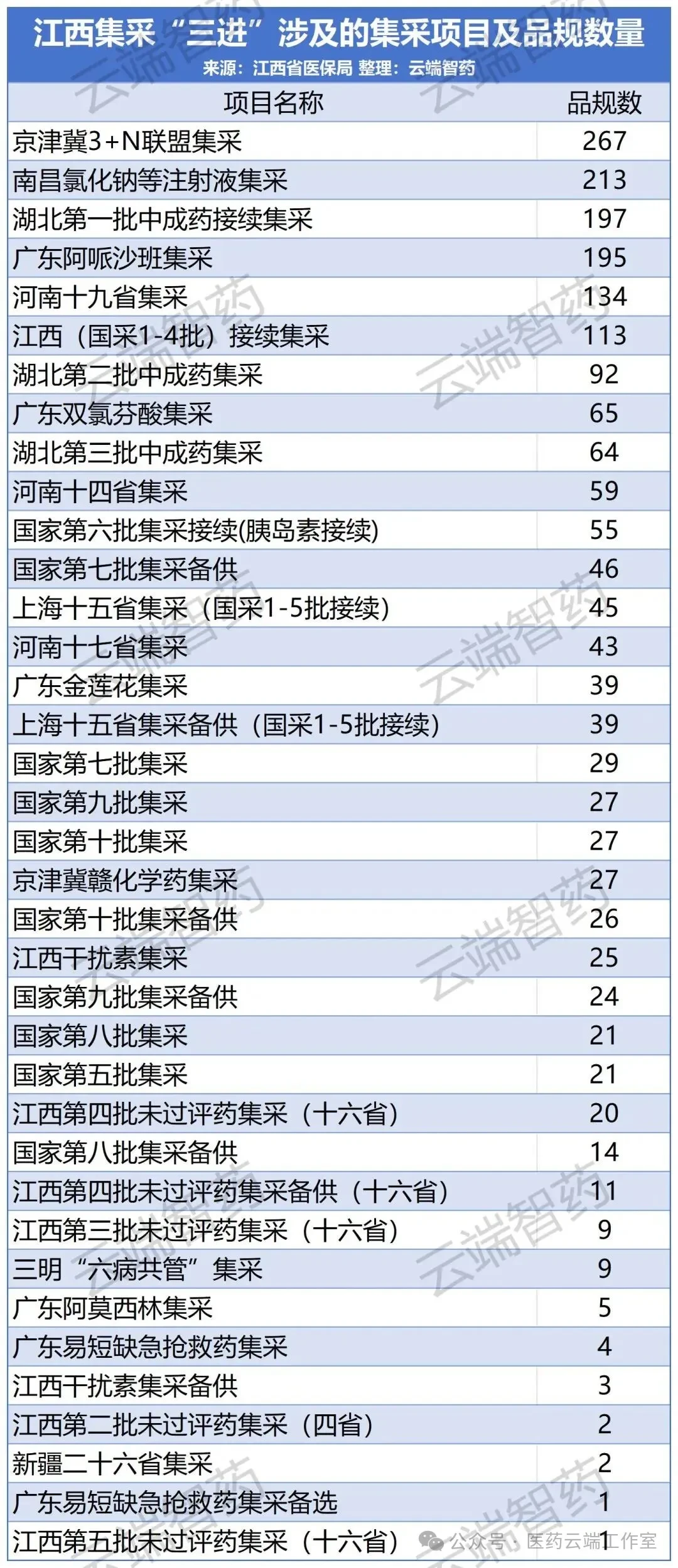
Involved in 37 centralized procurement projectsFrom national procurement to regional and alliance procurement, the procurement project involving the most products is the Beijing-Tianjin-Hebei 3+N Alliance Procurement, with a total of 267 product specifications. The following projects in descending order are the Nanchang Sodium Chloride and other injectables procurement, Hubei's first batch of traditional Chinese medicine continuation procurement, Guangdong's Apixaban procurement, Henan's nineteen-province procurement, and Jiangxi’s (national procurement batches 1-4) continuation procurement, involving 213, 197, 195, 134, and 113 product specifications respectively.
It can be seen that in the "three advances" of Jiangxi's collective procurement, the impact of local joint procurement has exceeded that of national procurement. This is a point that enterprises should pay attention to.
Private comprehensive tertiary medical institutions must stock no fewer than 80 types, and other private medical institutions must stock no fewer than 50 types.
The "Notice" adjusts the number of drug procurements equipped by private institutions from "no less than 50 types for comprehensive private hospitals and no less than 20 types for specialized hospitals" to "no less than 80 types for private comprehensive tertiary medical institutions and no less than 50 types for other private medical institutions." It encourages "three-entry" units to fill in their procurement demand volumes on the provincial pharmaceuticals procurement platform according to their needs and actively complete the agreed procurement volume.
Retail pharmacies can add a 15% markup, while private medical institutions must not exceed the selected price.
The Notice shows that, according to the relevant provisions of the "Pharmaceuticals and Medical Devices Prices and Centralized Procurement" policy in the 2025 version of the Medical Insurance定点 Service Agreement, the price policy stipulated in the Notice has been adjusted. Originally, it stated that "non-public medical institutions and retail pharmacies could sell at a markup of no more than 15% over the centralized procurement price." It is now revised to "designated non-public medical institutions must not sell selected drugs at a price higher than the procurement price; designated retail pharmacies may sell centralized procurement drugs at a markup of no more than 15% over the procurement price, with encouragement to sell at no higher than the procurement price."
Regions can explore linking the level of the quantity-price comparison index of designated retail pharmacies in their areas to the markup ratio of centrally procured drugs. For those with consistently high index levels, the markup ratio should be appropriately reduced to further promote the overall price of designated retail pharmacy medical insurance drugs toward a more reasonable range.
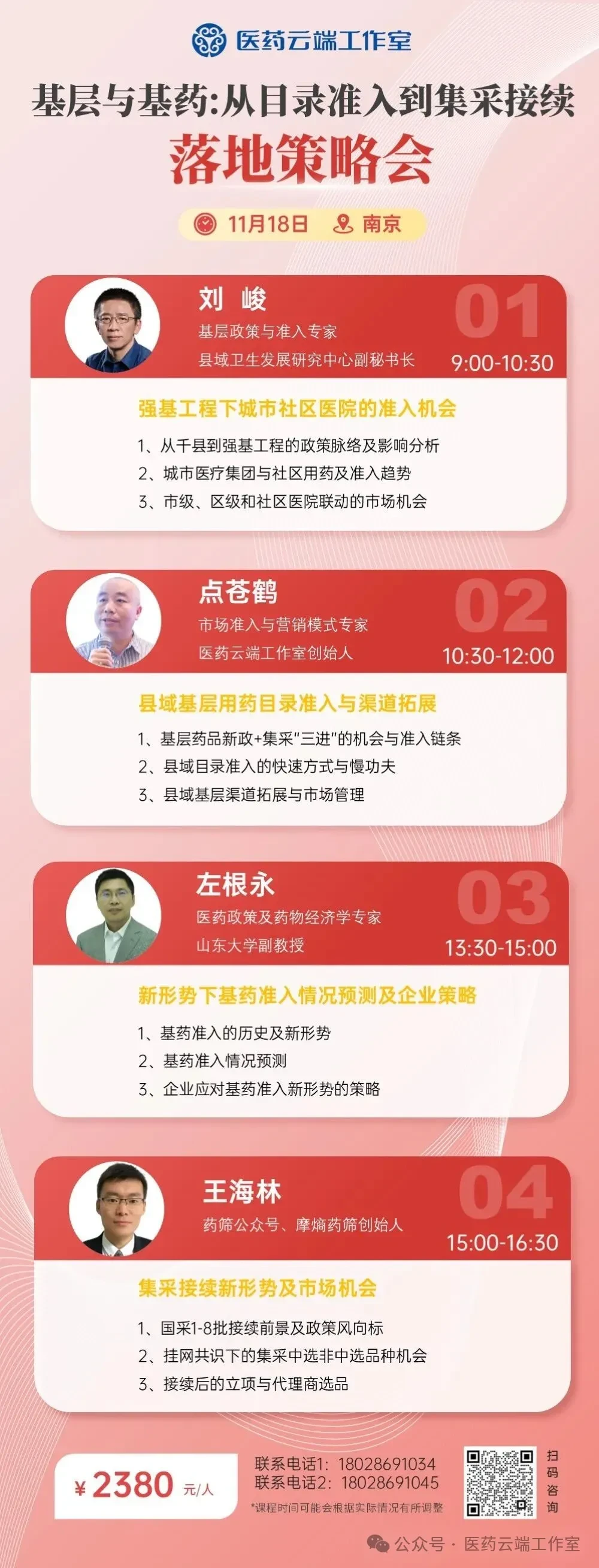
Welcome to the strategy meeting held on November 18 in Nanjing. For more details, please consult via the contact information shown in the image.
Follow the official account to get reliable and professional information and analysis.