Medtronic vs. Edwards: SMART Trial Three-Year Data Reinforces Evolut TAVR Superiority in Small Annuli Patients

Medtronic
Medical Device Manufacturer

Source: CPhI China Device
Author: Qin Jiu Editor: Yu Zhongjin
Medtronic and Edwards, the two giants, are in a head-to-head competition, while Boston Scientific is making a comeback. The TAVR track is subtly showing a three-way standoff. Meanwhile, the latest data released by Medtronic has added a new variable to this competition.
Recently, Medtronic announced that the SMART trial, which compares its own Evolut heart valve with Edwards' Sapien, has achieved three-year positive results.
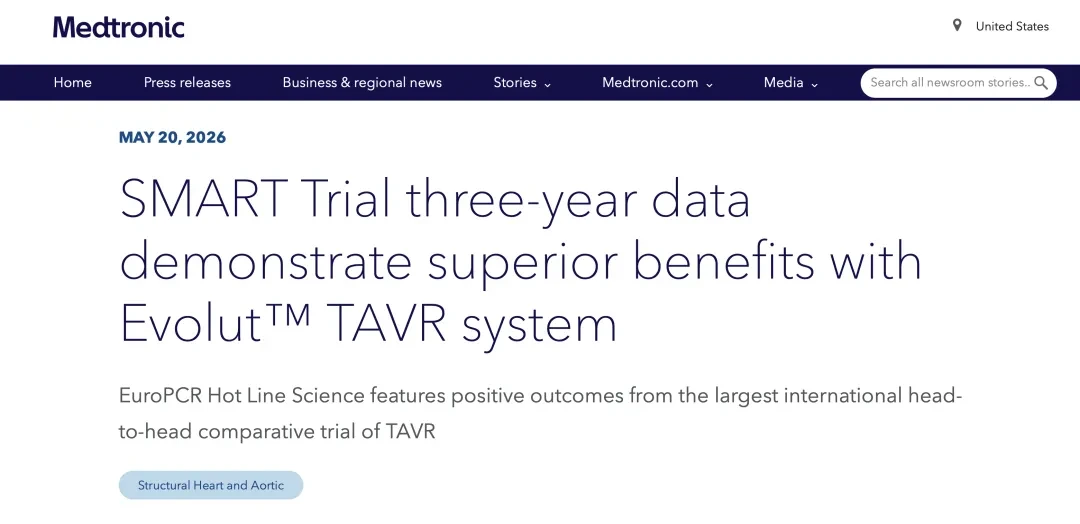
According to the press release, SMART (Small Annulus Randomized Trial) is currently the largest head-to-head comparison trial in transcatheter aortic valve replacement (TAVR).
Medtronic stated that in patients with aortic stenosis (AS) and smaller aortic annulus, the results showed that all individual and composite hemodynamic endpoints of Evolut™ TAVR remained superior to those of SAPIEN™ over three years. The findings, based on one-year results shared in 2024, also highlighted Evolut's outperformance compared to Sapien.
This trial is also the largest head-to-head randomized controlled study with female patients as the main enrolled population. The study randomized, enrolled, and treated 716 patients across more than 80 clinical centers globally, with women accounting for 87%. The study plans to follow up for five years post-surgery.
This scientific research was presented at the recent 2026 Paris EuroPCR Conference.
"The sustained three-year hemodynamic superiority results provide important evidence of the Evolut TAVR's advantages in treating aortic stenosis and small aortic annulus patients," said Howard C. Herrmann, M.D., the principal investigator of the trial. "Additionally, these findings offer new insights, including the use of Evolut to reduce valve thrombosis rates."
This data has a significant impact on the choice of surgical procedures for clinicians. Dr. Kendra J. Grubb, Vice President of Medtronic's Structural Heart Business and Chief Medical Officer, stated: "The SMART study results continue to build a robust evidence base for the safety and clinical efficacy of Evolut TAVR. The latest three-year data further indicates that Evolut is expected to offer better long-term outcomes for patients with smaller annuli, especially women, highlighting its value in personalized treatment and providing an important reference for future valve diagnosis and treatment strategies."
The announcement of Medtronic's experimental results coincides with Boston Scientific's strategic investment comeback to the TAVR market, intensifying market differentiation and seemingly breaking the old balance.
With the deepening of global aging, the demand for transcatheter aortic valve replacement (TAVR) is also growing rapidly. According to industry share statistics from Global Growth Insights, the global TAVR market size was $6.4497 billion in 2025, expected to reach $7.2366 billion by 2026, nearly $8.1194 billion by 2027, and will further soar to approximately $20.3923 billion by 2035.
For a long time, the global TAVR market has been dominated by a duopoly, with Edwards Lifesciences occupying half of the market. According to GlobalData estimates, Edwards currently holds over 60% of the global TAVR market share, reaching 75% in the U.S. market.
As the absolute leader in the TAVR market, Edwards Lifesciences has maintained strong momentum in recent years. The withdrawal of Boston Scientific's Acurate provided an excellent opportunity for Edwards to capture a larger share of the European market, with its SAPIEN 3 Ultra RESILIA platform quickly filling this market gap.
By 2025, Edwards' TAVR business is expected to generate $4.5 billion globally, accounting for approximately 75% of total sales and becoming the absolute main driver of performance. In the first quarter of 2026, TAVR revenue continued to grow by 14.4%, reaching $1.2 billion.
Although Medtronic ranks second in market share, in recent years, it has been continuously challenging Edwards' market position by leveraging the ongoing iterations of the Evolut platform, gaining a differentiated advantage in small annulus patients and self-expanding technology.
In the first quarter of this year, Medtronic's Structural Heart and Aortic business segment reported revenue of $9.30 billion, representing an 8.7% increase year-over-year (on a reported basis) and 6.1% organic growth. Among this, the TAVR business (represented by the Evolut FX+ platform) achieved mid-single-digit organic growth, with a growth rate higher than the average growth rate of the company’s overall cardiovascular business.
Medtronic also strategically invested $90 million in Anteris Technologies, an Australian-American joint venture, earlier this year, betting on the development of next-generation bionic TAVR products.
In this duel between two titans, Boston Scientific has become the biggest variable in this landscape.
When Boston Scientific globally discontinued the Acurate product line, its original TAVR market share shifted to Edwards and Medtronic. However, recently, Boston Scientific acquired approximately 34% of MiRus for $1.5 billion and secured an exclusive option to purchase its TAVR business for $3 billion, quietly reinstating the tripartite rivalry.
As the world's first nickel-free balloon-expandable TAVR valve, MiRus's core product SIEGEL highlights its differentiated innovation advantages: all size models of 23mm, 26mm, and 29mm can be delivered through
8Fr Expandable Sheath for Precise Delivery: This sheath is approximately 50% smaller than currently marketed TAVR delivery sheaths, minimizing the risk of vascular injury. The STAR pivotal trial has now been initiated, with plans to enroll 1,025 patients.
Edward Global Business Network Dominates, Medtronic Builds Barrier in Small Annulus Field with SMART Trial, Boston Scientific Attempts Comeback with MiRus—TAVR Track Moving from Dual Power Confrontation to Diversified Refinement.
This article is reprinted, all views belong to the original author.Platform, Medical DeviceMedical Device DealerIndustryThe comments remain neutral on all viewpoints in the article and are solely for sharing and exchange.

If you find the content helpful, welcomeStar Mark、Like、Forward!
Your support is our greatest motivation