

Qilu Pharmaceutical Bets $2.8 Billion on LAE002, an AKT Inhibitor from Laekna, as AstraZeneca Leads and Chinese Rivals Follow in Oncology Race

Laekna Therapeutics
Innovative Drug Developer

Qilu Pharmaceutical
Specialty Formulations and Active Pharmaceutical Ingredients (API) Developer

AstraZeneca
Pharmaceutical Technology Research and Development Provider

The target AKT, which has the potential for pan-cancer applications, is attracting more strong competitors to enter the field.
On November 12, Laekna Therapeutics announced that it had signed an exclusive licensing agreement with Qilu Pharmaceutical, granting the latter exclusive rights to research, develop, and commercialize the breast cancer candidate new drug LAE002 (afuresertib) in China. It is reported that LAE002 is a potent AKT inhibitor that can inhibit all three AKT subtypes (AKT1, AKT2, and AKT3). It is also one of the two AKT inhibitors globally in the late stage of clinical development for breast and prostate cancer.
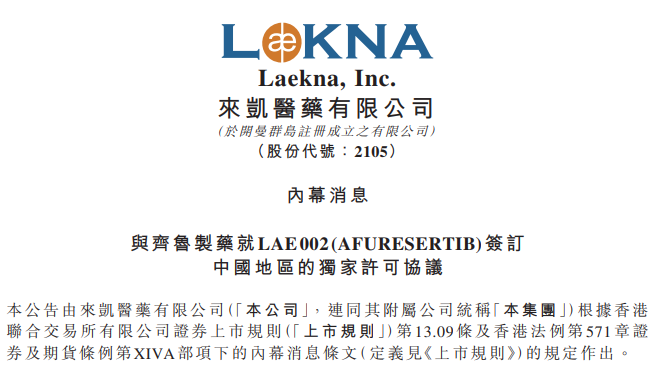
According to the terms of the agreement, until the first indication receives new drug application approval in China, Laekna Therapeutics is entitled to receive up to 530 million yuan in non-refundable upfront and clinical development milestone payments, as well as up to 2.045 billion yuan in upfront and milestone payments. In addition, Laekna Therapeutics is also entitled to receive tiered sales royalties based on future net sales within China. This model of monetizing part of the R&D achievements in advance while retaining long-term benefits after product launch has become the mainstream approach in current innovative drug licensing collaborations.
In April this year, Capivasertib, an AKT inhibitor developed by AstraZeneca, was approved for marketing in China. This is also the first approved AKT inhibitor in China. In the industry's view, Qilu Pharmaceutical's recent acquisition of Laekna Therapeutics' AKT inhibitor LAE002 for a substantial investment is a strategically clear and highly forward-looking transaction. This not only demonstrates Qilu Pharmaceutical’s determination to strengthen its oncology innovation pipeline but also reflects its optimism about the market potential of the AKT inhibitor target.
The reason why Laekna Therapeutics' LAE002 was able to secure such a high-value deal lies in the product's solid value and broad market prospects.
Data from the International Agency for Research on Cancer (IARC) of the World Health Organization shows that breast cancer has become the "number one killer" of women worldwide in 2022, with about 2.29 million new cases annually and 666,000 deaths. In China, breast cancer ranks second in female cancer incidence, with 70% of patients belonging to the HR+/HER2- type (hormone receptor-positive/HER2-negative) targeted by LAE002.
Although most HR+/HER2- breast cancer patients initially benefit from first/second-line endocrine therapy combined with CDK4/6 inhibitors and/or chemotherapy, the majority may develop resistance over time, leading to treatment failure. There is an urgent clinical need for new treatment options after resistance occurs. The discovery of the AKT target has brought new hope to patients.
AKT is a serine/threonine protein kinase and a key node in the PI3K/AKT/mTOR signaling cascade. AKT can activate downstream effector molecules such as mTOR, thereby stimulating metabolic growth and proliferation of tumor cells, immune escape, and angiogenesis. Among these, PTEN can inhibit the activation process of AKT, and its functional loss will lead to excessive activation of AKT, resulting in tumors. Therefore, inhibiting AKT activation is expected to achieve therapeutic effects across various cancer types.
LAE002, developed by Laekna Therapeutics, is a potent AKT inhibitor that can inhibit all three AKT subtypes (AKT1, AKT2, and AKT3). Currently, the Phase III clinical trial (AFFIRM-205) of LAE002 for HR+/HER2- breast cancer is recruiting as planned and will be completed by Laekna Therapeutics, with participant enrollment expected to finish in the fourth quarter of 2025. Additionally, Laekna Therapeutics plans to submit an NDA to the CDE in 2026.
Not only that, but Laekna Therapeutics announced in May 2024 that the FDA had approved the Phase III clinical trial protocol for LAE002 in combination with LAE001, the world’s first dual-target inhibitor of CYP17A1/CYP11B2, for the treatment of patients with metastatic castration-resistant prostate cancer (mCRPC). In addition, clinical trials of LAE002 in combination with chemotherapy for platinum-resistant ovarian cancer (PROC), in combination with a PD-1 inhibitor and chemotherapy for PD-(L)1 inhibitor-resistant solid tumors, and in combination with a PD-L1 inhibitor and chemotherapy for triple-negative breast cancer (TNBC) have all been successively advanced.
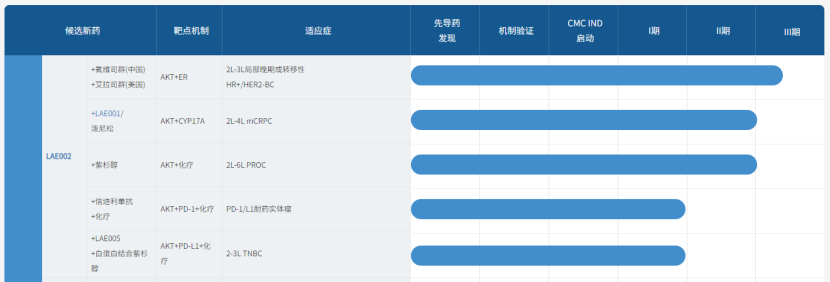
Currently, LAE002 has demonstrated better safety in early clinical trials and the convenience of once-daily dosing, giving it BIC (Best-in-Class) potential. In addition to breast cancer, LAE002 also shows development potential in indications such as prostate cancer. This suggests that its market ceiling extends far beyond breast cancer, with the potential to cover more cancer types in the future, becoming a "blockbuster" product spanning multiple major cancer types.
This transaction is not merely a simple product introduction but rather reflects the deep strategic alignment between the two parties. Qilu Pharmaceutical, as a giant among traditional pharmaceutical enterprises in China, possesses an extensively covered commercial network and mature market access capabilities. The introduction of LAE002, which is in the late stage of development, can quickly fill the gap in innovative target drugs within the oncology pipeline, achieving a strategic extension from "production-driven" to "innovation-driven." This represents a high-risk, high-reward strategy that avoids the uncertainty of starting research and development from scratch.
As a clinical-stage Biotech, Laekna Therapeutics has limited commercialization capabilities. This collaboration not only provided it with valuable upfront cash revenue, strengthening its financial position to support the development of other pipelines, but also retained long-term profit-sharing rights post-product launch through sales royalties. This is equivalent to monetizing part of the R&D achievements in advance, while sharing the risks of subsequent development and market promotion with Qilu Pharmaceutical.
This deal also provides a model for China's pharmaceutical innovation ecosystem: The complementary model where Biotech focuses on cutting-edge R&D and large pharmaceutical companies handle commercial promotion is maturing. This division of labor will help accelerate the transformation of innovative achievements and improve product accessibility.
It is predicted that the total sales of the global breast cancer market will reach 47.7 billion US dollars in 2029, with drugs targeting PI3K/AKT/mTOR accounting for 4% (1.908 billion US dollars) of the sales. According to the Frost & Sullivan report, China's breast cancer market is expected to grow at a higher rate than the global market and reach 122.3 billion yuan by 2030. Calculating with 4%, the sales of drugs targeting PI3K/AKT/mTOR will exceed 4.8 billion yuan in 2030.
Based on the potential demonstrated in overcoming drug resistance and treating specific types of cancer, AKT inhibitors have become a current research hotspot in targeted tumor therapy. At present, AKT inhibitors remain a highly promising yet uncrowded blue ocean globally, with the overall competitive landscape showing a "one superpower, one strong player, and multiple followers" situation. According to the PatSnap New Drug Database, there are currently over 20 AKT inhibitors in clinical stages.
In November 2023, AstraZeneca's Capivasertib was approved by the FDA for marketing. It is used in combination with Fulvestrant to treat adult patients with HR+/HER2-, locally advanced or metastatic breast cancer harboring one or more biomarker alterations (PIK3CA, AKT1, or PTEN), becoming the world’s first approved AKT inhibitor. In April this year, Capivasertib was also approved for marketing in China and simultaneously submitted for inclusion in the medical insurance directory and the commercial insurance innovative drug directory.
According to the financial report, the global sales of Capivasertib in its first full sales year of 2024 reached $430 million. In the first three quarters of this year, Capivasertib contributed $495 million in revenue to AstraZeneca, marking an 85% year-on-year increase and surpassing the total sales of 2024. According to Clarivate's forecast, Capivasertib is expected to achieve at least $1 billion in sales in the G7 (Group of Seven) markets by 2031.
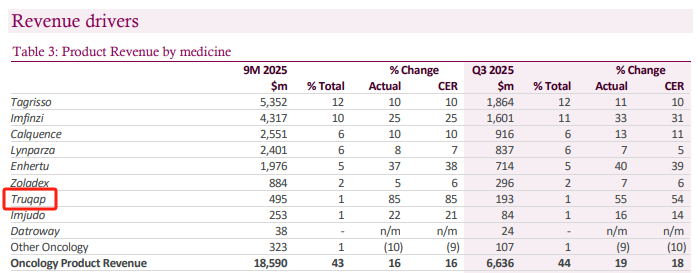
In addition to breast cancer, AstraZeneca is also expanding other indications for capivasertib, including prostate cancer (Phase III), non-small cell lung cancer (Phase II), and hematological tumors (Phase I), further broadening its first-mover advantage.
In terms of multinational pharmaceutical companies, GSK's Afuresertib and Pfizer's ipatasertib are at the forefront, having already entered Phase III clinical trials. Among them, ipatasertib was discovered through a collaboration between Genentech, a subsidiary of Roche, and Array BioPharma (which was acquired by Pfizer on July 30, 2019). It is an orally administered, highly specific investigational drug designed to target and bind to all three subtypes of AKT, blocking the PI3K/AKT signaling pathway.
In terms of Chinese pharmaceutical companies, HRS7415 from Hengrui Medicine, TQB3912 from Zhengda Tianqing, and NTQ1062 from Nanjing Zhengda Tianqing have also entered the early clinical stage. Among them, HRS7415 from Hengrui Medicine has registered three clinical trial applications since 2021 for advanced malignant tumors; TQB3912 from Zhengda Tianqing has completed clinical trials for the treatment of advanced malignant tumors and is currently conducting a Phase Ib/II clinical trial for HR+/HER2- breast cancer.
At present, the most definitive clinical value of AKT inhibitors lies in their use as a subsequent treatment option when drugs like CDK4/6 inhibitors develop resistance. In the future, developing a new generation of AKT inhibitors with better safety and a wider therapeutic window is a clear research direction. Combining AKT inhibitors with drugs of other mechanisms of action is an important strategy to expand their efficacy and application scope. In this race for development, whoever achieves breakthroughs first in launching superior AKT inhibitor products or combination therapy regimens will likely gain a competitive advantage.
Editor: Fan Xiaoyan
Layout Editor: Chen Shuwen
Reviewed by: Ma Fei, Zhang Song



www.yyjjb.com.cn
Insight into Industry Trends

"China Prescription Drug"
Academic Official Account
Focus on Pharmaceutical Academics and Evidence-Based Research

Terminal Official Account