ORR Significantly Improved: Qilu Pharmaceutical Unveils First Clinical Data of Trispecific Antibody QLS4131

Qilu Pharmaceutical
Specialty Formulations and Active Pharmaceutical Ingredients (API) Developer
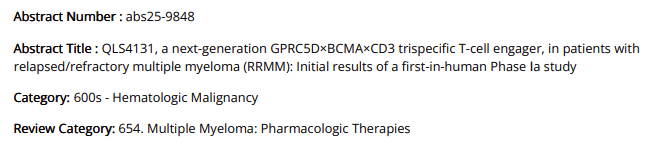
Qilu PharmaceuticalAt the 2025 American Society of Hematology (ASH) Annual MeetingFirst AnnouncementPreliminary Results of the First-in-Human Trial of the Next-Generation GPRC5D×BCMA×CD3 Trispecific Antibody QLS4131 in Patients with Relapsed or Refractory Multiple Myeloma (RRMM).
This conference will be held inFrom December 6 to 9 local timeHeld in Orlando, Florida, USA, currentlyRegular Summary Officially Released。
QLS4131 is a GPRC5D/BCMA/CD3 trispecific antibody developed by Qilu Pharmaceutical.With innovative molecular design (see molecular structure diagram).
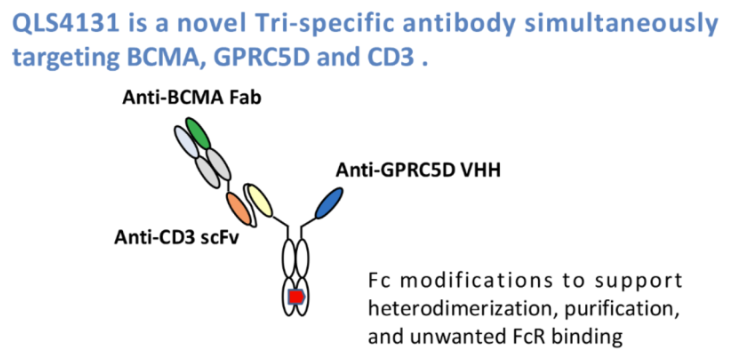
Molecular Design Diagram
The published content is an evaluationA Phase I Clinical Study of QLS4131 in RRMM Patients: Safety, Tolerability, Pharmacokinetics, Immunogenicity, and Preliminary Efficacy (NCT06500507).The data announced this time come from its Phase I clinical trial (NCT06500507) in RRMM patients, mainly evaluating safety, tolerability, pharmacokinetics (PK), immunogenicity, and preliminary efficacy.
Experimental Design
In the dose escalation phase,The recruitment targets are: RRMM patients with measurable lesions who have experienced disease progression after receiving existing treatments or are unable to tolerate them. The dose escalation regimen includes:
Intravenous Administration (IV): 0.06 → 30 µg/kg, once weekly (QW)
Subcutaneous Injection (SC): 30 → 600 µg/kg, once every two weeks (Q2W)
To reduce the risk of cytokine release syndrome (CRS), patients receive 1–2 step-up doses (SUD) before the first target dose (≥3 µg/kg level).
As of July 15, 2025, a total of 17 patients have received QLS4131 treatment, with a dose range of 0.06 to 30.µg/kg(IV, QW). In addition, 3 other enrolled patients received 30µg/kg QLS4131 Treatment (SC, Q2W).
The median age of the patients was 59 years, and the median number of prior treatment lines was 3. Among them, 64.7% of the patients had received 3 or more lines of treatment, and 35% of the patients had undergone stem cell transplantation.
The results showed that in ≥1µg/kg Dose Groupi.e., the observed efficacy. In15 namesAcceptQLS4131 Intravenous InjectionAmong patients who have been treated and meet the response evaluation criteria,ORR is 60%(≥VGPR 40%)。
In 30µg/kg In the dose group,100% of patients achieved VGPR or better relief.。
It is worth noting that, in10 µg/kg IV Dose Groupin2 patients with previousBCMA-Targeted CAR-T/CAR-NK Treatment FailureIn the patients: 1 case reachedStrict Complete Remission (sCR), achieved in 1 casePartial Response (PR)
In terms of safety, QLS4131 demonstrated generally manageable tolerability. No dose-limiting toxicity (DLT) was observed, and the maximum tolerated dose (MTD) was not reached. The most common treatment-related adverse events (TRAEs) were cytopenia and CRS, with an overall incidence rate of CRS at 80%.No ICANS Observed。
The researchers concluded that,QLS4131 The toxicity was tolerable, no DLT was observed, andCompared with the published results of competitive products (such as Johnson & Johnson's JNJ-79635322),QLS4131 shows a lower incidence of GPRC5D-related adverse reactions. Meanwhile, clear efficacy has been observed even at lower doses.。The trial is still ongoing, and the MTD, RP2D, and DLT have yet to be determined.





Previous Review
Review of Innovative Drugs at the Midpoint: A New Starting Point After the Bubble Burst
October: Overview of Financing and Investment in 17 Domestic Biopharmaceutical Enterprises