2025 Biotech 'Death List': A Year of Contrasts Amid Industry Consolidation

Carisma Therapeutics
Developer of Cell Immunotherapy

Under the influence of various factors, these 16 companies eventually closed down.
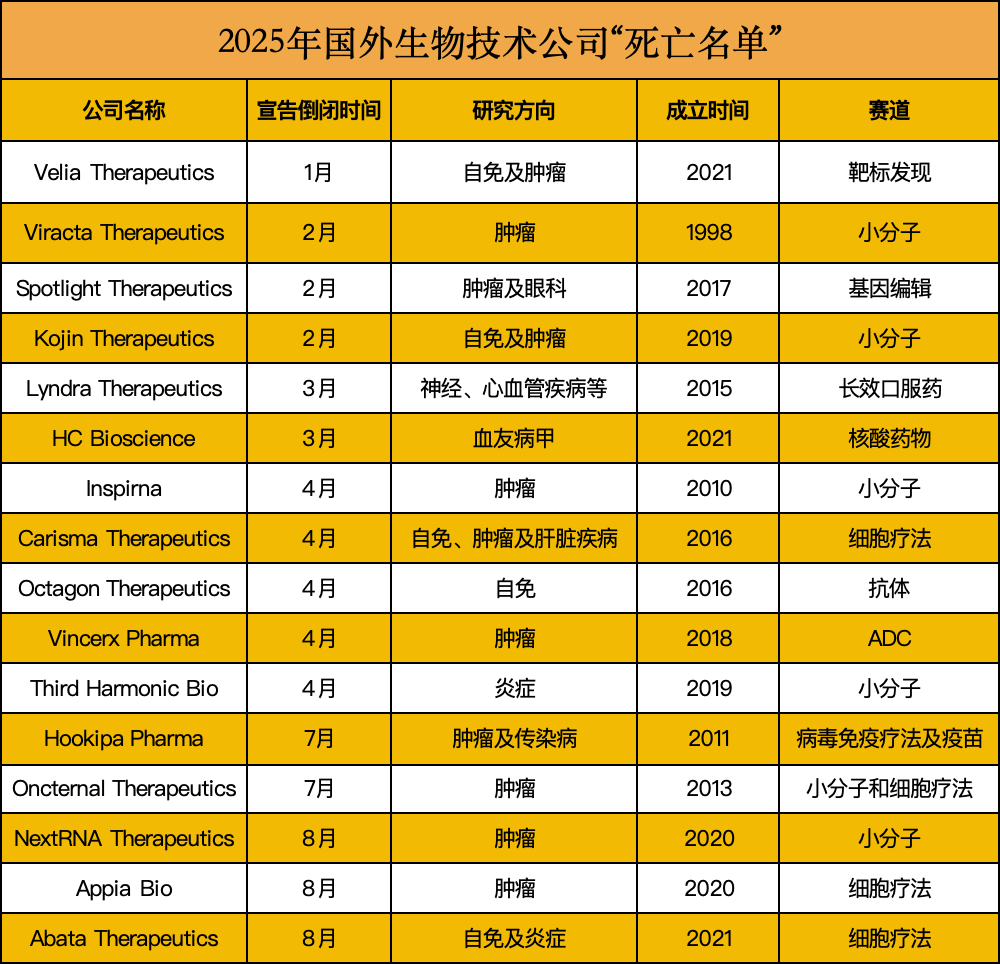

Among the companies shut down this year, those in the cell and gene therapy (CGT) field are the most notable. After experiencing technological breakthroughs, capital attention, industrial chain improvements, product launches, and commercial competition throughout the entire process, this technical field has ushered in a new wave of transformation.
This year, the biotechnology companies in the field of cell therapy that have gone bankrupt include Carisma Therapeutics, which focuses on the development of CAR-M macrophage drugs, Oncternal Therapeutics, which researches cancer CAR-T therapies, Abata Therapeutics, which is dedicated to the development of engineered Treg cell therapies, and Appia Bio, which hopes to use stem cell biology to develop more universal allogeneic CAR-T products, among others.Unfortunately, even collaborations with well-known pharmaceutical companies failed to save them.
At the end of 2024 and the beginning of 2025, Carisma Therapeutics faced financial pressure, forcing significant layoffs and the termination of its ex vivo CAR-M drug development. Only six employees were left to handle strategic evaluation and business liquidation.
Carisma Therapeutics had hoped to save itself through a reverse merger with OrthoCellix, a subsidiary of Ocugen that focuses on regenerative cell therapy. However, the deal fell apart in September this year.
In addition, Moderna has terminated its collaboration with Carisma Therapeutics, forcing the company to "sell, dispose of its remaining assets or otherwise liquidate."
At the beginning of 2022, Moderna and Carisma Therapeutics jointly collaborated to develop in vivo CAR-M tumor drugs based on mRNA-LNP technology. According to the cooperation agreement, Carisma received $45 million in upfront cash and a $35 million convertible bond investment, while Moderna was entitled to nominate 12 targets available for commercial development.
But in the end, this cooperation ended with Moderna paying Carisma Therapeutics $4 million to terminate the agreement.
Appia Bio once shone with financing and BD deals.
After completing the seed round financing in the early stage of the pandemic, Appia Bio紧接着 completed a $52 million Series A financing round in 2021.
Subsequently, Appia Bio signed a collaboration agreement with Kite Pharma, a subsidiary of Gilead, for the development of drugs targeting hematological tumors, with potential earnings amounting to $875 million.
Unfortunately, due to the lack of further funding for patient trials, this company has announced that it has reached "the end of the road."
Many other cell therapy companies have survived but also conducted layoffs in the process. According to statistics, foreign biotech companies in the cell and gene therapy field carried out 20 rounds of layoffs in the first quarter of 2025.
The CGT field in 2025 presents a "two contrasting extremes" characteristic.
On one side, major companies like Takeda and Novo Nordisk have chosen to exit this field; Gilead Kite and Roche Genentech, on the other hand, have torn up multi-billion-dollar cooperation agreements.
On the other hand, more pharmaceutical companies are making significant advances into the field of in vivo cell therapy.
Gilead Kite Signs $1.64 Billion In Vivo CAR-T Therapy Collaboration with China's Puregon Biotech; Bristol Myers Squibb Acquires Orbital Therapeutics for $1.5 Billion, a Biotech Focused on In Vivo Therapies with a Preclinical Autoimmune Disease Program.
In addition, the U.S. Advanced Research Projects Agency for Health (ARPA-H) recently announced a series of new grants for in vivo cell therapy research.
Vor Biopharma, which focuses on gene-editing stem cell therapies for blood cancers, has made a remarkable "comeback from the brink."
The company had originally announced its intention to cease operations in May this year, but was "revived" a month later with $175 million in private placement financing and a licensing deal potentially worth over $4 billion with Rongchang Biopharmaceuticals.
In June this year, Rongchang Bio announced that it had granted a royalty-bearing license for its proprietary drug Telitacicept to Vor Biopharma Inc. Vor Bio of the United States will obtain exclusive rights to develop and commercialize the drug globally, excluding Greater China.
According to the terms of the agreement, Rongchang Bio will receive $125 million in cash and warrants from Vor Bio (including a $45 million upfront payment and $80 million in warrants, representing approximately 23% of Vor Bio's expanded total issued shares), up to $4.105 billion in milestone payments, for a total amount of $4.23 billion. In addition, Rongchang Bio will also receive high single-digit to double-digit sales royalties.
Vor Bio's stock price also rebounded due to this deal.
Compared with the "thrilling" developments abroad, the field of cell therapy in China this year has shown a different kind of vitality.
According to the PharmaCube InvestGo database, among the 10 financing events exceeding 500 million yuan in China's innovative drug sector this year, the cell therapy field accounted for 3. It is evident that the cell therapy field in China is not only highly favored by capital but also has strong fundraising capabilities.

The "source innovation" of innovative drugs has always been separated from the "translational implementation" by the "valley of death." It's just that the rapid development of innovative drugs in recent years has created an illusion that innovation is easy to achieve.
Several biotech companies that went bankrupt this year, though failing to successfully cross the innovation "valley of death," had all attempted to push the boundaries of medicine in exciting ways.
Velia Therapeutics, dedicated to microprotein therapy, ceased operations this year due to insufficient funding to support basic science projects. Its founder stated that they still firmly believe in "the therapeutic potential of microproteins."
Another company that collapsed this year attempted to break new ground in the RNA drug field. Coded HC Bioscience, as the company was named, tried to develop a new therapy for hemophilia A using tRNA. However, affected by poor early preclinical data, the company concluded that the challenge of creating a new class of drugs was too great.
In April this year, Vincerx Pharma, a biotechnology company focusing on the research and development of antibody-drug conjugates (ADC), announced that it had to initiate liquidation procedures due to two failed acquisition attempts. The "last straw" that broke the camel's back was also financial issues.

In addition to the 16 biotechnology companies that have already declared bankruptcy, three more are on the verge of collapse.
Seelos Therapeutics Files for Bankruptcy After ALS Candidate Fails in Phase 2/3 Trial
Trevena is in a dilemma, weighing its strategic options after firing senior executives and reducing its workforce to four employees.
After the failure of iTeos Therapeutics' TIGIT drug in collaboration with GSK, the company began preparing for closure but was eventually acquired by Concentra Biosciences at a low price, avoiding bankruptcy.
Notably, Concentra Biosciences and Xoma Royalty, which focuses on monetizing royalty and milestone payment rights, have been actively seeking to acquire distressed biotech companies outright this year.
Turnstone Biologics was acquired by Xoma Royalty for less than $8 million after seemingly reaching a dead end; Essa Pharma, with the support of Xoma Royalty, was acquired by a non-profit research institute.
In addition, Xoma Royalty has also begun acquiring Lava Therapeutics, Mural Oncology, and HilleVax, which was spun off from Takeda.
In order to survive until 2025, some biotech companies have had to take "extraordinary" measures. For instance, when Aptose Biosciences was on the brink of bankruptcy, the CEO personally provided loans to keep operations running. Meanwhile, cutting pipelines and laying off staff have almost become "inevitable choices" for some companies.
Every year, there are biotechnology companies that go bankrupt, but we still hope that with the joint efforts of the industry and companies, this number will decrease.
Recommended Reading