Pharmaceutical Development, Production, Sales, and Consulting Service Provider
AstraZeneca
Pharmaceutical Technology Research and Development Provider
Qilu Pharmaceutical
Specialty Formulations and Active Pharmaceutical Ingredients (API) Developer
Image Source: Visual China
Interface News reporter |Huang Hua
Interface News Editor |Xu Yue
On November 24, Minghui Pharmaceutical Ltd. submitted its prospectus.
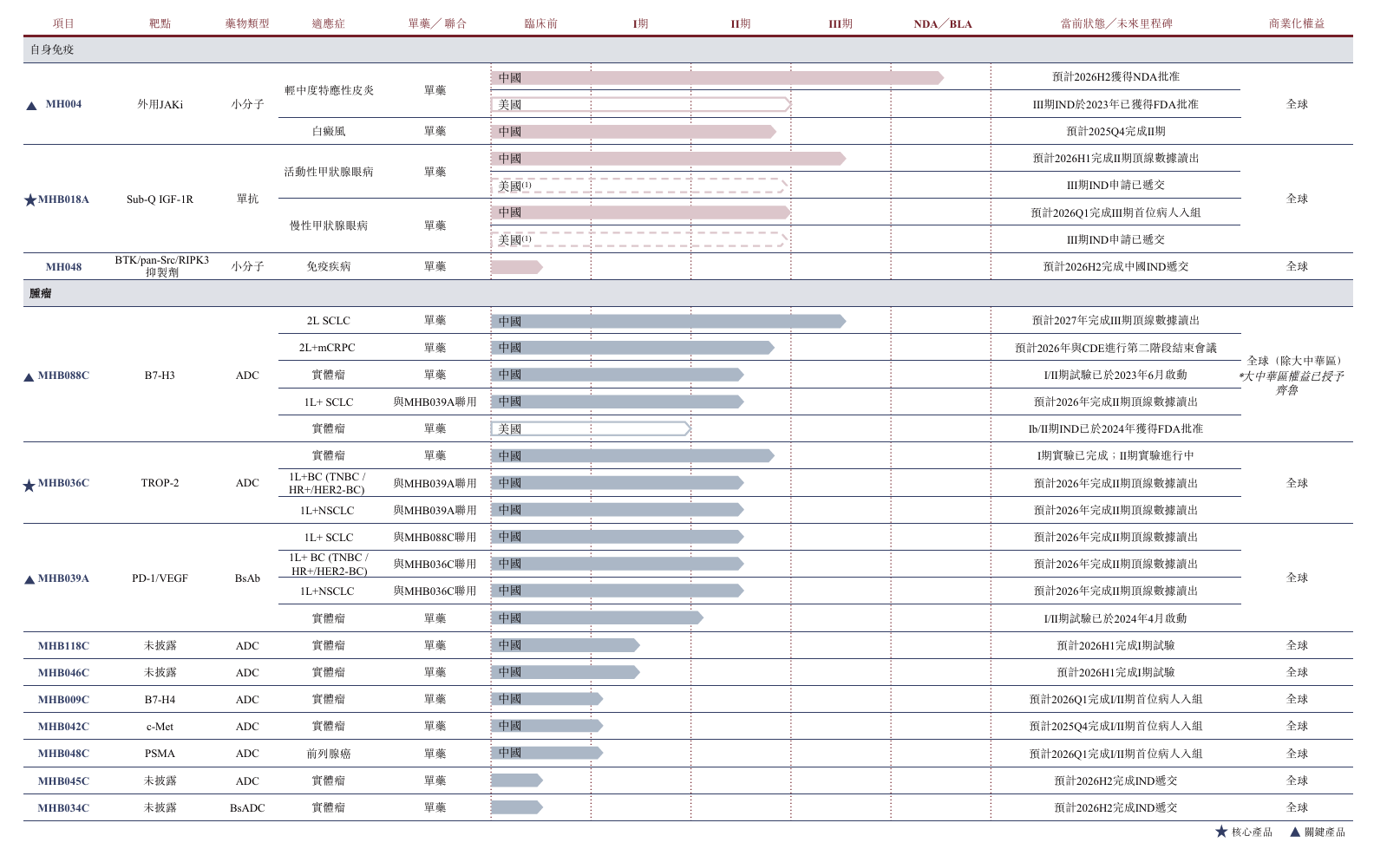
Founded in 2018, the company has nearly 10 antibody-drug conjugates (ADCs) in its disclosed pipeline. The targets include not only "red ocean targets" like TROP-2 but also B7-H3, B7-H4, c-Met, and PSMA. However, these products are still in the early stages of development, and their potential remains to be determined.
In addition, the company also has a PD-1/VEGF bispecific antibody drug under research, which has been a "trendsetter" in the innovative drug field over the past two years.
The field of antibody-drug conjugates is brewing the next blockbuster drug. In the first three quarters of this year, the sales of Enhertu from Daiichi Sankyo/AstraZeneca reached $1.976 billion, a year-on-year increase of 37%. Following Enhertu, the sales of Padcev from Astellas/Pfizer and Polivy from Roche were approximately $1.432 billion and $1.37 billion, with year-on-year growth of 25% and 40%, respectively.
The aforementioned products are all antibody-drug conjugates (ADCs) that have gained significant attention in recent years, with their first approvals all occurring in the second half of 2019. Among them, Padcev from Astellas/Pfizer and Polivy from Roche are the world’s first Nectin-4 ADC and the world’s first CD79b ADC, respectively. It is not difficult to see that, five years later, the market scale of these leading next-generation ADC products has reached an annual sales level of approximately 2 billion US dollars, with strong growth momentum.
Under this trend, it is reasonable for Minghui Pharmaceutical Ltd. to choose to go public at this time.
On November 25, a reporter from The Paper sent an interview request to the email address published on Tianyancha regarding the IPO progress of Minghui Pharmaceutical Ltd. and the advantages and disadvantages of the company’s pipeline. As of the time of publication, no response had been received.
Minghui Pharmaceutical Pipeline Diagram, Screenshot from the Company's Prospectus by Jiemian News
Antibody-drug conjugates are not a new concept; the idea can be traced back a century to the "magic bullet" envisioned by scientist Paul Ehrlich. They can be considered an "upgraded version of chemotherapy drugs," capable of "precise targeting," also known as "specificity." For instance, antibody-drug conjugates targeting HER2 only "attack" HER2. Since HER2 is highly expressed on the surface of tumor cells, the drug can release its payload in a targeted manner.
Minghui Pharmaceutical Emerges in the Antibody-Drug Conjugate Field in May This Year
From the industry landscape, there has not been any B7-H3 ADC product approved for marketing globally, but Minghui Pharmaceutical Ltd. already has no shortage of competitors. For instance, HS-20093 from Hansoh Pharma. Meanwhile, HS-20093 is also the antibody-drug conjugate with the highest upfront payment among the three in-house developed products out-licensed by Hansoh Pharma.
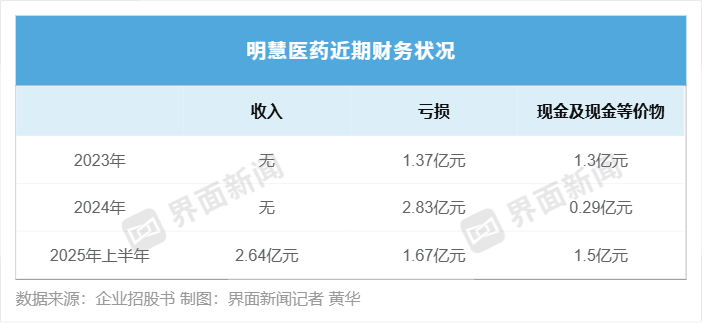
As of now, Minghui Pharmaceutical Ltd. has no marketed products. In 2023 and 2024, the company had no revenue, with losses amounting to 137 million yuan and 283 million yuan, respectively. Following product licensing, in the first half of this year, the company generated revenue of 264 million yuan, with a concurrent loss of 167 million yuan.
Among all products, Minghui Pharmaceutical Ltd.'s topical JAK inhibitor, Itopafantib Ointment, is closest to the commercialization stage, with its marketing application already accepted for review. The indication is for mild to moderate atopic dermatitis. Of course, whether in the JAK drug space or the atopic dermatitis field, there are many participants. While this market can generate some cash flow for companies, innovative pharmaceutical enterprises need to focus on developing products with stronger innovation capabilities and competitiveness.
In terms of R&D expenditure, the company's R&D spending in 2024 was significant, reaching 281 million yuan. Additionally, the R&D expenditures for 2023 and the first half of this year were 182 million yuan and 98 million yuan, respectively.
In addition, in the field of antibody-drug conjugates, another biotech "rising star," DualityBio, was listed on the Hong Kong Stock Exchange today, April 15. Its stock price surged over 110% at one point during its debut trading session, drawing significant market attention. Moreover, DualityBio's IPO is the largest financing by a biotech company through the Hong Kong Stock Exchange's Chapter 18A rules since 2022.
Minghui Pharmaceutical Ltd. Financial Status, Chart by Huang Hua, Reporter of Interface News
On November 25, Liao Yuan, Senior Executive Director of IQVIA and Head of China Oncology Solutions, told reporters from The Paper that breakthroughs in antibodies, payloads, linkers, and conjugation technologies could lead to innovations in each component of antibody-drug conjugates, potentially driving overall molecular innovation and delivering clinically differentiated outcomes.
Liao Yuan told reporters from The Paper that, in terms of target layout, Chinese companies are extending towards more innovative directions on targets such as HER2 and TROP2, for instance, CDH17 and B7H3. With breakthroughs in bispecific antibody technology, dual-target antibody-drug conjugates are also expected to see growth. Additionally, from the perspective of clinical indication development, antibody-drug conjugates were previously mainly used in later lines of advanced cancer treatment, targeting a smaller patient population, with limited patient tolerance and efficacy restricting their application. However, as antibody-drug conjugates gradually move to front-line and perioperative settings, and combination immunotherapy regimens are promoted, the application scenarios for these products are being broadened, which helps enhance their commercial potential.
Lu Likang, Director of CIC灼识Consulting, also told reporters from The Paper that China's ADC industry is rapidly transitioning from fast-follow to global-first. A series of candidate drugs with differentiated mechanisms and superior preclinical/clinical data have entered the global registration pathway, proving that Chinese companies have become a significant source of innovation.
In addition, Minghui Pharmaceutical is also well-known because of its founder. The prospectus shows that the founder, chairman, and chief scientific officer of Minghui Pharmaceutical is Cao Guoqing, a former senior executive of Hengrui Medicine. He served as the vice president of Hengrui Medicine for five years. According to the industry media Jian Shi IPO, Cao Guoqing was responsible for the research and development strategy and overall management of Hengrui Medicine's Camrelizumab.
Moreover, in August this year, the company announced the completion of a $131 million Pre-IPO round of financing. This round was led by OrbiMed, with Qiming Venture Partners as co-lead investor, and existing shareholder TF Capital continuing its support. OrbiMed and Qiming Venture Partners will also appoint representatives to join the company's board of directors. This round of financing has "replenished the company’s cash flow." As of the end of June this year, the company's cash and cash equivalents were only 149 million yuan, which is lower than its annual R&D expenditure.
The halo of well-known senior executives and investment institutions has endorsed Minghui Pharmaceutical Ltd. But setting aside the halo, the core issue for Minghui Pharmaceutical still lies in the subsequent commercial potential of its R&D pipeline.
From the publicly available sales performance of antibody-drug conjugates (ADCs) produced in China, this field in the country is still waiting for a "blockbuster" product. According to the *21st Century Business Herald*, the revenue from Rongchang Bio's Disitamab Vedotin reached approximately 720 million yuan in 2024, representing a 36% year-on-year increase. The company’s annual report showed that the sales volume of this product was 2.4 million units. Additionally, according to Kelun Biotech’s half-year report this year, the sales of Lupartuxizumab were around 300 million yuan.
Interface News reporter |Huang Hua
Interface News Editor |Xu Yue
On November 24, Minghui Pharmaceutical Ltd. submitted its prospectus.
Founded in 2018, the company has nearly 10 antibody-drug conjugates (ADCs) in its disclosed pipeline. The targets include not only "red ocean targets" like TROP-2 but also B7-H3, B7-H4, c-Met, and PSMA. However, these products are still in the early stages of development, and their potential remains to be determined.
In addition, the company also has a PD-1/VEGF bispecific antibody drug under research, which has been a "trendsetter" in the innovative drug field over the past two years.
The field of antibody-drug conjugates is brewing the next blockbuster drug. In the first three quarters of this year, the sales of Enhertu from Daiichi Sankyo/AstraZeneca reached $1.976 billion, a year-on-year increase of 37%. Following Enhertu, the sales of Padcev from Astellas/Pfizer and Polivy from Roche were approximately $1.432 billion and $1.37 billion, with year-on-year growth of 25% and 40%, respectively.
The aforementioned products are all antibody-drug conjugates (ADCs) that have gained significant attention in recent years, with their first approvals all occurring in the second half of 2019. Among them, Padcev from Astellas/Pfizer and Polivy from Roche are, respectively, the world’s first Nectin-4 ADC and the world’s first CD79b ADC. It is not difficult to see that, five years later, the market scale of these leading next-generation ADC products has reached an annual sales level of approximately $2 billion, with strong growth momentum.
Under this trend, it is reasonable for Minghui Pharmaceutical Ltd. to choose to go public at this time.
On November 25, a reporter from The Paper sent an interview request to the email address published on Tianyancha regarding the IPO progress of Minghui Pharmaceutical Ltd. and the strengths and weaknesses of the company’s pipeline. As of the time of publication, no response had been received.
Minghui Pharmaceutical Pipeline Diagram, Screenshot from the Company's Prospectus by Interface News
Antibody-drug conjugates are not a new concept; the idea can be traced back 100 years to the "magic bullet" proposed by scientist Paul Ehrlich. They can be seen as an "upgraded version of chemotherapy drugs," capable of "precise targeting," also known as "specificity." For example, antibody-drug conjugates targeting HER2 only "attack" HER2. Since HER2 is highly expressed on the surface of tumor cells, the drug can release its payload in a targeted manner.
Minghui Pharmaceutical Emerges in the Antibody-Drug Conjugate Field in May This Year
From the perspective of the industry landscape, no B7-H3 ADC products have been approved for marketing globally, but Minghui Pharmaceutical Ltd. already has no shortage of competitors. For instance, HS-20093 from Hansoh Pharma. Meanwhile, HS-20093 is also the investigational product with the highest upfront payment among the three antibody-drug conjugates out-licensed by Hansoh Pharma.
As of now, Minghui Pharmaceutical has no marketed products. In 2023 and 2024, the company had no revenue, with losses amounting to RMB 137 million and RMB 283 million, respectively. Following product licensing, in the first half of this year, the company generated revenue of RMB 264 million, with a concurrent loss of RMB 167 million.
Among all products, Minghui Pharmaceutical Ltd.'s topical JAK inhibitor, Itopafencib Ointment, is closest to the commercialization stage. The marketing application for this product has been accepted, with an indication for mild to moderate atopic dermatitis. Of course, whether in the field of JAK drugs or atopic dermatitis, there are many participants. While this market can generate some cash revenue for companies, innovative pharmaceutical enterprises need to reserve products with stronger innovation capabilities and competitiveness.
In terms of R&D expenditure, the company's R&D spending in 2024 was significant, reaching 281 million yuan. Additionally, the R&D expenditures for 2023 and the first half of this year were 182 million yuan and 98 million yuan, respectively.
In addition, in the field of antibody-drug conjugates, another biotech "rising star," DualityBio, was listed on the Hong Kong Stock Exchange today, April 15. Its stock price surged over 110% at one point during its first trading day, drawing significant market attention. Moreover, DualityBio's IPO is the largest biotech company financing through the Hong Kong Stock Exchange's Chapter 18A rules since 2022.
Financial Status of Minghui Pharmaceutical, Chart by Huang Hua, Reporter of Interface News
On November 25, Liao Yuan, Senior Executive Director of IQVIA and Head of China Oncology Solutions, told reporters from The Paper that breakthroughs in antibodies, payloads, linkers, and conjugation technologies could lead to innovations in each component of antibody-drug conjugates (ADCs), potentially driving overall molecular innovation and creating clinically differentiated outcomes.
Liao Yuan told reporters from The Paper that in terms of target layout, Chinese companies are extending towards more innovative directions in targets such as HER2 and TROP2, for instance, CDH17 and B7H3. With breakthroughs in bispecific antibody technology, dual-target antibody-drug conjugates are also expected to see growth. Additionally, from the perspective of clinical indication development, antibody-drug conjugates were previously mainly used in late-stage cancer treatment with a smaller target patient population, and factors such as limited patient tolerance and efficacy restricted their application. However, as antibody-drug conjugates gradually move towards frontline and perioperative settings, and combination immunotherapy regimens gain promotion, the application scenarios for these products are expanding, which helps enhance their commercial potential.
Lu Likang, Director of CIC灼识咨询, also told reporters from The Paper that China's ADC industry is rapidly transitioning from fast-follow to global-first. A series of candidate drugs with differentiated mechanisms and superior preclinical/clinical data have entered the global registration pathway, proving that Chinese companies have become a significant source of innovation.
In addition, Minghui Pharmaceutical is also well-known because of its founder. According to the prospectus, the founder, chairman and chief scientific officer of Minghui Pharmaceutical is Guoqing Cao, a former senior executive of Hengrui Medicine. He served as the vice president of Hengrui Medicine for five years. According to the industry media Jian Shi IPO, Guoqing Cao was responsible for the research and development strategy and the whole process management of Hengrui Medicine's Camrelizumab.
Moreover, in August this year, the company announced the completion of a $131 million Pre-IPO round of financing. This round was led by OrbiMed, co-led by Qiming Venture Partners, with continued support from existing shareholder TF Capital. OrbiMed and Qiming Venture Partners will also appoint representatives to join the company's board of directors. This round of financing has "replenished the company's resources." As of the end of June this year, its cash and cash equivalents were only 149 million yuan, already lower than its annual R&D expenditure.
The halo of well-known executives and investment institutions has endorsed Minghui Pharmaceutical Ltd. But setting aside the halo, the core issue for Minghui Pharmaceutical still lies in the subsequent commercial potential of its R&D pipeline.
From the sales performance of publicly disclosed antibody-drug conjugates (ADCs) produced in China, this field in the country is still awaiting a "blockbuster" product. According to the *21st Century Business Herald*, the revenue from Rongchang Bio's Disitamab Vedotin reached approximately 720 million yuan in 2024, marking a 36% year-on-year increase. In the company’s annual report, the sales volume of this product was 2.4 million units. Additionally, according to Kelun Biotech's semi-annual report this year, the sales performance of Lupartuximab Satruplasmid was around 300 million yuan.
Image Source: Visual China
Interface News reporter |Huang Hua
Interface News Editor |Xu Yue
On November 24, Minghui Pharmaceutical Ltd. submitted its prospectus.
Founded in 2018, the company has nearly 10 antibody-drug conjugates (ADCs) in its disclosed pipeline. The targets include not only "red ocean targets" like TROP-2 but also B7-H3, B7-H4, c-Met, and PSMA. However, these products are still in the early stages of development, and their potential remains to be determined.
In addition, the company also has a PD-1/VEGF bispecific antibody drug under research, which has been a "trendsetter" in the innovative drug field over the past two years.
The field of antibody-drug conjugates is brewing the next blockbuster drug. In the first three quarters of this year, the sales of Enhertu from Daiichi Sankyo/AstraZeneca reached $1.976 billion, a year-on-year increase of 37%. Following Enhertu, the sales of Padcev from Astellas/Pfizer and Polivy from Roche were approximately $1.432 billion and $1.37 billion, with year-on-year growth of 25% and 40%, respectively.
The aforementioned products are all antibody-drug conjugates (ADCs) that have gained significant attention in recent years, with their first approvals all occurring in the second half of 2019. Among them, Padcev from Astellas/Pfizer and Polivy from Roche are the world's first Nectin-4 ADC and the world's first CD79b ADC, respectively. It is not difficult to see that, five years later, the market scale of these leading next-generation ADC products has reached an annual sales level of approximately 2 billion US dollars, with strong growth momentum.
Under this trend, it is reasonable for Minghui Pharmaceutical Ltd. to choose to go public at this time.
On November 25, a reporter from The Paper sent an interview request to the email address published on Tianyancha regarding the IPO progress and pipeline strengths and weaknesses of Minghui Pharmaceutical Ltd. As of press time, no response had been received.
Minghui Pharmaceutical Pipeline Diagram, Screenshot from the Company's Prospectus by Interface News
Antibody-drug conjugates are not a new concept; the idea can be traced back a century to the "magic bullet" envisioned by scientist Paul Ehrlich. They can be seen as an "upgraded version of chemotherapy drugs," capable of "precise targeting," also known as "specificity." For instance, antibody-drug conjugates targeting HER2 only "attack" HER2. Since HER2 is highly expressed on the surface of tumor cells, the drug can be released in a targeted manner.
Minghui Pharmaceutical Emerges in the Antibody-Drug Conjugate Field in May This Year
From the perspective of the industry landscape, no B7-H3 ADC products have been approved for marketing globally, but Minghui Pharmaceutical Ltd. already has no shortage of competitors. For instance, HS-20093 from Hansoh Pharma. Meanwhile, HS-20093 is also the investigational product with the highest upfront payment among the three antibody-drug conjugates out-licensed by Hansoh Pharma.
As of now, Minghui Pharmaceutical Ltd. has no products on the market. In 2023 and 2024, the company had no revenue, with losses amounting to RMB 137 million and RMB 283 million, respectively. After product authorization, in the first half of this year, the company generated revenue of RMB 264 million, with a concurrent loss of RMB 167 million.
Among all products, Minghui Pharmaceutical Ltd.'s topical JAK inhibitor, itofabutib cream, is closest to the commercialization stage, with its marketing application already accepted for the indication of mild to moderate atopic dermatitis. Of course, whether in the JAK drug field or the atopic dermatitis field, there are many participants. While this market can generate some cash revenue for companies, innovative pharmaceutical enterprises need to reserve products with stronger innovation capabilities and competitiveness.
In terms of R&D expenditure, the company's R&D spending in 2024 was significant, reaching 281 million yuan. Additionally, the R&D expenditures for 2023 and the first half of this year were 182 million yuan and 98 million yuan, respectively.
Additionally, in the field of antibody-drug conjugates, another biotech "rising star," DualityBio, was listed on the Hong Kong Stock Exchange today, April 15. On its first trading day, the stock surged over 110% at one point, drawing significant market attention. Moreover, DualityBio's IPO is the largest financing by a biotech company through the Hong Kong Stock Exchange's Chapter 18A rules since 2022.
Financial Status of Minghui Pharmaceutical, Chart by Huang Hua, Reporter of Interface News
On November 25, Liao Yuan, Senior Executive Director of IQVIA and Head of China Oncology Solutions, told reporters from The Paper that breakthroughs in antibodies, payloads, linkers, and conjugation technologies could lead to innovations in each component of antibody-drug conjugates (ADCs), potentially resulting in overall molecular innovation and creating clinically differentiated outcomes.
Liao Yuan told reporters from The Paper that, in terms of target layout, Chinese companies are extending towards more innovative directions on targets such as HER2 and TROP2, for example, CDH17 and B7H3. With the breakthrough in bispecific antibody technology, bispecific antibody-drug conjugates are also expected to see growth. Additionally, from the perspective of clinical indication development, antibody-drug conjugates were mainly used in late-stage tumor treatments in the past, targeting a smaller patient population, with limited patient tolerance and efficacy restricting their application. However, as antibody-drug conjugates gradually move to earlier stages and perioperative settings, and combined immunotherapy regimens gain promotion, the application scenarios for these products are expanding, which helps enhance their commercial potential.
Lu Likang, Director of CIC灼识咨询, also told reporters from The Paper that China's ADC industry is rapidly transitioning from fast-follow to global-first. A series of candidate drugs with differentiated mechanisms and superior preclinical/clinical data have entered the global registration pathway, proving that Chinese companies have become a significant source of innovation.
In addition, Minghui Pharmaceutical is also well-known because of its founder. According to the prospectus, the founder, chairman and chief scientific officer of Minghui Pharmaceutical is Cao Guoqing, former senior executive of Hengrui Medicine. He served as vice president of Hengrui Medicine for five years. According to the industry media Jian Shi IPO, Cao Guoqing was responsible for the research and development strategy and overall management of Hengrui Medicine's Camrelizumab.
Moreover, in August this year, the company announced the completion of a $131 million Pre-IPO round of financing. This round was led by OrbiMed, co-led by Qiming Venture Partners, with continued support from existing shareholder TF Capital. OrbiMed and Qiming Venture Partners will also appoint representatives to join the company's board of directors. This round of financing has "boosted the company’s cash reserves." As of the end of June this year, the company's cash and cash equivalents were only 149 million yuan, which is lower than its annual R&D expenditures in recent years.
The halo of well-known executives and investment institutions has endorsed Minghui Pharmaceutical Ltd. But setting aside the光环, the core issue for Minghui Pharmaceutical lies in the subsequent commercial potential of its R&D pipeline.
From the publicly available sales performance of antibody-drug conjugates (ADCs) produced in China, this field in the country is still waiting for a "blockbuster" product. According to the *21st Century Business Herald*, the revenue from Rongchang Bio's Disitamab Vedotin reached approximately 720 million yuan in 2024, representing a 36% year-on-year increase. In the company’s annual report, the sales volume of this product was 2.4 million units. Additionally, according to Kelun Biotech’s semi-annual report this year, the sales performance of Lupartuximab Satruplasmid was around 300 million yuan.
Interface News reporter |Huang Hua
Interface News Editor |Xu Yue
On November 24, Minghui Pharmaceutical Ltd. submitted its prospectus.
Founded in 2018, the company has nearly 10 antibody-drug conjugates (ADCs) in its disclosed pipeline. The targets include not only "red ocean targets" like TROP-2 but also B7-H3, B7-H4, c-Met, and PSMA. However, all these products are still in the early stages of development, and their potential remains to be determined.
In addition, the company also has a PD-1/VEGF bispecific antibody drug under research, which has been a "trendsetter" in the innovative drug field over the past two years.
The field of antibody-drug conjugates is brewing the next blockbuster drug. In the first three quarters of this year, the sales of Enhertu from Daiichi Sankyo/AstraZeneca reached $1.976 billion, a year-on-year increase of 37%. Following Enhertu, the sales of Padcev from Astellas/Pfizer and Polivy from Roche were approximately $1.432 billion and $1.37 billion, with year-on-year growth of 25% and 40%, respectively.
The aforementioned products are all antibody-drug conjugates (ADCs) that have gained significant attention in recent years, with their first approvals all occurring in the second half of 2019. Among them, Padcev from Astellas/Pfizer and Polivy from Roche are the world's first Nectin-4 ADC and the world's first CD79b ADC, respectively. It is not difficult to see that, five years later, the market scale of these leading next-generation ADC products has reached an annual sales level of approximately 2 billion US dollars, with strong growth momentum.
Under this trend, it is reasonable for Minghui Pharmaceutical Ltd. to choose to go public at this time.
On November 25, a reporter from The Paper sent an interview request to the email address published on Tianyancha regarding the IPO progress of Minghui Pharmaceutical Ltd. and the strengths and weaknesses of the company's pipeline. As of the time of publication, no response had been received.
Minghui Pharmaceutical Pipeline Diagram, Screenshot from the Company's Prospectus by Jiemian News
Antibody-drug conjugates are not a new concept; the idea can be traced back a century to the "magic bullet" envisioned by scientist Paul Ehrlich. They can be considered an "upgraded version of chemotherapy drugs," capable of "precise targeting," also known as "specificity." For example, antibody-drug conjugates targeting HER2 only "attack" HER2. Since HER2 is highly expressed on the surface of tumor cells, the drug can release its payload in a targeted manner.
Minghui Pharmaceutical Emerges in the Antibody-Drug Conjugate Field in May This Year
From the industry landscape, no B7-H3 ADC product has been approved for marketing globally, but Minghui Pharmaceutical Ltd. already faces no shortage of competitors. For instance, HS-20093 from Hansoh Pharma. Meanwhile, HS-20093 is also the in-development product with the highest upfront payment among the three antibody-drug conjugates out-licensed by Hansoh Pharma.
As of now, Minghui Pharmaceutical Ltd. has no marketed products. In 2023 and 2024, the company had no revenue, with losses amounting to RMB 137 million and RMB 283 million, respectively. Following product licensing, in the first half of this year, the company generated revenue of RMB 264 million, with a concurrent loss of RMB 167 million.
Among all products, Minghui Pharmaceutical Ltd.'s topical JAK inhibitor, Itopafib cream, is closest to the commercialization stage. The product's marketing application has also been accepted, with an indication for mild to moderate atopic dermatitis. Of course, whether in the JAK drug field or the atopic dermatitis field, there are many participants. While this market can generate some cash income for companies, innovative pharmaceutical enterprises need to reserve products with stronger innovation capabilities and competitiveness.
In terms of R&D expenditure, the company's R&D spending in 2024 was significant, reaching 281 million yuan. Additionally, the R&D expenditures for 2023 and the first half of this year were 182 million yuan and 98 million yuan, respectively.
Additionally, in the field of antibody-drug conjugates, another biotech "rising star," DualityBio, was listed on the Hong Kong Stock Exchange today, April 15. Its stock price surged over 110% at one point during its debut, drawing significant market attention. Moreover, DualityBio's IPO is the largest biotech company financing through the Hong Kong Stock Exchange's Chapter 18A rules since 2022.
Minghui Pharmaceutical Ltd. Financial Status, Chart by Huang Hua, Reporter of Interface News
On November 25, Liao Yuan, Senior Executive Director of IQVIA and Head of China Oncology Solutions, told reporters from The Paper that breakthroughs in antibodies, payloads, linkers, and conjugation technologies could lead to innovations in each component of antibody-drug conjugates (ADCs), potentially resulting in overall molecular innovation and creating clinically differentiated outcomes.
Liao Yuan told reporters from The Paper that, in terms of target layout, Chinese companies are extending towards more innovative directions in targets such as HER2 and TROP2, for example, CDH17 and B7H3. With breakthroughs in bispecific antibody technology, dual-target antibody-drug conjugates are also expected to see growth. Additionally, from the perspective of clinical indication development, antibody-drug conjugates were previously mainly used in later lines of advanced cancer treatment, with a smaller target patient population, and factors such as limited patient tolerance and efficacy restricted their application. However, as antibody-drug conjugates gradually move to earlier lines and perioperative settings, and combination immunotherapy regimens are promoted, the application scenarios for these products are being broadened, which helps enhance their commercial potential.
Lu Likang, Director of CIC灼识咨询, also told reporters from The Paper that China's ADC industry is rapidly transitioning from fast-follow to global-first. A series of candidate drugs with differentiated mechanisms and superior pre-clinical/clinical data have entered the global registration pathway, proving that Chinese companies have become a significant source of innovation.
In addition, Minghui Pharmaceutical is also well-known because of its founder. According to the prospectus, the founder, chairman, and chief scientific officer of Minghui Pharmaceutical is Cao Guoqing, a former senior executive of Hengrui Medicine. He served as the vice president of Hengrui Medicine for five years. According to the industry media Jian Shi IPO, Cao Guoqing was responsible for the research and development strategy and the entire management process of Hengrui Medicine's Camrelizumab.
Moreover, in August this year, the company announced the completion of a $131 million Pre-IPO round of financing. This round was led by OrbiMed, co-led by Qiming Venture Partners, with continued support from existing shareholder TF Capital. OrbiMed and Qiming Venture Partners will also appoint representatives to join the company's board of directors. This round of financing has "replenished the company's resources." As of the end of June this year, its cash and cash equivalents were only 149 million yuan, which is lower than its annual R&D expenditure in recent years.
The halo of well-known executives and investment institutions has endorsed Minghui Pharmaceutical Ltd. But setting aside the halo, the core issue for Minghui Pharmaceutical still lies in the subsequent commercial potential of its R&D pipeline.
From the publicly available sales performance of antibody-drug conjugates (ADCs) produced in China, this field in the country is still waiting for a "blockbuster" product. According to the *21st Century Business Herald*, the revenue from Rongchang Bio's Disitamab Vedotin reached approximately 720 million yuan in 2024, representing a 36% year-on-year increase. In the company’s annual report, the sales volume of this product was 2.4 million vials. Meanwhile, according to Kelun Biotech’s semi-annual report this year, the sales performance of Lupartuximab Satetraxetan was approximately 300 million yuan.