


Although BCMA CAR-T cell therapy has significantly improved the efficacy for relapsed/refractory multiple myeloma (RRMM), relapses remain common, particularly due to issues such as antigen escape and T-cell exhaustion. GPRC5D is an emerging therapeutic target, showing potential especially in patients who have failed BCMA treatment. RD118, developed by IASO Bio, is a novel, fully human GPRC5D-targeted CAR-T therapy that utilizes a single-domain antibody (VHH) structure, offering advantages such as small molecular size, low immunogenicity, and strong persistence.
Chinese scholars conducted a Phase I study to evaluate the preliminary efficacy and safety of RD118 in treating RRMM, which was recently published in *Blood*. Professor Jianqing Mi from the Department of Hematology, Ruijin Hospital/Shanghai Institute of Hematology, Professor Chunrui Li from Tongji Hospital, Tongji Medical College, Huazhong University of Science and Technology, and Professor Weiping Zhang from the Department of Hematology, Ruijin Hospital/National Center for Translational Medicine (Shanghai) are the co-corresponding authors of the paper. Dr. Mengmeng Pan from the Department of Hematology, Ruijin Hospital/National Center for Translational Medicine (Shanghai), Associate Chief Physician Di Wang from Tongji Hospital, Tongji Medical College, Huazhong University of Science and Technology, and Associate Chief Physician Jie Xu from the Department of Hematology, Ruijin Hospital are the co-first authors of the paper.
Study Design
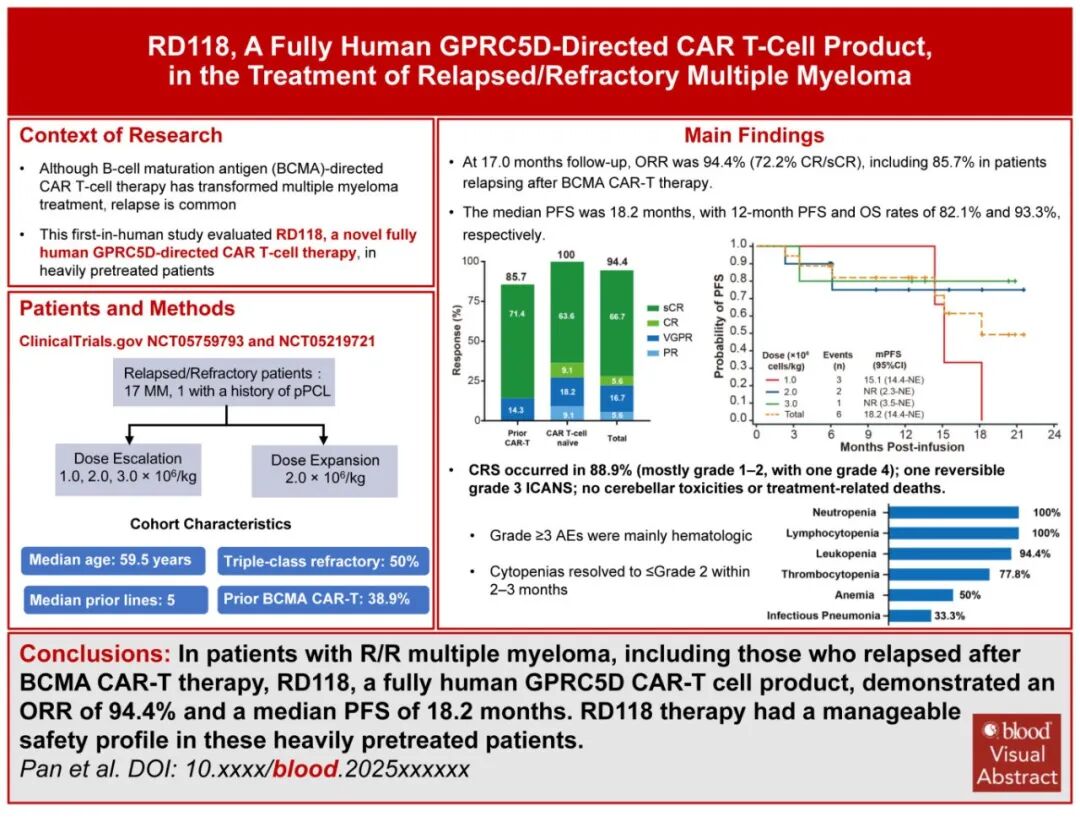
Study Type:Open-label, Phase I Dose Escalation and Expansion Trial
Enrolled Patients: Patients with RRMM and primary plasma cell leukemia
Dose Setting: 1.0, 2.0, 3.0×10⁶ CAR+T cells/kg, the expansion cohort was unified to 2.0×10⁶/kg
Primary Endpoint: Safety (including Dose-Limiting Toxicity DLT)
Secondary Endpoint:Efficacy (ORR, CR/sCR, PFS, OS, MRD negativity rate), Pharmacokinetics, Pharmacodynamics
Research Results
Patient
18 patients with relapsed/refractory disease after multiple lines of therapy (17 with multiple myeloma, 1 with primary plasma cell leukemia).
Median Age: 59.5 Years
Median number of prior treatment lines: 5 lines
38.9% of patients had previously received BCMA CAR-T therapy.
50% were triple-resistant, and 22.2% were quintuple-resistant.
Efficacy
Median follow-up of 17 months
Overall Response Rate (ORR): 94.4% (17/18)
Complete/Strict Complete Remission (CR/sCR): 72.2%
Very Good Partial Response (VGPR): 16.7%
Partial Response (PR): 5.6%
Patients with BCMA CAR-T treatment failure: ORR was 85.7%, CR/sCR was 71.4%
Median Progression-Free Survival (mPFS): 18.2 months
12-Month PFS Rate: 82.1%, OS Rate: 93.3%
MRD Negative Rate at Day 28: 88.2% (15/17 Responders)
Safety
Cytokine Release Syndrome (CRS): 88.9%, mostly grade 1–2, with only one case of grade 4 (accompanied by DIC and acute kidney injury, recovered after active management)
Immune Effector Cell-Associated Neurotoxicity Syndrome (ICANS): 1 case of Grade 3, resolved within 72 hours
No cerebellar toxicity or treatment-related deaths
Common adverse reactions:
Hematological Toxicity: Neutropenia, Thrombocytopenia, Anemia, etc., Recovery within 2-3 months
Skin Toxicity: Toxicities associated with GPRC5D expression in keratinized tissues were observed, such as nail changes (44.4%), rash (16.7%), pruritus (16.7%), and mild alopecia (11.1%).
CAR-T Cell Kinetics
Peak Time of Amplification: Median 20 Days
Persistence: Median 366 days (28–655 days)
Patients in the high-expansion group (VCN AUC180 high) had significantly longer PFS and DOR.
Recurrence Mechanism
Six patients experienced disease progression, three of whom had GPRC5D antigen-negative relapse.
Suggesting that antigen escape may be one of the drug resistance mechanisms, dual-target strategies or epigenetic regulation methods could be considered in the future.
Summary
RD118, as a fully human GPRC5D CAR-T therapy, has demonstrated highly effective and durable responses in heavily pretreated RRMM patients (ORR 94.4%, mPFS 18.2 months) with manageable safety.
Patients who failed BCMA CAR-T therapy still have a good remission rate, making it a highly promising novel therapeutic option.
Further pivotal clinical trials are required to validate its efficacy and safety, and to explore its application value in earlier treatment lines.
References
Pan M, Wang D, Xu J, Jin S, Wang Y, Tao Y, Liu Y, Ouyang W, Weng X, Yi H, Huang Y, Cao X, Li S, Zhang F, Zhang W, Li C, Mi JQ. Fully Human anti-GPRC5D CAR T-Cell Therapy RD118 Induces Durable Remissions in Relapsed/Refractory Multiple Myeloma. Blood. 2025 Oct 21:blood.2025030559. doi: 10.1182/blood.2025030559. Epub ahead of print. PMID: 41118600.