

Korui Bio's Global First-in-Class TCR-TCE Therapy CRPA1A2 Receives FDA IND Approval, Pioneering Precision Treatment for Solid Tumors

CorreGene
Developer of Tumor Immunotherapy and Gene Therapy Technologies
December 10, 2025
eMedClub News
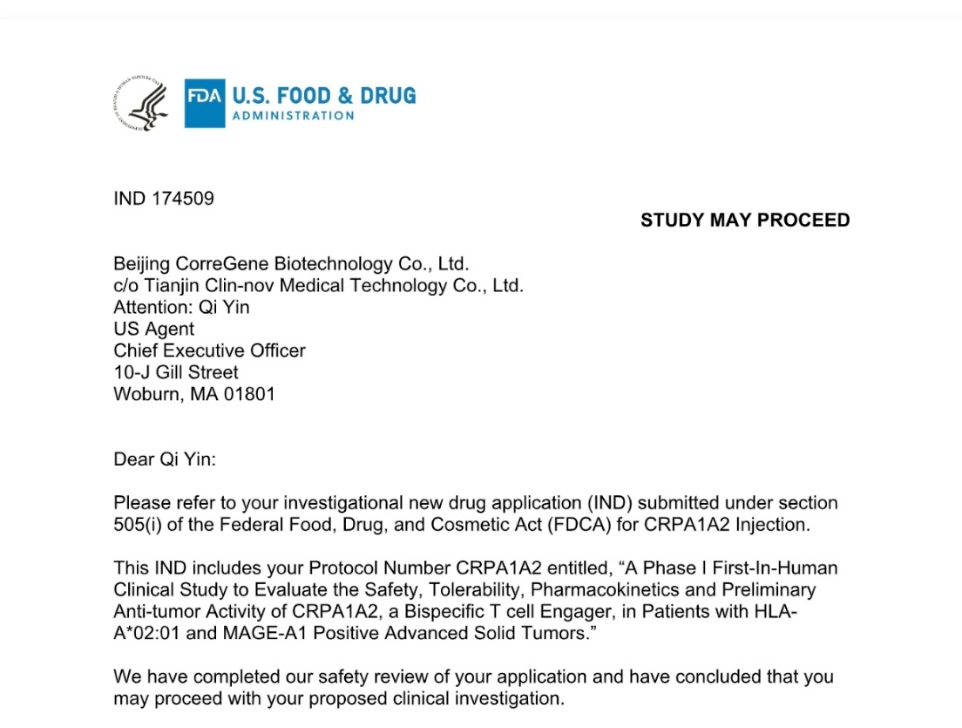
December 5, 2025, Beijing Kerui Biological Technology Co., Ltd.(hereinafter referred to as "Kerui Biological")Self-developed TCR-TCE(T Cell Receptor - T Cell Engager)Drug CRPA1A2 Injection Officially Approved by the U.S. Food and Drug Administration(FDA)New Drug Clinical Trials(IND)This milestone event not only marks the official entry of the world's first TCR-TCE drug targeting MAGE-A1 positive and HLA-A*02:01 positive advanced solid tumors into international clinical research, but also sets a record as the first TCR protein drug developed by a Chinese company to enter the clinical stage, demonstrating the global competitiveness of China's innovative pharmaceutical companies in the field of precision oncology treatment.
Dual Assurance:
Precisely Target Tumors, Balancing Safety and Coverage
MAGE-A1, as a cancer/testis antigen, is expressed at medium to high frequency in various solid tumors such as hepatocellular carcinoma, squamous cell carcinoma of the lung, esophageal cancer, head and neck cancer, and gastric cancer, with a positive rate reaching 20%-60%. It is basically not expressed in normal somatic cells of the human body and is only present in testicular tissue lacking HLA-I molecules.(Unable to present MAGE-A1 to form antigenic epitopes)This highly tumor-restricted expression pattern provides CRPA1A2 with an inherent safety margin, enabling it to "precisely accumulate" attacks on tumor cells while minimizing damage to normal tissues. Combined with the high carriage rate of HLA-A*02:01 in the global population, this establishes a broad population coverage foundation for CRPA1A2.
More notably, the TCR molecule adopted by CRPA1A2 is derived from Beijing Kerui Biological Technology Co., Ltd.'s independently developed SMART-TCR® affinity optimization platform. While significantly enhancing the affinity and functional activity of the TCR, this platform rigorously eliminates potentially cross-reactive clones, ensuring excellent specificity for the MAGE-A1/HLA-A02:01 complex. The dual advantages of tumor-specific antigens and highly precise TCR molecules provide CRPA1A2 with a "safety + precision" double safeguard, which is expected to effectively avoid the common on-target/off-tumor toxicity risks associated with traditional membrane surface antigen-targeted TCE drugs, enabling safer and more precise immune targeting of solid tumors.
Mechanism Innovation:
Dual Battlefield Synergy Amplifies Anti-Tumor Effects
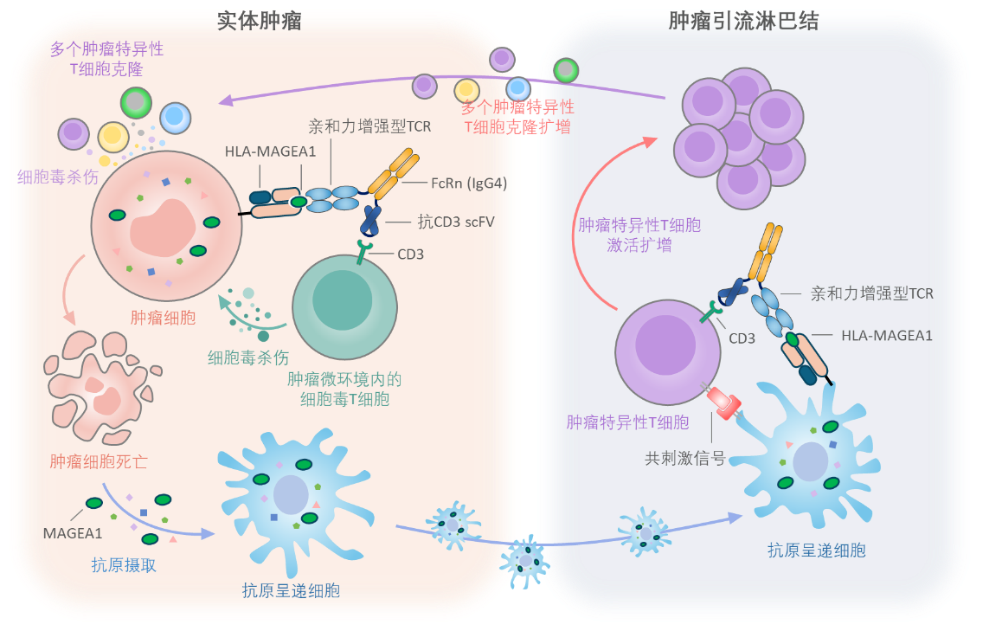
TCR-TCE not only achieves rapid and potent cytotoxic killing locally in the tumor but also remodels and amplifies systemic antitumor immune responses in tumor-draining lymph nodes, contributing to the objective response rate.(ORR)And Overall Survival(OS)Laid a mechanistic foundation for achieving better outcomes in key clinical endpoints.
At the tumor site, CRPA1A2 utilizes its bispecific structure to bridge tumor cells and T cells: the TCR domain at one end binds with high selectivity to the MAGE-A1/HLA-A*02:01 complex, precisely locking onto tumor cells; the anti-CD3 domain at the other end recruits and activates surrounding T cells, forming a stable and efficient immune synapse. This induces effector molecules such as granzymes and perforin, mediating tumor cell lysis and release, thereby achieving direct "clearance-style" elimination of the lesion.
When tumor cells are killed, a variety of released tumor-associated antigens are captured, processed by antigen-presenting cells such as dendritic cells, and then migrate to the tumor-draining lymph nodes, the "second battlefield." Here, CRPA1A2 bridges antigen-presenting cells and T cells: the TCR domain recognizes antigen-presenting cells presenting the MAGE-A1 peptide.(Such as DC), The anti-CD3 domain provides activation and co-stimulatory signals to T cells, prompting polyclonal tumor-specific T cells to be more efficiently activated by DCs and expanded on a large scale. These "secondarily amplified" polyclonal T cells then re-infuse into the tumor site and potential metastatic sites, creating sustained and broad-spectrum immune pressure. This not only holds the potential for more durable anti-tumor effects but also effectively addresses challenges like tumor heterogeneity and antigen escape.
In addition, CRPA1A2 molecules are based on the next-generation CorEngager® TCR-TCE platform, which is independently developed by Beijing Kerui Biological Technology Co., Ltd. The platform adopts IgG-like molecular design and an optimized Fc structure in CMC.(Chemistry, Manufacturing, and Control), molecular stability, in vivo half-life, and tumor and lymph node penetration, among other key attributes. This platform advantage ensures that CRPA1A2 achieves sustained and adequate drug exposure and immune effects in the two critical battlefields of local tumors and draining lymph nodes, providing strong support for dual clinical benefits of ORR and long-term OS.
Global Layout: From Chinese Innovation to Global Contribution, Benefiting Patients Worldwide
Following the approval of this IND, Kerui Bio will immediately initiate a global multicenter Phase I clinical trial to primarily evaluate the safety, tolerability, and preliminary efficacy of CRPA1A2 injection in patients with advanced solid tumors.
Dr. Xie Xingwang, founder of Beijing Kerui Biological Technology Co., Ltd., stated: "The FDA's IND approval for CRPA1A2 Injection marks a key breakthrough in the company’s internationalization strategy, fully demonstrating our independent R&D capabilities in the field of TCR innovative drugs. Leveraging our proprietary SMART-TCR® affinity optimization platform and CorEngager® T-cell engager platform, we have successfully advanced the first First-in-Class TCR-TCE product into the clinical stage. Moving forward, Kerui Biological Technology will continue to deepen its expertise in TCR technology, develop more groundbreaking therapies for solid tumors, address current treatment challenges, and provide better options for patients worldwide."
About Kerui Bio
Beijing Kerui Biological Technology Co., Ltd. is committed to T-cell receptor-based(TCR)The development of innovative drugs has revolutionized the treatment landscape for solid tumors and chronic infectious diseases. By establishing a systematic R&D platform through technological innovation, key technical barriers in TCR innovative drug development have been overcome. This addresses a series of challenges in TCR discovery, optimization, and the drug development process, enabling high-efficiency, high-throughput TCR drug innovation and effectively filling gaps within China. The proprietary "SMART-TCR®" affinity optimization and "CorEngager®" T-cell engager platforms break industry barriers, while mature process development and analytical quality control systems accelerate TCR therapy innovation. Supported by R&D and industrialization platforms, Beijing Kerui Biological Technology Co., Ltd. is developing two product categories: TCR-T cell therapies and soluble TCR protein drugs, targeting trillion-dollar markets including cancer, chronic infections, and autoimmune diseases.

Exciting Live Broadcast Preview
Press and hold to scan the QR code and participate immediately ↓

'%20fill='%23FFFFFF'%3E%3Crect%20x='249'%20y='126'%20width='1'%20height='1'%3E%3C/rect%3E%3C/g%3E%3C/g%3E%3C/svg%3E)

DianDian "Share”、“Like"and"In View",Give me a little recharge~