Qilu Pharmaceutical Gains Approval for Panitumumab Biosimilar Ankeze® (QL1203) as First Domestic Fully Human Anti-EGFR mAb for First-Line Treatment of RAS Wild-Type Metastatic Colorectal Cancer

Qilu Pharmaceutical
Specialty Formulations and Active Pharmaceutical Ingredients (API) Developer

Recently, Qilu Pharmaceutical's Pertuzumab N01 Injection (QL1203) has been approved for marketing in China, used forIn combination with FOLFOX for the first-line treatment of patients with RAS wild-type (both KRAS and NRAS wild-type) metastatic colorectal cancer (mCRC), Trade Name: Ancoraze.
This drug is a new drug of category 3.4. The original research drug is Panitumumab (trade name Vectibix).It is a monoclonal antibody targeting the epidermal growth factor receptor (EGFR) co-developed by Takeda and Amgen.Not approved for marketing in China.
Epidermal Growth Factor Receptor (EGFR) is currently the most representative target for targeted therapy in colorectal cancer treatment. In colorectal cancer, EGFR is often overexpressed, and its high expression is closely related to poor prognosis. After EGFR activation, it can inhibit apoptosis, promote invasion and angiogenesis, ultimately leading to tumor growth.
Panitumumab has a high affinity for the extracellular portion of the EFGR protein and can competitively bind to EGFR, thereby blocking EGFR and downstream signaling pathways, promoting apoptosis, and inhibiting angiogenesis, thus exerting its anti-tumor effects.
In September 2006, panitumumab was first approved by the FDA in the United States. It has now been approved globally for various cancer indications, including monotherapy for metastatic colorectal cancer (mCRC) patients with EGFR-expressing tumors, first-line treatment combined with the FOLFOX chemotherapy regimen for mCRC patients with KRAS exon 2 wild-type, and second-line treatment for RAS wild-type mCRC patients, among others.
Qilu Pharmaceutical initiated the relevant research on Pertuzumab in 2012 and conducted a pharmaceutical comparative study with Amgen's Panitumumab. The results proved that,Qilu Pharmaceutical's Ankeze has highly similar quality attributes to Panitumumab, and the overall quality is comparable.
In a multicenter, randomized, double-blind, parallel-controlled Phase III clinical trial, Encorafenib combined with the mFOLFOX6 regimen was compared to placebo combined with the mFOLFOX6 regimen to evaluate the efficacy and safety of first-line treatment for RAS wild-type advanced metastatic colorectal cancer. The study enrolled 641 patients, who were randomly assigned in a 2:1 ratio to the experimental group (426 patients) and the control group (215 patients). The primary endpoint of the study was progression-free survival (PFS) assessed by a Blinded Independent Review Committee (BIRC).
As of March 22, 2025, the BIRC assessment results showed that the experimental group and the control groupThe median PFS was 11.2 months (95% confidence interval [CI]: 9.9–13.0) and 8.3 months (95% CI: 7.3–8.5), respectively., with statistically significant differences (Stratified Log-Rank P<0.001; Hazard Ratio
The result was 0.61 [95% CI: 0.49–0.76]). The primary endpoint of the study met the pre-specified superiority target.
In terms of safety, no new safety signals were identified. The incidence rates of treatment-emergent adverse events (TEAEs) graded ≥3 in the two groups were 81.6% and 65.7%, respectively.
Colorectal cancer is the third most commonly diagnosed cancer and the second leading cause of cancer-related deaths worldwide. In 2022, there were over 1.9 million new cases of colorectal cancer globally, with 904,000 deaths. In recent years, both the incidence and mortality of colorectal cancer in China have shown a rapid upward trend. In 2022, the number of new cases of colorectal cancer in China was approximately 517,100, ranking second among malignant tumors.
The approval of Pertuzumab N01 Injection brings a new treatment option for patients in China.
Currently,Qilu Pharmaceutical has received approval for 15 biologics in China., covering multiple important areas such as solid tumors, supportive cancer care, rheumatology and immunology, ophthalmology, etc., with several innovative biologics and biosimilars currently under development.
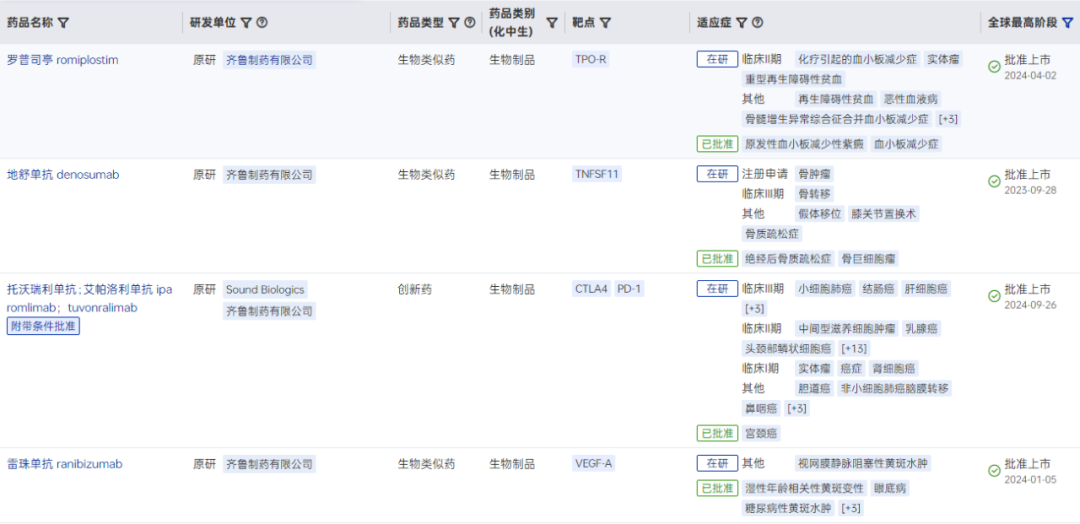
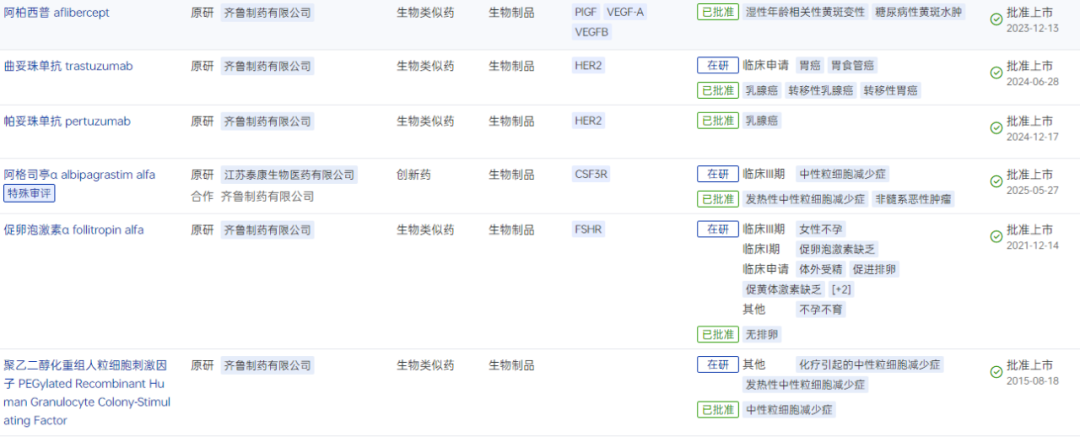

Biological Drugs Approved for Marketing by Qilu Pharmaceutical
Source of the image: Yaoke Data - Global Drug Analysis System
Source: Public data, Pharmcube Data - Global Drug Analysis System