

ASH 2025: Five In Vivo CAR-T Companies Report Early Clinical Data Demonstrating Sustained Patient Responses and Advancements in Viral and Non-Viral Delivery Platforms

Vivacta Biotechnology
Cell Therapy Research Firm

December 14, 2025
eMedClub News

Clinical Research/IIT Research
IVACTA Biotechnology
IVACTA Biotechnology, spun off from Grail Bio's in vivo CAR-T platform, presented the first clinical data of its innovative anti-CD19 in vivo CAR candidate product GT801 in an oral report at this year’s conference.
GT801 is an innovative anti-CD19 in vivo CAR candidate product that delivers optimized mRNA through T cell-targeting LNPs.The platform integrates the CLAMP technology co-developed by Grail Bio and IVACTA Biotechnology, enabling targeted VHH antibody-LNP conjugation with precise positioning and quantification in T cells. This enhances targeting efficiency while avoiding non-specific uptake, thereby promoting specific and efficient CAR expression and maximizing the functionality of CAR-T cells generated in vivo.

In a phase 1 investigator-initiated clinical trial evaluating GT801 for the treatment of relapsed/refractory CD19-positive B-cell lymphoma, as of November 30, 2025, two non-Hodgkin lymphoma patients did not receive lymphodepletion preconditioning and completed three doses of 0.5 mg each and four doses of 1.5 mg each, respectively.
The subjects showed overall good clinical tolerance, with high CAR expression levels in peripheral blood T cells. Persistent and reproducible CAR-T expansion was observed after each dosing, while no CAR expression was detected in peripheral blood mononuclear cells, indicating no off-target delivery risk for GT801. This confirms that the T-LNP delivery platform can sufficiently enhance targeting efficiency while avoiding non-specific uptake. In the fourth week after completing multiple doses,Both patients achieved partial remission.。
Kelonia
Core Pipeline of KeloniaKLN-1010 is an investigational therapy capable of generating novel fully human anti-BCMA CAR-T cells in vivo., using a modified third-generation lentiviral vector for selective transduction of circulating T cells, aimed at developing a treatment for relapsed/refractory multiple myeloma.
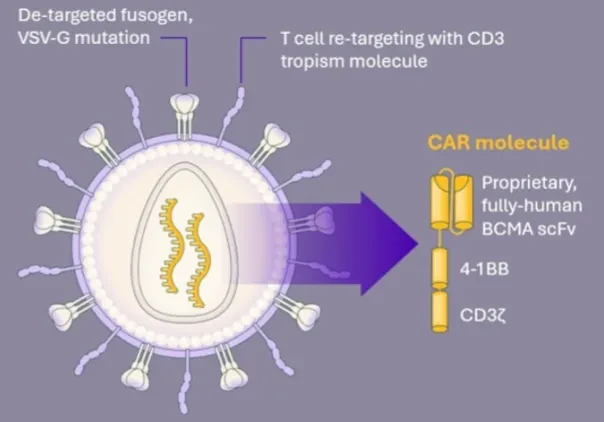
An open-label, dose-escalation Phase 1 clinical trial aims to evaluate the safety, tolerability, pharmacology, and preliminary efficacy of a single dose of KLN-1010 in target patients. The study announced here included four patients, and despite not undergoing lymphodepleting chemotherapy, KLN-1010 still achieved CAR-T cell expansion.All patients achieved MRD negativity in the first month, and the patient with the longest follow-up remained MRD negative at the third month.According to the IMWG criteria, all patients achieved partial remission in the first month.(PR), and the depth of remission deepens over time. Meanwhile, within 3 months after treatment, memory CAR-T cells can be continuously detected in both bone marrow and peripheral blood, with overall good safety.
How to systematically understand these challenges of in vivo CAR-T? What are the latest practical insights and solutions accumulated by the leaders in the industry?December 16, 2025 (Tuesday) 14:00-15:30, Yima Guest United with Agilent and Ucar Bio specially planned"Conquering in vivo CAR-T Therapy: A Comprehensive Analysis from Challenges to Quality Control"Thematic Live Broadcast Class. At that time, Xu Nan, Vice General Manager of R&D at Ucard Biotechnology, and Yu Weiping, Business Development Manager at Agilent, will focus on"Challenges and Latest Insights in the Development of in vivo CAR-T Therapy"And"Safe Lock and Efficacy Ruler: Agilent Technology Matrix Empowers Multi-dimensional Preclinical Evaluation of in vivo CAR-T"Two Major Themes for Technical Insights Sharing. Everyone is sincerely invited to scan the QR code for free viewing and exchange!
Preclinical Study
Immunofocus Biotechnology
IMV101, developed by ImmunoForge Biologics, is a CD19 CAR-T candidate therapy based on a lentiviral vector.The surface of this vector is coated with a mutated MxV glycoprotein, which eliminates its receptor-binding ability while retaining its membrane fusion activity. Meanwhile, the vector incorporates a new-generation T-cell targeting module, TCM3, which can specifically recognize and bind to T-cell surface receptors, thereby achieving highly efficient infection.
In vitro experimental data show that IMV101 has the following characteristics: it can transduce human primary T cells at a low multiplicity of infection, and upregulate the expression of CAR and activation marker CD25; T cells treated with it exhibit dose-dependent killing of CD19-positive tumor cells, accompanied by IFN-γ release; this vector selectively transduces T cells, with very low transduction levels in B cells, NK cells, various tumor cell lines, and normal primary cells of major organs.
In a mouse tumor model with a reconstituted human immune system,Single Intravenous Injection of IMV101 Dose-Dependently Inhibits Tumor Growth and Prolongs Survival; At the same time, functional CAR-T cells can be continuously detected in peripheral blood, consistent with the expected mode of action of "one injection, sustained effect." Biodistribution studies show that the genetic modification effect of IMV101 is mainly enriched in splenic T cells. This distribution characteristic, which matches the key organ of immune response, aligns with its design mechanism and provides a reference for subsequent safety assessments.
Reindeer Biotechnology
IASO Biotherapeutics Shares at the ASH Annual MeetingA Novel In Vivo CAR-T Cell Preparation Platform Based on Third-Generation Engineered Lentiviral VectorsThe researchers modified the cocai glycoprotein to disrupt its natural receptor LDL-R without affecting its fusion potential, through high-affinity CD7 conjugates.(As the second envelope protein)Retargeting Specific T Cells.
Non-replicating, self-inactivating lentiviral vector, which can deliver CAR transgenes targeting different antigens to T cells through the CD7-mediated T cell transduction pathway, including: humanized single-domain antibody-based(VHH)Targeting BCMA CAR(IASO 206)、Based on Humanized Single-Chain Variable Fragment(scFv)Targeted CD19 CAR(IASO 207), and based on humanized single-domain antibodies(VHH)Targeted CD20 CAR(IASO 208), thereby ensuring the specific expression of the CAR structure in T cells.
In mouse models, a single tail vein injection of IASO 207 and IASO 208 effectively depleted B cells in the peripheral blood and spleen of mice. Similarly, in human PBMC-reconstituted NPG mice, a single tail vein injection of IASO 206 significantly inhibited the growth of RPMI-8226 multiple myeloma xenografts, with no apparent toxicity observed in the mice.
Qihan Biotechnology
Qihan Biotech Presents Preclinical Data of In Vivo CAR-T at ASH Annual Meeting. In the research "abs25-7466 Engineering Quiescent Viral Entry Pathways for in Vivo CAR-T Generation via Binder Fusogen Combinatorics," a combination of binder-fusogen proteins was systematically screened to achieve high-titer transduction with low induction of early activation markers and cytokine release.The optimal combination can mediate rapid receptor endocytosis without forming persistent TCR signal complexes., maintaining the metabolic characteristics of resting T cells and avoiding the upregulation of exhaustion markers. This "functional quiescence" design maintains baseline cytokine levels during the transduction phase and can drive efficient CAR-T cell expansion after antigen stimulation.
"abs25-8194 Enhanced vsvg variants for binder‑dependent and high‑specificity transduction of primary T cells" describes a novel VSVG mutant that enables high-specificity, binder-dependent targeted transduction while maintaining or even enhancing the virus's persistence and packaging efficiency in vivo. This mutant provides an excellent tool for targeted delivery of lentiviral vectors, particularly suitable for in vivo T-cell engineering applications.
Summary
Overall, the current research data in the field of CAR-T therapies in vivo shows"Preclinical R&D as the foundation, with a few clinical explorations breaking through"The distinct characteristics are highly consistent with the early stage of technological exploration and transformation in this field. In preclinical research and development, various enterprises focus on"Precision Delivery, Potent Killing, Low Toxicity Tolerance"Three core demands have continued to make breakthroughs, laying a solid foundation for clinical transformation. Clinical research/IIT data has preliminarily demonstrated the safety and therapeutic potential of in vivo CAR-T therapy, breaking the tradition of "relying on lymphodepletion" and providing a new pathway to improve the accessibility of the therapy.
With the continuous maturation of preclinical technologies and the disclosure of more IIT/clinical data, in vivo CAR-T is expected to gradually address the current pain points faced by ex vivo CAR-T, such as complex preparation, high costs, and low accessibility. It is set to become one of the core paradigms of the next generation of cancer immunotherapy. Driven by both technological iteration and clinical validation, the expansion of indications in hematological malignancies and autoimmune diseases, along with breakthroughs in solid tumors, will jointly propel in vivo CAR-T from a track hotspot to a clinical necessity, providing more treatment options for cancer patients.
Editorial Responsibility | Xun
Proofread by Xun
References:
1.https://www.hematology.org/

Exciting Live Broadcast Preview
Press and hold to scan the QR code to participate immediately ↓
Recommendation 1
December 16th, 14:00-15:30
Conquering in vivo CAR-T Therapy: From Challenges to Quality Control, A Comprehensive Analysis
Recommendation 2
December 18th, 19:00-20:00
The Last Mile of Cell Therapy Scaling: Technological Innovation in the Aseptic Filling Process
Recommendation 3
December 23rd, 15:00-16:00
Frontier Advances in Drug Screening Using Liver Organoids

DianDian "Share”、“Like" and "In View",Give me a little recharge~"