

Price Disruptor Enters the Arena: How China's Huadao Biologics Slashes CAR-T Therapy Cost to $30,000

Huadao Biopharma
Developer and Manufacturer of Cell-Based Immunotherapy Drugs

On December 12, 2025, a landmark moment arrived in China's CAR-T cell therapy field. HuaDao CAR-Tcell (Shanghai) Biomedical Co., Ltd. revealed that it has officially submitted the market application for its first CAR-T cell drug to the Center for Drug Evaluation of the National Medical Products Administration. What truly shook the industry was the disclosed pricing: this "Made-in-China" cell drug, targeting refractory and relapsed non-Hodgkin lymphoma, is priced at onlyMore than 200,000 RMB。
This price, compared to similar products already on the market in China that easily cost...MillionChinese PeopleCurrencyThe pricing has formed a glaring contrast. Since the approval of the first CAR-T therapy in China in 2021, the treatment costs reaching up to a million yuan have made this revolutionary therapy, capable of "curing" certain hematological tumors, still treat less than 2,000 patients nationwide after four years, becoming an unattainable "luxury" for the vast majority of patients.
The emergence of HuaDao CAR-Tcell is like a sharp blade wielded by a "price butcher," breaking through the thick ice of high costs. People can't help but ask: How did it achieve this? And how will this disruptive pricing reshape the landscape of China’s and even the global cell therapy market?
CAR-T therapy, known in the industry as the "anti-cancer injection" cellular immunotherapy, has gained significant attention due to its revolutionary treatment outcomes. However, its high cost makes it an unattainable luxury for the majority of patients.
For a long time, the key production technologies, core equipment, and consumables of the global CAR-T industry have been monopolized by a few European and American companies. For instance, the widely used German Miltenyi CliniMACS Prodigy fully automatic cell preparation system and its配套的一次性耗材包 (matching single-use consumable kits) have a consumable cost alone as high as 100,000 to 150,000 RMB. Moreover, the essential viral vectors required in the preparation process also rely on imports, with costs reaching 15,000 to 30,000 USD.
More severe is the capacity bottleneck. Relying on imported closed production systems, a single unit can only serve about 25 patients per year. Limited production capacity has driven up unit costs and deprived companies of pricing power. As Yu Xuejun, founder of HuaDao CAR-Tcell, stated:"If the industrial equipment is not our own, we will never have production capacity, nor will we have pricing power."
Currently, the price of CAR-T products approved for marketing in China generally exceeds one million yuan. Fosun Kite's Axicabtagene Ciloleucel Injection is priced at 1.2 million yuan per dose, Wuxi JWCAR029's Relmacabtagene Autoleucel Injection at 1.29 million yuan per dose, and IASO Biotherapeutics' Equecabtagene Autoleucel Injection at 1.166 million yuan per dose. Even the lowest-priced product, CNCT19 Cell Injection from Hecan Biotechnology, reaches 999,000 yuan per vial.
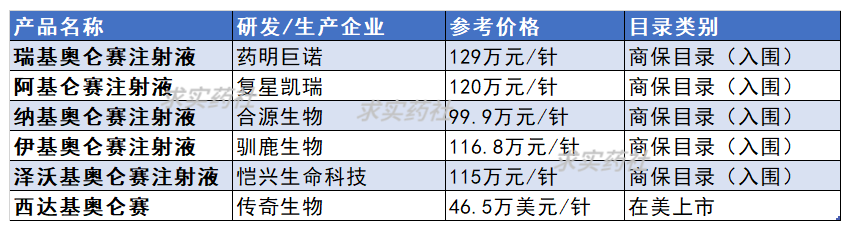
Qiu Shi Pharmacy Co., Ltd.
Since the first CAR-T drug was launched in China in 2021, a total of 7-8 products have been approved so far, but over the span of four years...The total number of patients treated does not exceed2000 peopleThe core pain point remains that patients cannot afford the treatment.
HuaDao CAR-Tcell's solution appears simple and straightforward, yet it requires tremendous determination and a long-term commitment:Achieve whole industry chain independent innovation from underlying technology to final product。
This strategic choice originated from the original intention of the founder, Yu Xuejun, as a retired military doctor and hematologist. After witnessing too many patients at Changhai Hospital give up treatment due to financial reasons, he deeply felt, "If the drugs we make are unaffordable for patients and also unaffordable for the national health insurance, then what social significance do they have?" In 2014, when the team discovered that using imported equipment and consumables would make it impossible to price the future drug below 800,000 yuan, Yu Xuejun made a difficult decision: in addition to developing the drug, they must simultaneously overcome all key production technologies and equipment.
This is a long journey of "ten years of honing a single sword." HuaDao CAR-Tcell did not choose the shortcut of introduction and imitation, but started from the most fundamental steps:
· Equipment Autonomy: Independently developed a fully automatic, fully enclosed cell drug intelligent manufacturing device named "Ant Workshop," achieving complete replacement of imported core equipment.
· Localization of Consumables and Reagents: A complete set of production materials, including disposable consumables, cell culture reagents, and viral vectors, have been successfully developed, eliminating the reliance on expensive imported supply chains.
· Technological Innovation in Production: Integrate key unit operations into a single enclosed cabinet to build an independent GMP-level microenvironment, significantly reducing production energy consumption and reliance on high-end cleanroom facilities.
In June 2023, this technological journey reached a key milestone. The critical industrial technology and equipment for CAR-T cells independently developed by HuaDao CAR-Tcell officially passed the associated review of the National Medical Products Administration (NMPA), making it becomeAt that time, the only one in China that ownedEnterprises with Independent Intellectual Property Rights in the Whole CAR-T Cell Industry ChainThis means that China's cell drug industry has achieved independent control over its core production lifeline for the first time.
Full-chain autonomy brings absolute control over costs, but the disruptive innovation of HuaDao CAR-Tcell goes far beyond that. Its deeper level of innovation lies in,The industrialized, automated mass production mindset has been introduced into what originally belonged to"The 'Hand-Customized' Cell Therapy Field"。
Traditional CAR-T production is highly reliant on manual operations, which not only results in low efficiency and difficulty in ensuring inter-batch stability but is also a major reason for the high costs. HuaDao CAR-Tcell, through its self-developed fully automatic, fully enclosed, and unmanned production system, has completely transformed this paradigm.
According to public information, this system can increase the production capacity of cell drugs to50 times or more。The production base that the company is constructing in Songjiang, Shanghai, has an initial planned annual production capacity of9,000 doses, while the annual production capacity of other products already on the market in China is generally below 300 person-doses. In theory, this system can achieve "produce as much as needed clinically."
The diminishing marginal cost effect brought by scaled production is the core economic logic that enables HuaDao CAR-Tcell to price its product in the range of 200,000 RMB. It demonstrates that although cell-based drugs are personalized treatments, their manufacturing process can fully resemble that of modern biologics, achieving an exponential reduction in costs through standardized, automated, and scaled "engineering capabilities."
Priced at onlyIf the CAR-T drug, priced at over 2 million yuan, successfully enters the market, its impact will far exceed the scope of a single product and is likely to become a turning point that rewrites the trajectory of the entire industry.
First, there is a fundamental change in the payment and market landscape.The Million-Dollar Out-of-Pocket Cost Restricts CAR-T Therapy to a Very Limited Market Space.And20YuThe price of ten thousand yuan has already entered China's multi-level medical security system (such as national medical insurance, city-customized commercial insurance)."Huimin Bao") may carry within its threshold range. Once included in the payment scope, CAR-T therapy will transform from a "luxury drug for the wealthy" to a "popular treatment" accessible to a broader patient population, with market demand expected to be instantly activated and market capacity poised to grow exponentially.
Secondly, it is the tremendous pressure from existing competitors.Facing competitors with prices only 1/5 to 1/6 of their own, other CAR-T companies will have to accelerate the process of reducing costs and increasing efficiency. It can be foreseen that the industry will witness a wave of seeking domestically produced alternatives, optimizing production processes, and exploring universal CAR-T (to reduce personalized production costs). The industry's cost focus will shift partially from research and development and clinical trials to the optimization of production processes and supply chains.
The most intriguing part might be the announcement made by HuaDao CAR-Tcell."Open Source" Vision.The founder of the company, Yu Xuejun, has repeatedly stated that after the first drug is launched,HuaDao CAR-Tcell Plans to Open Source and Share Its Independent Industrial Technology Platform with Research Institutions, Hospitals, and Enterprises in ChinaIf this commitment is fulfilled, its significance would be comparable to creating an "Android system" for the biopharmaceuticals field. It aims to lower the innovation threshold and manufacturing costs for the entire cell therapy industry in China, fostering an ecosystem for "affordable cell therapies" for ordinary citizens. This is no longer just one company's business strategy but a "China solution" aimed at propelling the overall breakthrough of the industry.
The story of HuaDao CAR-Tcell provides an inspiring model for the development of innovative drugs in China: true innovation is not only about creating "me-better" or "me-best" drugs with excellent efficacy, but more importantly, it involves solving the fundamental social issue of drug "accessibility" through revolutionary advancements in foundational technologies and production models.
Of course, this drug is still under review, and its final approved indications, clinical data details, and exact commercial performance remain to be seen. HuaDao CAR-Tcell itself is also facing challenges, such as how to manage the upcoming huge production capacity and how to build a commercial team for a broader market, which are new topics.
Disclaimer:
The content of the article is for reference only and does not constitute investment advice. Investors who take action based on this information bear their own risks. The article maintains a neutral stance on the statements and viewpoints expressed, and does not provide any explicit or implicit guarantees regarding the accuracy, reliability, or completeness of the content included. Readers are advised to use it solely as a reference and assume full responsibility for their actions.

The First in 2026!
Top Summit on Cellular Immunity and In Vivo CAR-T!

ICAR 2026
Booths are booking up fast!
Scan the code for immediate consultation
Phone: 13816031174
(Same as WeChat)
Sponsorship forms include but are not limited to speaking slots, exhibition booths, color pages in the conference brochure, dinner sponsorship, and promotional meeting supplies.