

China's First Domestic Phaco-Vitrectomy Combo System Approved, Offering Hope for 200 Million Ophthalmic Patients

Rhino Health
Developer of High-End Ophthalmic Surgical Equipment
Ophthalmic Innovative Medical Devices Achieve Significant Breakthrough.
In December this year, Rhino Health has successfully obtained the medical device registration certificates for its disposable phacoemulsification kit (Zhejiang Medical Device Registration No. 20252161988) and its phacoemulsification-vitrectomy integrated ophthalmic equipment (China Medical Device Registration No. 20253162583).
The former is a consumable product launched by Rhino Health to meet the current clinical usage needs. The latter is China's first domestically produced phacoemulsification and vitrectomy integrated machine developed through independent research and development.Its approval means that Chinese companies have finally achieved a breakthrough in key technologies for high-end ophthalmic surgical equipment, filling the gap in domestically produced phacoemulsification and vitrectomy integrated machines. With the domestic products entering the market, the monopoly of foreign enterprises will be broken, allowing Chinese companies to compete on the same stage with European and American enterprises, bringing high-quality products to a wider range of patients.
For patients and clinicians, the urgency of launching a phacoemulsification and vitrectomy machine made in China is evident.
From the perspective of patient treatment needs, the number of patients with eye diseases in China is extremely large, and the demand for eye disease diagnosis and treatment is still growing rapidly. Taking cataract patients as an example, according to statistics from the Ophthalmology Branch of the Chinese Medical Association, the incidence rate of cataracts in people aged 60 to 89 in China is 80%, while the incidence rate in people over 90 years old reaches more than 90%. Based on this estimation, there are currently nearly 200 million cataract patients in China; the number of patients with fundus diseases is also as high as 46 million. Among them, phacoemulsification + intraocular lens implantation is the only means to treat cataracts; while vitrectomy is the main method for treating fundus diseases.
From the clinical needs of doctors, the demand for phacoemulsification and vitrectomy integrated machines is continuously growing. Phacoemulsification and vitrectomy account for 50% of total ophthalmic surgeries. Among these, phacoemulsification is classified as a Level 3 surgery, while vitrectomy is a Level 4 surgery, indicating extremely high surgical difficulty and risk. Cataracts and fundus diseases often occur simultaneously and influence each other, frequently requiring combined surgical treatment. Compared to standalone phacoemulsification and vitrectomy machines, the phacoemulsification-vitrectomy integrated machine can complete both anterior and posterior segment treatments in a single surgery, significantly reducing the number of operations and trauma, making it suitable for complex cases such as cataracts combined with fundus diseases.
"In the field of high-end ophthalmic diagnostic and treatment equipment, compared to products for myopia prevention and control such as all-femtosecond laser treatments, there is a more urgent demand from clinicians and patients for phacoemulsification and vitrectomy machines. Starting with the Twelfth Five-Year Plan (2011-2015), the Chinese government initiated efforts to eliminate blindness caused by cataracts and trachoma, continuously promoting national eye health initiatives. By the release of the latest 'Fourteenth Five-Year National Eye Health Plan (2021-2025),' significant progress had been made in China's eye health sector, with cataract surgery rates increasing substantially. Surgical expertise and advanced equipment have also been extended to grassroots hospitals, benefiting a wide range of patients with eye diseases and improving healthcare at the primary level. However, given China’s large population and the growing issue of aging, the number of patients suffering from cataracts and retinal diseases remains substantial, with many still awaiting treatment, placing ongoing pressure on the healthcare system. The main causes of blindness in China have shifted from infectious eye diseases to conditions like cataracts, myopic retinopathy, glaucoma, corneal diseases, and diabetic retinopathy. Efficient diagnosis and treatment for these conditions are urgently needed." Rhino Health founder Zhang Chi added.
However, in the past, the market for phacoemulsification and vitrectomy integrated machines was monopolized by foreign companies such as Alcon and Bausch + Lomb. Now, with the launch of Rhino Health's phacoemulsification and vitrectomy integrated machine, China has finally ushered in its first domestically developed, locally produced device. According to Zhang Chi, the ophthalmic surgical system (Registration Certificate No.: 20253162583) recently approved for Rhino Health includes two product specifications, corresponding to the company’s Genesis I and Genesis II products. This series of products is suitable for cataract extraction and vitrectomy in ophthalmology.
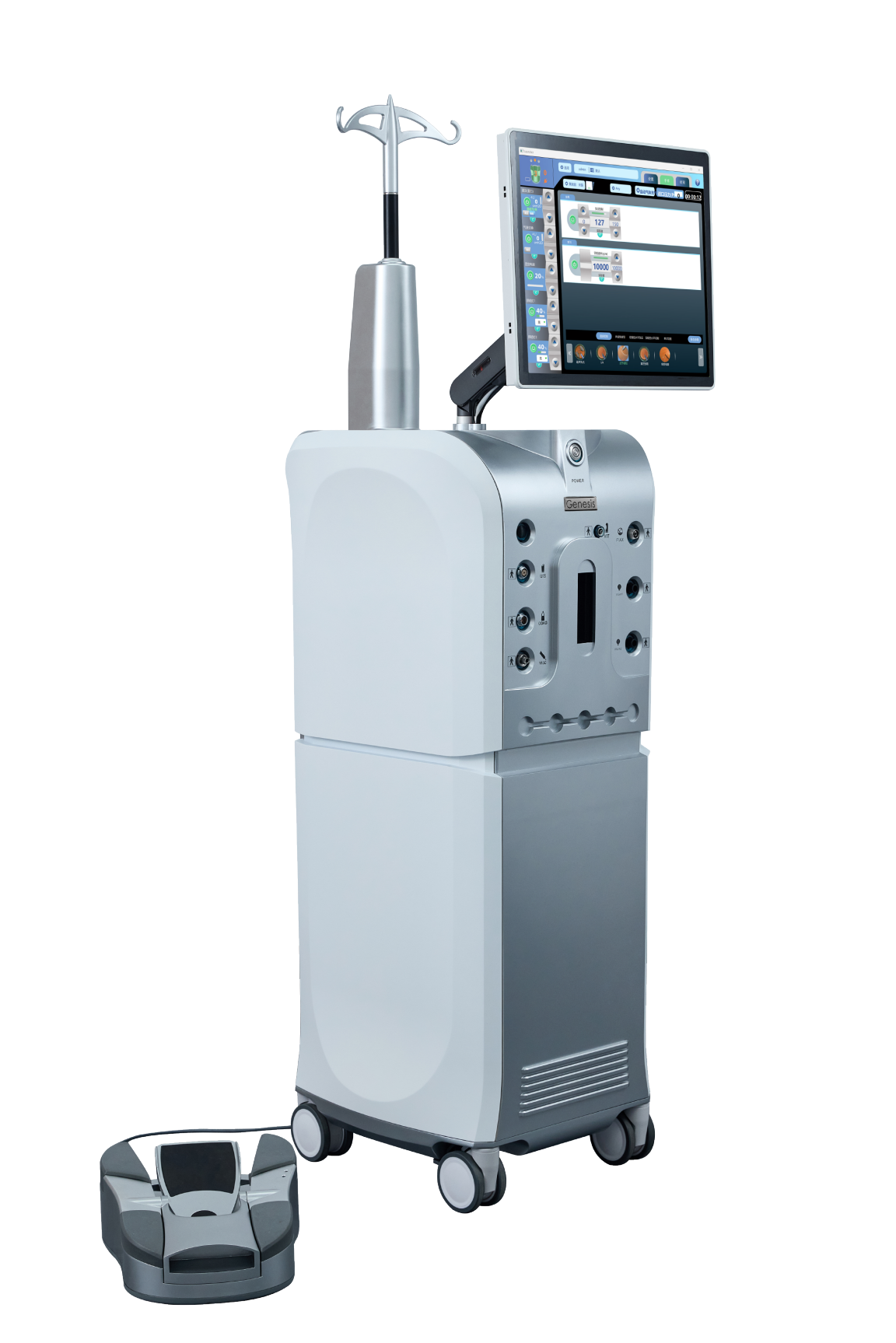
Rhino Health Phacoemulsification and Vitrectomy Integrated Machine
The vitrectomy cutting speeds of the Genesis series products are 15k and 20k CPM, respectively, capable of performing various types of vitrectomy surgeries from 20G to 27G. At the same time, they are equipped with a dual-pump system and intraocular pressure control. The phacoemulsification adopts the globally lowest frequency of 28.5kHz and the smallest incision of 1.8mm, which can effectively reduce postoperative iatrogenic astigmatism and incision thermal damage, allowing for faster postoperative recovery. In addition, the two products also have the functions of light source wavelength switching and ultrasonic vitrectomy.The integrated design concept of multi-functionality and differentiated configurations allows for rapid deployment across hospitals of various levels. Currently, in the prospective, multi-center, randomized, parallel-controlled clinical trials being conducted at the clinical trial centers of five top ophthalmology hospitals in China, the functional safety, operational convenience, and performance evaluation of Rhino Health's Genesis series products have all received excellent ratings.
Compared with similar products from overseas companies, Rhino Health's phacoemulsification and vitrectomy machine also has some unique advantages:
First, the Genesis series adopts a modular design, enabling faster upgrades and iterations. Second, compared to overseas products, Rhino Health customizes its products based on the usage habits of Chinese doctors, shortening the learning curve for domestic doctors. Additionally, Rhino Health has a dedicated training team and product support team to help doctors better master device operation. Third, Rhino Health provides exclusive disposable consumables for its devices. As clinical adoption scales up, this will further reduce the overall equipment and consumable costs for medical institutions in the future.
The long-term monopoly of overseas giants such as Alcon and Bausch + Lomb in the phacoemulsification and vitrectomy integrated machine market is a clear indication of the high "barriers" in this field.
Zhang Chi also mentioned, "The first clinically applied vitrectomy machine in China was developed in the 1970s, but for various reasons, it soon faded from public view. Now, it is not until December 2025 that China's first phacoemulsification and vitrectomy integrated machine has officially obtained the Class III medical device certification, which shows how high the threshold is."
The reasons are twofold. On one hand, it is the extremely high technical threshold of the phacoemulsification and vitrectomy integrated machine. Compared with traditional split designs, the phacoemulsification and vitrectomy integrated machine needs to integrate multiple functional modules within a limited overall space, including phacoemulsification, vitreous cutting, infusion/aspiration, intraocular pressure control, light source, laser, and electrocoagulation, while ensuring their coordinated operation. It requires companies to quickly achieve functional integration and precise control. Moreover, the device must deliver stable energy output — given that the vitreous volume of the eye is only 4.5 mL, its tolerance to temperature and fluid flow changes is relatively low. The control of cutting speed and fluid stability is particularly critical. On the other hand, the phacoemulsification and vitrectomy integrated machine has numerous accessories. Behind the successful creation of the product lies the need for a mature and complete medical supply chain.
And Rhino Health's ability to obtain the first certificate in China is the result of accumulated advantageous experience and years of technical reserve and research——
First, the founding team has rich clinical medical experience and industry experience, ensuring the smooth progress of the phacoemulsification and vitrectomy machine from project initiation to registration.Rhino Health Founder Zhang Chi, a former ophthalmologist at an eye hospital, has a deep understanding of clinical pain points and is able to consider the needs of clinicians from their perspective. Additionally, with over a decade of experience in leading foreign medical enterprises, where he was responsible for the market registration and training of ophthalmic equipment, Zhang Chi laid a solid foundation for Rhino Health to quickly achieve product approval. Breaking through technological barriers also hinges on building a talented team. Currently, Rhino Health has gathered a large group of talents from industry-leading companies such as Alcon, Bausch + Lomb, and GE Healthcare. Moreover, Rhino Health has established collaborations with several top overseas universities and research institutions to accelerate domestic product development and reduce R&D time and labor costs. In other words, Rhino Health has achieved cross-disciplinary technology integration to address the challenges of clinical R&D and product implementation.
Secondly, Rhino Health has been laying out in the field of phacoemulsification and vitrectomy integrated machines for as long as fifteen years, effectively avoiding patent infringement risks from companies like Alcon and Bausch + Lomb.As early as 2010, before the establishment of Rhino Health, Zhang Chi had already been seeking appropriate technical solutions and matching supply chain systems upon realizing the equipment gap faced by the industry. The company's FTO analysis report also shows that the possibility of infringement for Rhino Health’s related technical solutions is extremely low. Moreover, Rhino Health continues to monitor the entire ophthalmology sector and strategically layout patents. Currently, Rhino Health has been granted 9 invention patents, 10 utility model patents, 4 software copyrights, and 2 design patents.
In addition, Zhang Chi added that Rhino Health's successful acquisition of the first certificate for a domestically produced phacoemulsification and vitrectomy integrated machine is also closely related to the perfection of China's medical device industry chain.In the past, few companies were able to achieve breakthroughs, which was also related to the insufficient maturity of the industrial chain. However, as the capabilities of the industrial chain, such as precision processing, have matured, more high-quality industrial chain suppliers have emerged in the industry. This has further facilitated the implementation of core technology solutions and reduced production costs for companies, enabling them to better develop related equipment.
How will the launch of Rhino Health's phacoemulsification and vitrectomy integrated machine impact the industry?
In terms of accessibility, the launch of domestically produced products will greatly enhance product availability and significantly reduce the financial burden on patients.It is reported that Rhino Health has an annual production capacity of 4 million sets of consumables and over 400 phacoemulsification and vitrectomy machines. In the future, as the scope of clinical applications expands, Rhino Health's products will further benefit a wide range of patients.
From the market landscape, although companies dedicated to high-end ophthalmic equipment have successively secured financing, in Zhang Chi's view, domestically produced phacoemulsification and vitrectomy integrated machines will not experience an "approval surge" for the time being. This means that the phacoemulsification and vitrectomy integrated machine market will be a competition between Rhino Health and imported brands such as Alcon in the future.In response, Rhino Health has made ample preparations. On one hand, Rhino Health is further establishing its product's reputation in hospitals through clinical trials and other methods, preparing for subsequent market expansion. On the other hand, Rhino Health also plans to initiate expansion into countries and regions along the land and maritime Silk Road. Currently, it is actively pursuing CE and FDA certification applications to tap into the global market. In the more distant future, as the approval of Rhino Health’s products will reduce the difficulty for similar products to gain approval, more domestic manufacturers will enter the market, leading to further development and prosperity of the entire market.
From the perspective of industry development, the approval of Rhino Health's phacoemulsification and vitrectomy machine is also sending a clear signal to the outside world: in the high-end ophthalmic equipment market, domestic manufacturers have the ability to overtake on a curve.We believe that in the future, there will be more industry-leading enterprises with core technology patents, which will not only achieve overtaking on a curve but also lead the innovative development of the industry. Rhino Health will also continue to upgrade and iterate in the future, bringing more intelligent, convenient, and operable products to clinical practice, thereby helping doctors achieve higher surgical efficiency and better surgical outcomes.
Now and in the future, Chinese innovative enterprises represented by Rhino Health are using concrete actions to prove that: In the high-end ophthalmic equipment market, China's innovative strength is rapidly emerging!