

Over 20 CGT Therapies Receive IND Approvals in One Week: CAR-T/NK, iPSC, and siRNA Advance into Autoimmune, CNS, and Chronic Disease Frontiers

Juventas
Innovative Cell Therapy Drug Developer

Astem Therapeutics
Stem Cell Product Developer

January 6, 2026
eMedClub News
According to the Center for Drug Evaluation of the National Medical Products Administration of China(CDE)According to incomplete statistics from official websites and public data, approximately 40 Class 1 innovative drugs were proposed for inclusion in the breakthrough therapy designation/priority review/IND approval with tacit consent for clinical trials/IND application acceptance last week.More than half are CGT therapies, covering various细分fields such as CAR-T, CAR-NK, iPSC, MSC, small nucleic acids, AAV gene therapy, and oncolytic viruses.
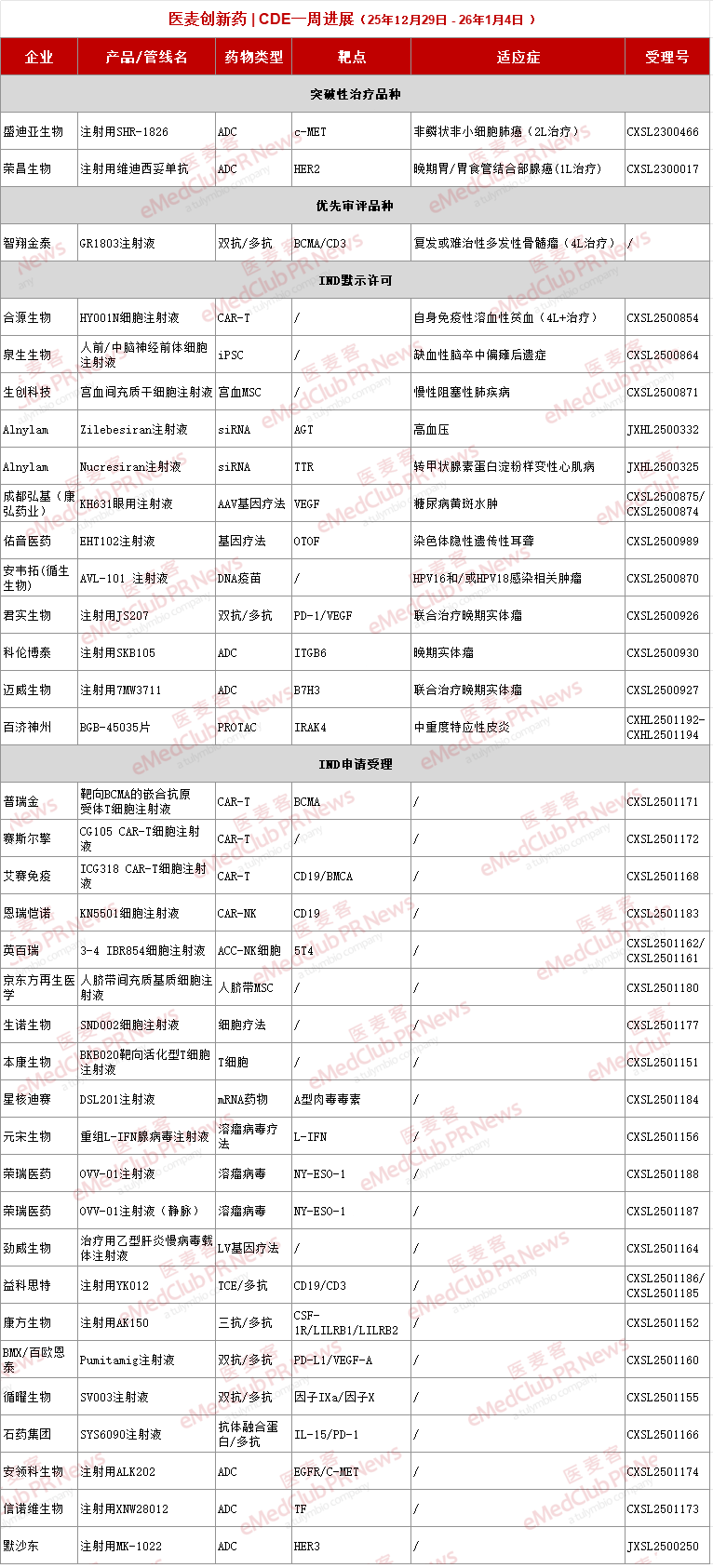
The following will introduce representative Class 1 innovative drugs approved for clinical trials.
Juventas:
Rapid Preparation Innovation Technology Platform CAR-T
Juventas' HY001N Cell Injection Approved for Clinical Trial, Intended Indication for Autoimmune Hemolytic Anemia Failed by At Least 3 Lines of Treatment(AIHA)It is the first product developed on the company's innovative rapid preparation NexT technology platform.
Compared with the traditional autologous CAR-T technology platform process, the rapid preparation NexT process technology reduces the expansion and culture operation steps of CAR-T cells in vitro, shortening the production time of CAR-T cells in the workshop from 9-14 days to within 2 days, and reducing the waiting time for patients.50%,Up to 10 days, the production cost is significantly reduced based on the existing preparation technology. Meanwhile, the proportion of T naïve cells in the rapid preparation of the final CAR-T product is significantly increased, laying the foundation for its efficacy and safety.
cStem:
iPSC Therapy
cStem Human Forebrain/Midbrain Neural Precursor Cell Injection(ACT121)Approved for clinical trials, intended for the development of treatment for hemiplegia sequelae after ischemic stroke. It is an allogeneic neural precursor cell product derived from iPSC differentiation, independently developed by the company, for use in cell replacement therapy for stroke and traumatic brain injury.
Based on the completed non-clinical study results of the product, after ACT121 cells are transplanted into the brain through stereotactic injection, they can differentiate into neurons and astrocytes, and secrete vascular endothelial growth factor.(VEGF)Through other pathways, repair infarct damage and improve functional outcomes in stroke animal models.
Alnylam:
AGT-targeting siRNA/TTR-targeting siRNA
Alnylam's Two Class 1 New Drugs, Nucresiran Injection and Zilebesiran Injection, Approved for Clinical Trials to Treat Patients with Transthyretin Amyloid Cardiomyopathy and Adult Hypertension Patients with Cardiovascular Disease or High Cardiovascular Risk, Respectively.
Nucresiran is a TTR-targeted siRNA therapy developed through Alnylam's proprietary IKARIA platform, designed to rapidly reduce mutant and wild-type transthyretin protein.(TTR)The level, fundamentally treating transthyretin(ATTR)Patients with amyloidosis. Studies have shown that the product has the potential to achieve deeper and more sustained rapid reduction of TTR.Subcutaneous injection once every six months or once a yearThe potential.
Zilebesiran is a product of Alnylam and Roche.(Roche)The jointly developed siRNA therapy targeting AGT inhibits the expression of angiotensinogen in the liver through subcutaneous injection and requires onlyOnce every six months, continuous blood pressure reduction can be achieved, with the potential to lower the risk of major cardiovascular events.
Kanghong Pharmaceutical:
AAV Gene Therapy
KH631 Ophthalmic Injection, Submitted by Kanghong Pharmaceutical Subsidiary, Approved for Clinical Trials to Develop Treatment for Diabetic Macular Edema(DME). The drug has previously been approved for use in China to treat neovascular age-related macular degeneration.(nAMD)Clinical trials, becomingThe first gene therapy candidate product for nAMD to enter the clinical stage in China。

KH631 adopts a proprietary AAV delivery system with characteristics such as tissue specificity, immunogenicity, controllable expression, and infection efficiency, and has demonstrated sustained efficacy in preclinical disease models.
In June 2025, Professor Yu Honghua from the Ophthalmology Department of Guangdong Provincial People's Hospital successfully completed the first subretinal injection surgery of KH631 ophthalmic injection, a gene therapy drug, in South China. The patient's best-corrected visual acuity before the surgery was 50 letters.Increased to 75 letters at 3 weeks post-operation, The lesion in the macular area remains free of edema.
Kelun Biotech:
ITGB6-Targeted ADC
Kelun Biotech's Injectable SKB105 Approved for Clinical Trials, Intended for Development to Treat Advanced Solid Tumors. In December 2025, Kelun Biotech partnered with Crescent Biopharma to jointly develop and commercialize oncology treatments, including this SKB105.
SKB105 is a differentiated ADC targeting ITGB6, with a topoisomerase I inhibitor as its payload. It consists of a fully human IgG1 monoclonal antibody targeting ITGB6 conjugated to a stable and clinically validated cleavable linker, utilizing Kthiol irreversible conjugation technology. This design aims to enhance drug stability and tumor-specific payload delivery while reducing adverse effects.ITGB6 is highly expressed in a variety of solid tumors but is lowly expressed or not expressed in most normal tissues, thus having the potential to reduce systemic toxicity and off-target risks.
For more IND progress of new drugs, please refer to the table.

Exciting Events
Press and hold to scan the QR code to participate immediately ↓
Recommendation 1
January 9th, 13:30-17:00
In Vivo Cell Gene Therapy: From Technological Breakthrough to Industrial Transformation
Recommendation 2
Year-End Stock-Up Festival, Buy More Save More!

DianDian "Share”、“Like" and "In View”
Give me a little recharge~