

Three Cell Therapy Companies Raise Over $300M in a Week: Solid Tumors, Allogeneic, and In Vivo Emerge as Key Trends

Oricell Therapeutics
Developer of Tumor Immunocyte Products
January 14, 2026
eMedClub News
QrigincellTherapeutics
Qrigincell Therapeutics Announces Completion of$70 million in Series C1 financing, The funds raised will accelerate Qrigincell Therapeutics' internationalization and clinical development process, strengthen its technical capabilities in the field of cell therapy, and enhance the value of its industrialization pipeline.
Avoiding the crowded R&D "red ocean" of targets such as CD19 and BCMA, Qrigincell Therapeutics focuses on the clinical pain points of solid tumor treatment and has chosen...GPC3、GPRC5D... and other differentiated targets. Its key pipeline, Ori-C101, is a GPC3 CAR-T therapy targeting GPC3-positive hepatocellular carcinoma.(HCC), has completed Phase I investigator-initiated clinical research and Phase I registered clinical trials, preliminarily demonstrating good safety and efficacy, and is about to launch pivotal Phase II clinical trials. According to official disclosures, the candidate pipelineExpected to become the world's first approvedCAR-T drug for hepatocellular carcinoma.
In addition, to address the common pain point of antigen escape leading to recurrence in single-target CAR-T therapy, Qrigincell Therapeutics has also developed a dual-target CAR-T.OriC613 is a Claudin 18.2/MSLN autologous CAR-T, featuring an "AND" logic gate design., which can enhance tumor-targeting cytotoxic activity while reducing non-tumor-targeting toxicity, thereby improving clinical safety. The candidate pipeline has already been approved for IND.
In March 2025, Qrigincell Therapeutics announced preclinical study data of the GPRC5D/BCMA dual-target CAR-T, demonstrating the candidate product's breakthrough potential in R/R MM, with the ability to overcome antigen escape and the tumor microenvironment.(TME)Key therapeutic barriers such as tolerance and antigen expression heterogeneity.
Orca Bio
Orca Bio Announces Completion of Series F Financing Led by Lightspeed Venture Partners, Securing $250 Million in New Equity Capital to Support Commercialization Efforts
ItsAllogeneic Cell Therapy Orca-T, composed of highly purified Tregs, conventional T cells, and peripheral blood CD34+ stem cells from related or unrelated matched donors, among other cell types. In October 2025, the FDA has accepted Orca-T for the treatment of hematologic malignancies.(Including AML, ALL, MDS)The BLA and granted Priority Review status,PDUFA Target Action Date Set for April 6, 2026。
The results of its pivotal Phase 3 study showed:At one year, the Orca-T group had no moderate to severe chronic graft-versus-host disease.(cGvHD)The survival rate was 78%, and the overall survival rate was 94%., while the alloHSCT group reached 38% and 83%, respectively. Additionally, Orca-T is manufactured at Orca Bio's centralized GMP facility and can be infused within 72 hours.
STRM.BIO
STRM.BIO recently announced the completion of an $8 million Series B seed funding round, bringing the total seed funding to $16.4 million.
The core technology of STRM.BIO lies in its non-viral, cell-derived delivery platform——Megakaryocyte-derived vesicles(MV)Gene Delivery Platform, This platform is capable of precisely, efficiently, and safely delivering complex genetic payloads directly to bone marrow tissue, while also having the potential for on-demand repeated dosing, overcoming the limitations of viral vectors and synthetic delivery systems. Reportedly, STRM.BIO is applying this technology to develop in vivo CAR-T. The funds raised will be used to achieve key milestones for platform validation, advancing the company’s pipeline toward clinical trials.
Product Trial
PorciGel® MatrixIt is an acid-soluble porcine-derived Type I collagen solution, suitable for traditional two-dimensional(2D)Culture system, and a three-dimensional system for simulating cell growth in fibroblasts and chondrocytes(3D)Gel Scaffold.
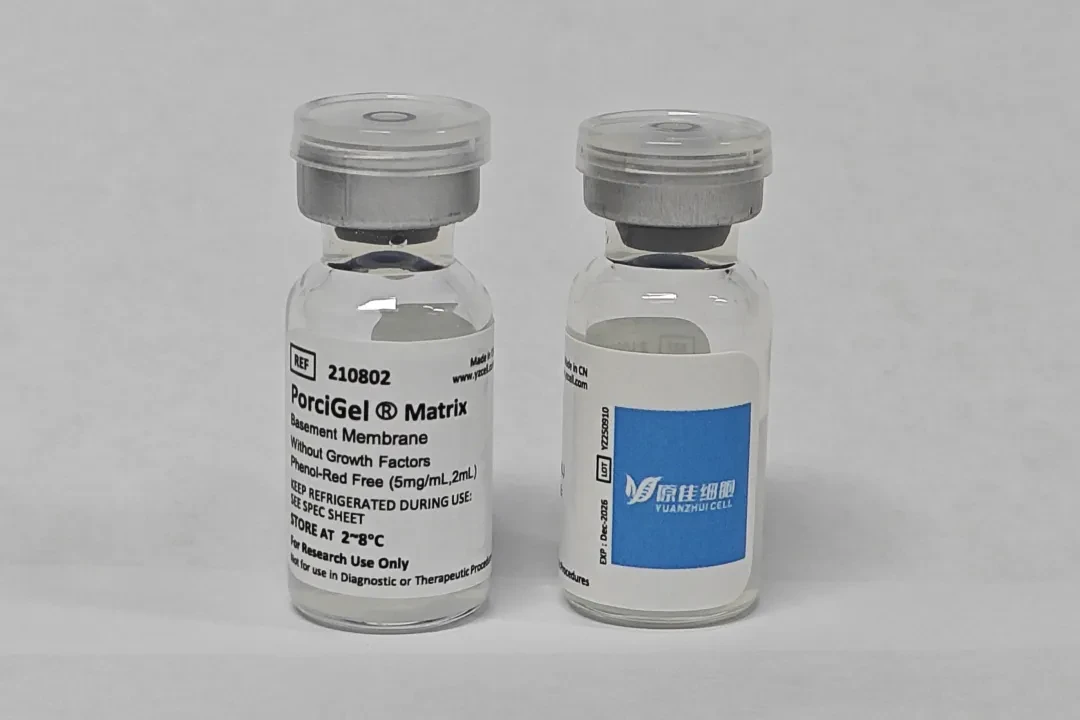

PorciGel® Matrix
Porcine-derived Type I Collagen Solution
Trial Pack - 2mL
Event Time: January
Another product: Human Liver Spheroid, 96 human liver organoids(Spheroids)/Apply for a trial of the 96-well plate, or scan the code to leave your information for access.
Overall, Qrigincell Therapeutics targets the unmet clinical needs of solid tumors with innovative designs such as differentiated and dual-targeting approaches, breaking away from homogeneous competition. Solid tumors represent a key focus for CAR-T cell therapy following its success in hematologic malignancies, and the approval of new products is expected to mark a milestone in this field.
Orca Bio focuses on allogeneic cell therapy, and with its precise control of multi-cellular components and standardized production system, it is expected to validate the feasibility of scaling up; STRM.BIO, on the other hand, delves into the innovation and upgrading of underlying delivery technologies. While viral vectors remain mainstream for now, its cell-derived delivery vehicles can be used not only for developing the next generation of in vivo CAR-T but also highlight"Innovation in Delivery Technology Drives Therapy Upgrade"The underlying logic of industry development.
An Overview of the Three Major Development Directions
These three companies represent a microcosm of the three core development directions in the cell therapy sector—expansion of indications, off-the-shelf solutions, and in vivo applications. These are also the tracks where industry resources are currently concentrated, each forming its own unique development landscape.
In terms of solid tumor immunotherapy, according to incomplete statistics,More than 70 companies in China have already made strategic investments, with at least 43 companies and over 60 pipelines having entered the clinical stage., mainly CAR-T, also including popular TIL, TCR-T, CAR-NK, etc. Among the CAR-T pipelines that have entered the clinical stage, most are in Phase 1 clinical trials.
From the perspective of the layout of universal CAR-T, a rough statisticThe number of universal CAR-T companies in China exceeds 10., which is still in the early exploration and preclinical/early clinical stage,The technical pathway mainly involves iPSC-derived sources or modifications using gene editing technology.In terms of target selection, CD19 and BCMA remain the absolute mainstream, with indications focused on hematological malignancies such as relapsed/refractory B-cell non-Hodgkin lymphoma, multiple myeloma, and acute B lymphoblastic leukemia.
In the emerging track of in vivo CAR-T,The number of companies with a presence in China exceeds 10., and the overall development is at a critical stage transitioning from preclinical exploration to early clinical trials.Delivery technology pathways exhibit distinct binary divergence characteristics., the core is divided into two major directions: viral vector delivery and non-viral vector delivery. Lentivirus is the mainstream for viral vectors, while LNP delivery of mRNA is the mainstream for non-viral vector routes.
In terms of target and indication layout, the targets still focus on mature ones such as CD19 and CLDN18.2. The indications have broken through the traditional hematological tumor scope, forming a dual-core layout of "hematological tumors + autoimmune diseases." Due to the current characteristic of short persistence of CAR-T in the body, this becomes one of the safety advantages when applied to treat autoimmune diseases. Several companies have already made breakthroughs in the field of autoimmune diseases.
In the future, with the diversified development of the cell therapy track, the current pain points are expected to be addressed one by one. Breakthrough progress by companies, continuous investment from capital, and policy support are likely to form a virtuous cycle, enabling this field to reach new heights.
Editor-in-Chief | Xun
Proofread by Xun
References:
1. Official website of the company and public information

DianDian "Share”、“Like" and "In Progress”
Give me a little charge~