

100% Disease Control Rate Achieved: First Preconditioning-Free, Off-the-Shelf CAR-NK Therapy Shows Breakthrough Potential, Paving the Way for Outpatient CAR-T/NK Delivery

ImmunityBio
Developer of Immunotherapy Products

January 23, 2026
eMedClub News
Recently, ImmunityBio announced the latest efficacy and safety data from a clinical trial of QUILT-106, which aims to evaluate aAllogeneic CD19 CAR-NK Therapy Combined with RituximabEfficacy and Safety of Treating Waldenström's Macroglobulinemia.

The company's CD19 CAR-NK is equipped with a high-affinity CD16 receptor.(i.e., FcγRIIIa 158V), withDual Antitumor Mechanism: On the one hand, it directly kills tumor cells through CAR-mediated cytotoxicity; on the other hand, when used in combination with the anti-CD20 antibody rituximab, it can enhance antibody-dependent cell-mediated cytotoxicity. Therefore, when the two are used together,Can achieve targeted killing of CD19/CD20 lymphoma cells, thereby enhancing the efficiency of tumor cell clearance.
Data show that four patients have been enrolled.Achieve 100% Disease Control Rate(DCR)Among them, 2 patients are currently undergoing long-term follow-up evaluation.Remained in complete remission at 7 months and 15 months after the end of treatment, respectively.(CR), without the need for further treatment. These two patients had relatively severe conditions at baseline, with one patient having approximately 95% bone marrow involvement and the other having multiple lymphoma bone lesions; however, both achieved remission after only four doses of treatment.
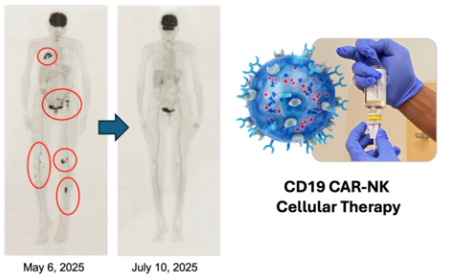
Notably, according to a press release from ImmunityBio,This is the first CAR-NK cell therapy that requires no chemotherapy and no lymphocyte depletion preconditioning., and ImmunityBio also has an already approved IL-15 superagonist, Anktiva, which can effectively stimulate and expand NK cells, forming a synergistic advantage with the CD19 CAR-NK pipeline.
Patrick Soon-Shiong, Founder, Executive Chairman, and Global Chief Medical and Scientific Officer of ImmunityBio, stated: "This updated follow-up further validates that restoring and activating the immune system can achieve durable disease control without the use of chemotherapy or lymphodepletion. The fact that patients, who have exhausted available treatment options, can experience sustained complete remission for up to a year after discontinuing treatment represents a meaningful advancement for individuals with the rare Waldenström macroglobulinemia and underscores the potential of CAR-NK as a next-generation immunotherapy platform."
Outpatient Cell Therapy
The results of ImmunityBio's QUILT-106 trial not only offer a potential treatment for patients with relapsed or refractory Waldenström's macroglobulinemia, but also, with the groundbreaking feature of "no chemotherapy, no lymphodepletion pretreatment," disrupt the traditional treatment paradigm of cell therapy.Promoting the Shift of Cell Therapy Towards an "Outpatient-Accessible" Model。Currently, this is also a major trend in the development of cell therapy, and several companies have already explored it.
CAR-NK/NK
Artiva Biotherapeutics has developed a cord blood-derived, allogeneic, cryopreserved, non-GMO, ADCC-enhanced NK cell therapeutic candidate, AB-101.(AlloNK), can be used in combination with monoclonal antibodies or innate cell engagers in outpatient settings for the treatment of autoimmune diseases.
This candidate pipeline was approved by the FDA for clinical trials as early as 2023, and isAllogeneic NK Cell Therapy Used for the First Time in Treating Autoimmune DiseasesCurrently, it is undergoing a Phase II basket trial, covering patients with rheumatoid arthritis, Sjögren's syndrome, idiopathic inflammatory myopathy, and systemic sclerosis.
At the 28th Annual Meeting of ASGCT in 2025, Artiva presented Phase 1/2 clinical study data on AB-101 in combination with rituximab for relapsed/refractory B-cell non-Hodgkin lymphoma:Among the 14 patients who had not previously received CAR-T therapy, the CR rate reached 64%.As of the data cutoff date of March 7, 2025, the duration of response was at least 19.4 months, with most treated patients maintaining a complete response.
The CEO of Artiva once stated,This is one of the most active and durable data sets in current allogeneic cell therapies for heavily pretreated aggressive B-cell NHL patients., with efficacy comparable to the already approved partial autologous CAR-T cell therapy. It is reported that in the first half of this year, Artiva plans to release preliminary clinical response data for more than 15 patients with refractory rheumatoid arthritis.
CAR-T
Compared with outpatient CAR-NK/NK, CAR-T has become one of the core battlegrounds in the competition for outpatient cellular therapies, based on technological accumulation and iteration.Outpatient CAR-NK/NK exploration focuses more on the allogeneic universal technology pathway, with safety breakthroughs as the core focus, while outpatient CAR-T research and development shows a characteristic of diversified technical routes.——There are directions to optimize CAR-T through gene editing, reduce immunogenicity and side effects to fit outpatient scenarios, as well as disruptive technologies represented by in vivo CAR-T, achieving intravenous infusion administration similar to conventional drugs in an outpatient setting.
The marketed CAR-T cell therapies are already exploring the feasibility of outpatient administration., such as Yescarta, Tecartus, Kymriah, etc. In 2025, an article titled "Feasibility of axicabtagene ciloleucel in the outpatient setting: primary analysis of prospective trial" reported a single-center, non-randomized, open-label, prospective clinical trial.(NCT05108805), evaluated the use of wearable devices and telemedicine in outpatient treatment with Yescarta for relapsed/refractory diffuse large B-cell lymphoma.(R/R DLBCL)Feasibility and safety.
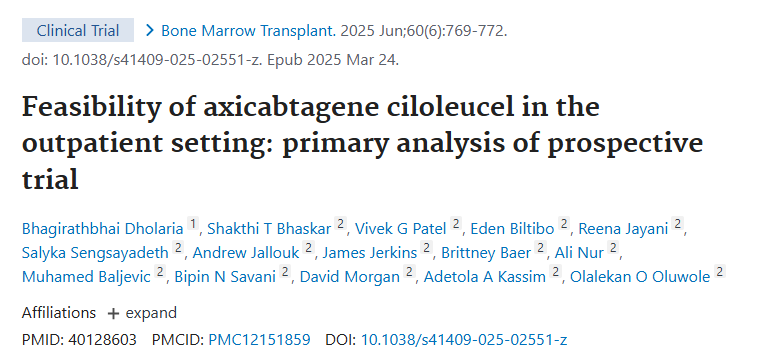
From November 2021 to October 2023, this study enrolled 25 patients, with 20 patients actually receiving treatment, and the median follow-up time was 374 days. In the study, patients' lymphocyte-depleting chemotherapy and CAR-T infusion were completed in the outpatient setting. A total of 19 patients were hospitalized due to CRS.(Median hospital stay 5.5 days, historical hospital stay data 15 days),1-Year Progression-Free Survival Rate(PFS)And Overall Survival(OS)68% and 74%, respectivelyStudies show that outpatient Yescarta administration is feasible and safety is manageable, significantly reducing the burden of hospitalization.
In the research therapy, Immix Biopharma'sNXC-201 is a BCMA-targeted CAR-T therapy intended for the treatment of AL amyloidosis.Its CAR structure has been optimized, enabling NXC-201 to feature high transduction efficiency, high persistence, and low off-target effects. It can achieve better outcomes at a lower dose, reducing dose-related toxicity. Additionally, the persistence of this candidate has been enhanced, allowing it to function effectively in the body for an extended period and minimizing cell exhaustion. These characteristics also support its use in outpatient settings.
In December 2025, Immix Biopharma announced the results of the Phase II clinical trial of NXC-201 for the treatment of relapsed/refractory light chain amyloidosis:15 of 20 patients achieved complete remission(CR is 75%)Among the 5 patients with pending efficacy evaluation, 4 tested negative for minimal residual disease in the bone marrow., this indicator suggests that it is expected to subsequently achieve complete remission, potentially increasing the long-term complete remission rate of this therapy to 95%. According to reports,The company plans to submit a BLA this year.。
In addition, MB-106 from Mustang Bio is a fully human, third-generation, CD20-targeted CAR-T cell therapy containing 4-1BB and CD28 co-stimulatory domains, with a modified IgG1 spacer that eliminates FcR binding, supporting administration in an outpatient setting. Previously released data from Mustang Bio showed that MB-106 was effective in treating Waldenström's macroglobulinemia.(WM)The ORR of the patients was as high as 90%, with one patient achieving a durable complete response for 31 months.
Summary
In the past, traditional cell therapy required hospitalization for close monitoring and management of severe side effects such as CRS and ICANS, which not only increased the financial burden on patients but also led to a decline in their quality of life. However, the development of outpatient cell therapy, whether it is CAR-NK that does not require chemotherapy preconditioning, CAR-T with reduced toxicity through structural optimization, or the exploration of marketed CAR-T outpatient treatment relying on remote monitoring technology for risk management, is breaking through this dilemma from both technological innovation and model creativity.
In the future, cell therapy will present a trend of "technology diversification, scenario generalization, and dual improvement in efficacy and safety," while also having the potential to reconstruct the clinical service model of cell therapy.
Editorial Responsibility | Xun
Proofread by Xun
References:
1. Official website of the company and publicly available information

Wonderful Events
Press and hold to scan the QR code and participate immediately ↓


Dian Dian "Share”、“Like" and "In View”
Give me a little recharge~