

46% YoY Growth: Nearly 20 Chinese Gene Therapy Companies Secure Funding in 2025 Amid Industry’s Shift Toward Value Realization

Epigenic
Gene Editing Technology Developer
YolTech Therapeutics
mRNA Drug and Gene Editing Drug Developer
StarryGene
Gene Therapy Drug Developer

Jinweike Biotechnology
AAV Gene Therapy New Drug Developer

CHIGENOVO
Clinical Genetic Diagnosis, Prevention, and Gene Therapy Drug Development for Hereditary Eye Diseases

January 26, 2026
eMedClub News
2025 is the year of ChinaCHIGENOVOA Key Turning Point in the Gene Therapy Industry: The First AAV Gene Therapy Completes Commercialization Loop, Shifting the Industry from Technical Validation to Innovation"Value Realization"。
This transformation is epitomized through two major pathways: capital securitization and technology export. Fangtuo Bio, as China's first AAV gene therapy platform company, is advancing towards a Hong Kong stock listing. Its product portfolio, which covers multiple ophthalmic indications, demonstrates systematic development capabilities. Meanwhile, Starlight Therapeutics has licensed out its optogenetic therapy UGX202 for a potential consideration of up to $413 million, marking that China’s original innovations have gained international market recognition and valuation.
These breakthroughs are driven by a triple force of capital, technology, and clinical progress: funding fuels R&D, advancements in AAV, non-viral vectors, gene editing, and other technological pathways broaden treatment boundaries, while late-stage clinical pipelines provide an empirical basis for value realization. Therefore, an in-depth analysis of the 2025 financing dynamics serves as a key entry point to understand the evolution logic of this industry cycle and predict future trends.
1. Overall warming up,
HeadBiotech Secured Large-Scale Financing
According to incomplete statistics, the gene therapy field in China in 2025(Excluding small nucleic acids, immunocyte therapy, stem cells, oncolytic therapy)Biotech public financing events totaled approximately 19, compared to over 13 reported by Yima Passenger in 2024.Significant Growth(Approximately 46%), indicating a resurgence in track popularity(If there are any errors or omissions, please feel free to add.)。
Swipe up to view
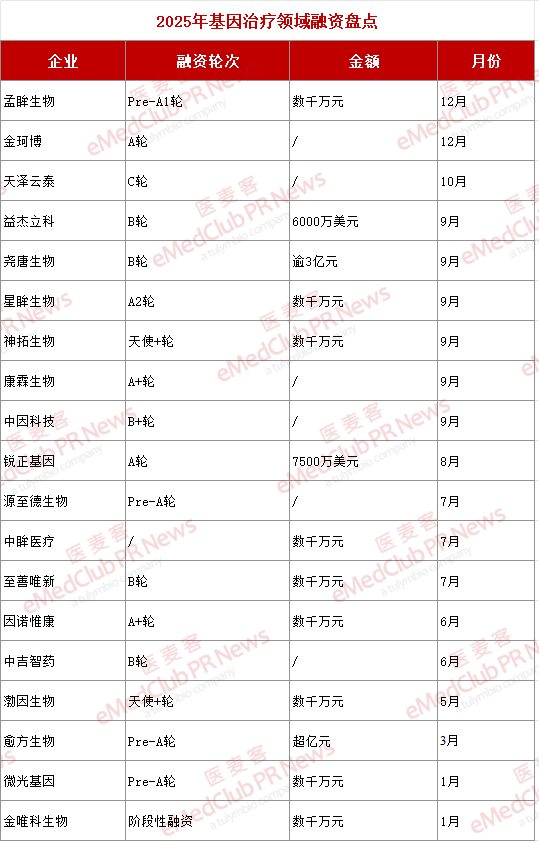
In terms of financing scale, despite the number of disclosed financing events reaching hundreds of millions throughout the year(4 cases)Compared with 2024(5 cases)Remained basically flat, but the amount of a single round of financing has increased significantly. Epigenic($60 million)、RuiZheng Gene($75 million, approximately 540 million yuan)YolTech Therapeutics(Over 300 million yuan)Leading companies have secured substantial financing, with the highest amount raised in 2024 reaching hundreds of millions of yuan, while the rest are all below 200 million yuan, directly reflecting the market recovery.
Financing Round: Early to Mid-Stage(Angel Round - Series A)FinancingEvent(12 cases), accounting forCompared toOver 60%, reflecting capital's keen attention to disruptive early-stage innovation; meanwhile, Series B and later-stage matureEnterprises have attracted the vast majority of huge funds this year. This pattern of "casting a wide net early and placing heavy bets later" signifies that the investment logic of capital has matured — while laying out investments in cutting-edge technology imagination, it is also more pragmatic.Enterprises with clear progress in on-site re-injection pipelines and preliminary platform validation.
2. AAV Dominance,
The Rise of Non-Viral Vectors
In terms of vector layout, AAV vectors remain the core focus of capital. Companies such as StarryGene, Jinweike Biotechnology, and CHIGENOVO are deeply engaged in ophthalmic gene therapy, aligning with the global AAV vector trend of "moving beyond the liver to target specific organs." Moreover, the ability of these vectors to precisely penetrate the retinal barrier and achieve long-term expression makes them the preferred choice for ophthalmic gene therapy.
Non-viral vector technology has become a new highlight in the financing market in 2025. Companies such as RuiZheng Gene and YolTech Therapeutics, which are focused on LNP delivery technology, have secured large-scale financings exceeding 100 million yuan. Compared with AAV vectors, LNP non-viral vectors offer advantages such as lower cost, larger capacity, and no risk of immunogenicity. These features not only help overcome the industrialization bottlenecks of AAV vectors but also hold the potential to break the application limitations of liver targeting.
3. General-purpose gene therapy
Breaking Through with Editing Technology
Technology investments in 2025 clearly point to two major goals: first, solving the commercialization challenges of rare diseases through "universal" design; second, challenging common diseases with large patient populations, such as hepatitis B and hyperlipidemia, through more precise and long-lasting editing and regulation technologies, opening up entirely new market growth opportunities for the industry.
On the one hand, "universal" strategies represented by optogenetics have become a highlight.
StarryGene successfully authorized its technology for overseas use, with therapies that do not rely on specific gene mutations. A single drug can cover various degenerative retinal diseases such as retinitis pigmentosa and dry age-related macular degeneration. This is expected to fundamentally solve the R&D challenges caused by the dispersion of patient mutations, significantly reducing development costs and commercialization risks. CHIGENOVO is also deeply engaged in this field.
Yuanzhider Bio targets familial Alzheimer's disease to develop a "one-to-many" gene-editing therapy, usingOne set of editing tools can cover different pathogenic mutations of the same gene., reflecting a similar platform-based design approach.
On the other hand, the indications for gene editing and epigenetic regulation technologies are expanding to include common diseases.
Epigenic is committed to developing a new generation of epigenetic regulation technology for the treatment of chronic diseases. The combination of its EPIREG™ technology platform and EpiTax™ delivery platform not only effectively avoids potential safety concerns associated with traditional gene editing but also holds promise for precise delivery to the liver and multiple extrahepatic target organs.
Currently, its core pipeline epigenetic innovative drug EPI-003 has received dual approval from China and the United States for the treatment of chronic hepatitis B, and has already demonstrated the potential for functional cure in preclinical studies.
RapidGen and YolTech Therapeutics Focus on LNP Delivery for In Vivo Gene Editing Drug Development, Targeting Rare and Common Diseases. RapidGen’s LNP-based in vivo gene editing product ART001 is aimed at treating transthyretin amyloidosis.(ATTR), has entered Phase II clinical trials,The efficacy can be stably maintained for up to 2 years., verifying the feasibility of "one-time cure";
It targets heterozygous familial hypercholesterolemia.(HeFH)Pipeline ART002 to Become Available in 2025The world's first to achieve therapeutic saturation in the human body, and effectively reduce LDL-C in patients with ultra-high baseline levels. Relevant subject data has been observed for up to 48 weeks.
YolTech Therapeutics has four in vivo gene editing drug pipelines that have entered the clinical stage, covering ATTR, HeFH, and primary hyperoxaluria.(PH1)and Thalassemia(β-Thalassemia)/Sickle Cell Anemia(SCD)And other major rare and common disease indications.
4. Ophthalmology Cluster, Extending to Chronic Diseases
The layout of indications presents the characteristics of "focusing on advantageous tracks and expanding the boundaries of indications."
Ophthalmic gene therapy, with clear indications, a large patient base, and relatively controllable delivery challenges, has become a hotspot for capital investment. Companies such as Mengmou Biotechnology, StarryGene, Jinweike Biotechnology, and CHIGENOVO are all focusing on this field, covering various blinding diseases like retinitis pigmentosa and macular degeneration, echoing the global trend of AAV vector ocular targeting applications.
Notably, the boundaries of indications are gradually expanding. Epigenic Therapeutics is applying epigenetic regulation technology to the treatment of chronic hepatitis B and hypercholesterolemia. YolTech Therapeutics and Rui Zheng Gene are developing LNP-based in vivo gene editing therapies for significant rare diseases and common indications. Meanwhile, Yu Fang Bio is leveraging its proprietary telomere precision regulation platform to develop gene therapy drugs, focusing on major disease areas such as cardiovascular, neurological, and renal conditions, opening new avenues for commercial growth.
Conclusion
From racing to become the "first AAV gene therapy stock," the successful overseas expansion of optogenetic therapy, to nearly 20 Biotech financings throughout the year, China's gene therapy industry in 2025 clearly outlines an evolutionary path from "technological breakthrough" to "value output."
However, the road from "value expectation" to "scaled value realization" remains full of challenges.The Final Clinical Triumph of Technology、Sustainable Payment Solutions for Million-Dollar Therapies, as well asCost Control in Large-Scale Production, will be the core proposition that determines whether this industrial leap can ultimately complete the commercial closed loop and truly benefit a wide range of patients.
Editor-in-Chief: Ju
Proofread by Ju
References:
1. Official Materials of Each Company

Exciting Events
Press and hold to scan the QR code to participate immediately ↓

DianDian "Share”、“Like" and "In Progress”
Give me a little charge~