ImmunityBio's Chemotherapy-Free, Off-the-Shelf CAR-NK Therapy Achieves 100% Disease Control Rate in Outpatient Setting; Pioneering Chemical Reprogramming of Human T Cells to Pluripotent Stem Cells by Peking University’s Deng Hongkui Team

ImmunityBio
Developer of Immunotherapy Products
Industry Trends
Potential First-in-Class! Novartis' Targeted New Drug for Chronic Autoimmune Diseases Granted FDA Breakthrough Therapy Designation, Launch Imminent
Sjögren's SyndromeIt is a chronic autoimmune disease in which the patient's immune system mistakenly attacks moisture-secreting glands. This can lead not only to extreme dry mouth and dry eyes but also potentially affect organs such as the lungs and kidneys. For a long time, there has been a lack of targeted drugs that can precisely address the root cause in this disease area.
On January 16, 2026, Novartis announced its investigational new drugIanalumabHas received FDA Breakthrough Therapy Designation. Based on positive data from two Phase 3 clinical trials, the drug has shown excellent performance in improving the condition and safety.Novartis Plans to Initiate Global Market Application in Early 2026, is expected to become the first targeted solution to change the treatment landscape of the disease.
Ianalumab is a fully human monoclonal antibody that canPrecisely Block BAFF Receptor (BAFF-R),While effectively clearing pathogenic B cells, inhibit their activation and survivalThis "two-pronged" unique mechanism provides strong technical support for reshaping the immune balance of patients.

Image Source:Novartis
No Chemotherapy Needed, Can Be Completed Outpatient! Positive Results of Off-the-Shelf CAR-NK Therapy Announced, Achieving 100% Disease Control Rate in Initial Patients
Waldenström Macroglobulinemia(Waldenström's macroglobulinemia) is a rare and slowly progressingB-cell LymphomaDue to the excessive proliferation of malignant cells in the bone marrow and the production of a large amount of monoclonal IgM protein, blood viscosity increases, leading to vision damage, neuropathy, and organ dysfunction.
On January 16, 2026, ImmunityBio announced the latest outstanding results of the QUILT-106 study:Its CAR-NK therapy CD19 t-haNK, in combination with rituximab for the treatment of this rare lymphoma, achieved a 100% disease control rate in the first four patients.The most exciting part is that this treatment plan does not require traditional chemotherapy preconditioning, and patients can complete the treatment in an outpatient setting. Several participants have achieved long-term complete remission.
CD19 t-haNK is an off-the-shelf allogeneic CAR-NK cell therapy. It has been engineered to precisely express high-affinity receptors targeting CD19, acting like a cruise missile to eliminate malignant B cells. Compared with traditional CAR-T therapy, itNo need to extract the patient's own cells, higher safety, and ready-to-use.。

Image Source:ImmunityBio
Risk of recurrence reduced by half! Moderna's personalized mRNA cancer vaccine shows impressive five-year data
MelanomaIt is the most fatal type of skin cancer. Even after radical surgery, patients at high risk in stages III/IV still face extremely high risks of recurrence and death. Although traditional single-agent immunotherapy has shown some efficacy, a large number of patients are still unable to achieve long-term survival, urgently requiring more precise methods to reinforce the immune defense.
On January 20, 2026, Moderna and Merck announced the five-year median follow-up data from the Phase 2b study: for post-surgical patients with high-risk melanoma,mRNA Cancer Vaccine Intismeran Autogene Combined with Keytruda Therapy Shows Excellent Performance. Compared with Keytruda alone, this combination willThe risk of recurrence or death for patients was significantly reduced by 49%.At present, the vaccine has launched 8 clinical studies in multiple cancer types, including melanoma, lung cancer, and bladder cancer.
Intismeran Autogene is a personalized neoantigen therapy. It analyzes the unique DNA mutations of each patient's tumor through an algorithm.Up to 34 specific neoantigens encoded into a single mRNA moleculeAfter being injected into the body, it can train T cells to precisely identify and attack residual cancer cells carrying these markers, like a "wanted poster," achieving truly personalized precision cancer treatment.

Image Source:MSD, Moderna
Discussion Express
Promising to Disrupt Current Cancer Treatment Models! Deng Hongkui's Team at Peking University Achieves Chemical Reprogramming of Human T Cells into Pluripotent Stem Cells for the First Time
T cells are the anti-cancer special forces in the human body, but they are极易因疲劳而丧失战斗力 (i.e., become exhausted) in the prolonged battle against tumors. Currently, immunotherapy is facingHigh-quality T-cell sources are scarce, the production cycle is long, and the cells are extremely prone to aging.The bottleneck, which severely limits the patients' opportunities to receive timely treatment.
On January 16, 2026, the team of Academician Deng Hongkui of Peking University, et al.Cell Research Published an article titled:Efficient chemical reprogramming of human T cells to pluripotent stem cells Research paper.
Research Team Successfully Utilizes Chemical Small Molecules to Reprogram Mature Human T Cells into Pluripotent Stem Cells with Unlimited Expansion Potential, Transforming Them into Young, Potent, and Precise Cancer-Fighting Recruits. This TechnologyNo exogenous gene introduction required`, not only is it safer, but it can also be mass-produced industrially.`"Buy and Use Immediately"T cell product has the potential to completely颠覆现有的癌症治疗模式。
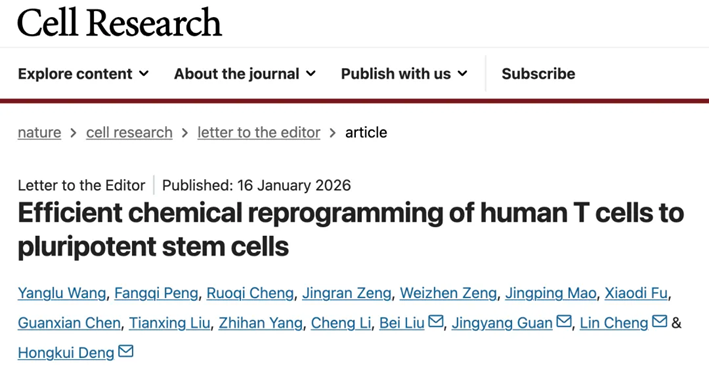
Image Source:Cell Research
Paper link:
https://doi.org/10.1038/s41422-025-01216-2
Delivery Efficiency Surges 15 Times! Tsinghua/Capital Medical University TeamCell Publication: Developing New Strategies for Transcranial Drug Delivery to Overcome the Blood-Brain Barrier Challenge
The brain has a natural blood-brain barrier that can block harmful substances from invading, but it also keeps out more than 98% of small-molecule drugs and almost all large-molecule drugs. For a long time, how to safely and efficiently deliver drugs across this formidable barrier into the affected area has been one of the most challenging problems in the field of neuroscience.
On January 16, 2026, a research team from Tsinghua University and Beijing Tiantan Hospital, Capital Medical University,Cell Co-published an article titled:Nanoparticles hijack calvarial immune cells for CNS drug delivery and stroke therapy Research paper.
The research team found that drug-loaded nanoparticles can "hijack" immune cells to travel along natural microchannels directly to the brain through transcranial injection. Experiments have shown,This method requires only 1/15 of the traditional intravenous dose to achieve superior neuroprotective effects.. The safety of this approach has been validated in an exploratory study involving 20 subjects, offering a new strategy to bypass the blood-brain barrier for diseases such as stroke.
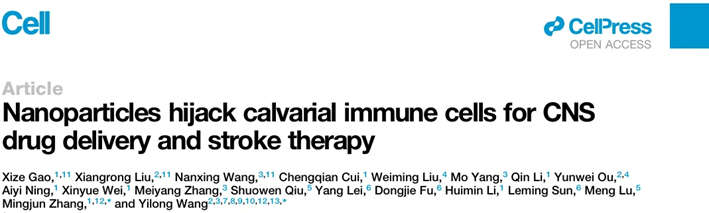
Image Source:Cell
Paper link:
https://doi.org/10.1016/j.cell.2025.12.008
Nature : Discovery of New Cancer Immunotherapy Target KLHL6 Empowers T Cells with Enhanced Anti-Cancer Endurance
In the protracted battle against tumors,T cellsOften driven to a state of "exhaustion" by overstimulation, not only does their combat effectiveness plummet, but their internal power plants——MitochondriaFailures can also occur. The complete collapse of this function is the core bottleneck leading to the setbacks of immunotherapies such as CAR-T in the face of solid tumors.
On January 14, 2026, a research team from the Chinese Academy of Medical Sciences and the Fred Hutchinson Cancer Research CenterNature Co-published an article titled:The Ubiquitin Ligase KLHL6 Drives Resistance to CD8+ T Cell Dysfunction Research paper.
The research team discovered through screening,The Ubiquitin Ligase KLHL6 Is Key to Reversing T-Cell Dysfunction. It works in two ways:By degrading the exhaustion factor TOX to prevent cells from "aging" and maintaining mitochondrial healthEnhancing KLHL6 expression can significantly improve the efficacy and durability of immunotherapy against cancer.
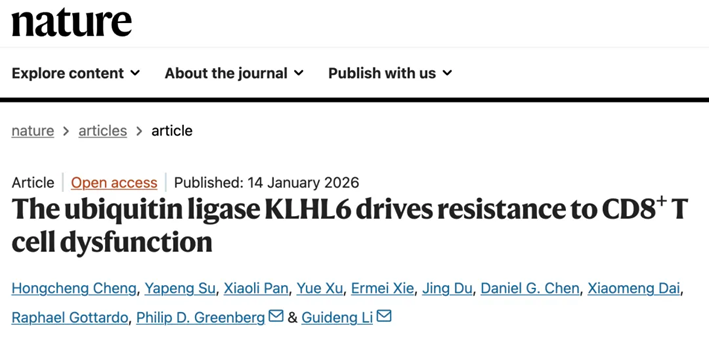
Image Source:Nature
Paper link:
https://doi.org/10.1038/s41586-025-09926-8
Cancer Cell :Peking University Team Discovers New Fibroblast Target ADAM12, Offering New Insights for Cancer Immunotherapy
In tumor tissues,FibroblastIt is a type of stromal cell with a very high proportion. Among them,MyofibroblastsChangshouTransforming Growth Factor-β (TGF-β)Driving the formation of a dense "protective shell" around the tumor, it not only directly promotes tumor growth but also hinders the entry of immune cells, serving as an important cause of resistance to immunotherapy.
On January 15, 2026, a research team from Peking University Cancer Cell Published an article titled:Single-cell screens identify ADAM12 as a fibroblast checkpoint impeding anti-tumor immunity Research Paper.
The research team discovered a key target in patient-derived fibroblasts through single-cell screening technology.ADAM12. Research confirms,Loss of ADAM12 suppresses the activation of pro-cancer fibroblasts and induces an anti-tumor interferon response, thereby revitalizing the cytotoxic capacity of T cells.. This discovery provides a strong basis for the development of novel immunotherapies targeting the tumor microenvironment.
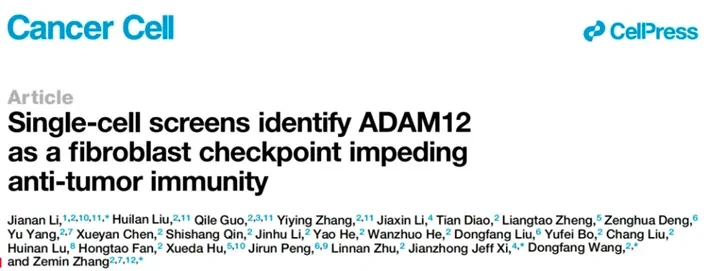
Image Source:Cancer Cell
Paper link:
https://doi.org/10.1016/j.ccell.2025.12.018
Science: For the first time, the initial origin of glioma has been pinpointed to be the latent cortical progenitor cells.
GliomaIs the most common malignant tumor in the skull, among whichPatients with IDH mutations typically develop the disease at an earlier age.For a long time, the medical community has been divided on what the first-generation origin cells are and where they hide in the brain. Since tumors are often large-scale when diagnosed, tracing their initial origin is like finding the first match after a forest fire.
On January 8, 2026, a research team from the Korea Advanced Institute of Science and Technology and Yonsei University College of MedicineScience Co-published an article titled:IDH-mutant gliomas arise from glial progenitor cells harboring the initial driver mutation Research paper.
The research team utilized technologies such as deep sequencing and spatial transcriptomics.First confirmed that IDH-mutant gliomas originate from oligodendrocyte precursor cells (OPCs) in the peritumoral cortex.. Data show,Approximately 40% of patients' normal peritumoral tissues already carry IDH point mutations.. This discovery completely clarifies the entire progression of tumors from "single mutation → clonal expansion → malignant transformation."
Image Source:Science
Paper link:
https://doi.org/10.1126/science.adt0559
References