


This article is a professional academic paper interpretation and does not provide medical advice.
Recently, Life Biosciences, a biotechnology company co-founded by Harvard University genetics professor David Sinclair, announced that the U.S. Food and Drug Administration (FDA) has approved its Phase I clinical trial, allowing human testing of a gene therapy designed to reverse cellular aging. This marks the first time that "partial epigenetic reprogramming" technology has been authorized to enter human trials, representing a milestone in the field of anti-aging research.
Days before the announcement, Elon Musk said at the Davos Forum that he believed aging was a "solvable problem," and when scientists uncover the root cause of aging, "it will be something obvious." Sinclair later responded on the X platform: "There is a relatively simple explanation for aging, and it is clearly reversible. Clinical trials will begin soon." Musk replied, "ER-100?" Sinclair briefly responded, "Yes."
ER-100 is the codename for the gene therapy that Life Biosciences is about to test. According to a statement released by the company on January 28, the FDA has approved its Investigational New Drug (IND) application, allowing the initiation of a Phase I clinical trial targeting two optic neuropathies—primary open-angle glaucoma and non-arteritic anterior ischemic optic neuropathy (NAION). The trial will first assess safety in approximately 12 patients while also observing whether the therapy can restore vision to some extent.
Why choose eye diseases as the breakthrough point? Life Biosciences CEO Jerry McLaughlin explained in an interview with Fortune magazine that the company is adopting a "phased strategy." Glaucoma is the second leading cause of blindness globally and, according to the U.S. Centers for Disease Control and Prevention, is particularly prevalent among adults aged 64 to 84.
NAION, known as "stroke of the eye," is the most common acute optic neuropathy in people over 50, with no currently approved treatments. More notably, NAION patients have a 20% to 30% chance of developing the same issue in the other eye within two to three years after onset. The severity of these conditions and the lack of treatment options make it easier for the FDA to approve related trials.
In terms of scientific principles, the core of ER-100 lies in "epigenetic reprogramming." This concept stems from the discovery by Shinya Yamanaka, the 2012 Nobel Prize winner in Physiology or Medicine and a Japanese scientist, who found that by introducing four specific transcription factors (later called "Yamanaka factors") into adult cells, they could be reprogrammed into a pluripotent state similar to embryonic stem cells.
These four factors are Oct4, Sox2, Klf4, and c-Myc. However, it is dangerous to directly use all four factors in living organisms because c-Myc is closely associated with tumor formation; in early experiments, mice that were simultaneously introduced with the four factors experienced high mortality and developed tumors.
Sinclair Lab's approach is to use only three of the factors (Oct4, Sox2, Klf4, abbreviated as OSK), eliminating c-Myc, which carries the highest risk of carcinogenesis. This "partial reprogramming" strategy aims to rejuvenate cells while preventing them from completely "forgetting" their identity and turning into primitive cells that could potentially become cancerous.
In 2020, the Sinclair team published a study in Nature, demonstrating that this technology could reverse vision loss in mice with glaucoma and even regenerate damaged optic nerves. This paper made the cover of Nature, titled "Turning Back Time."
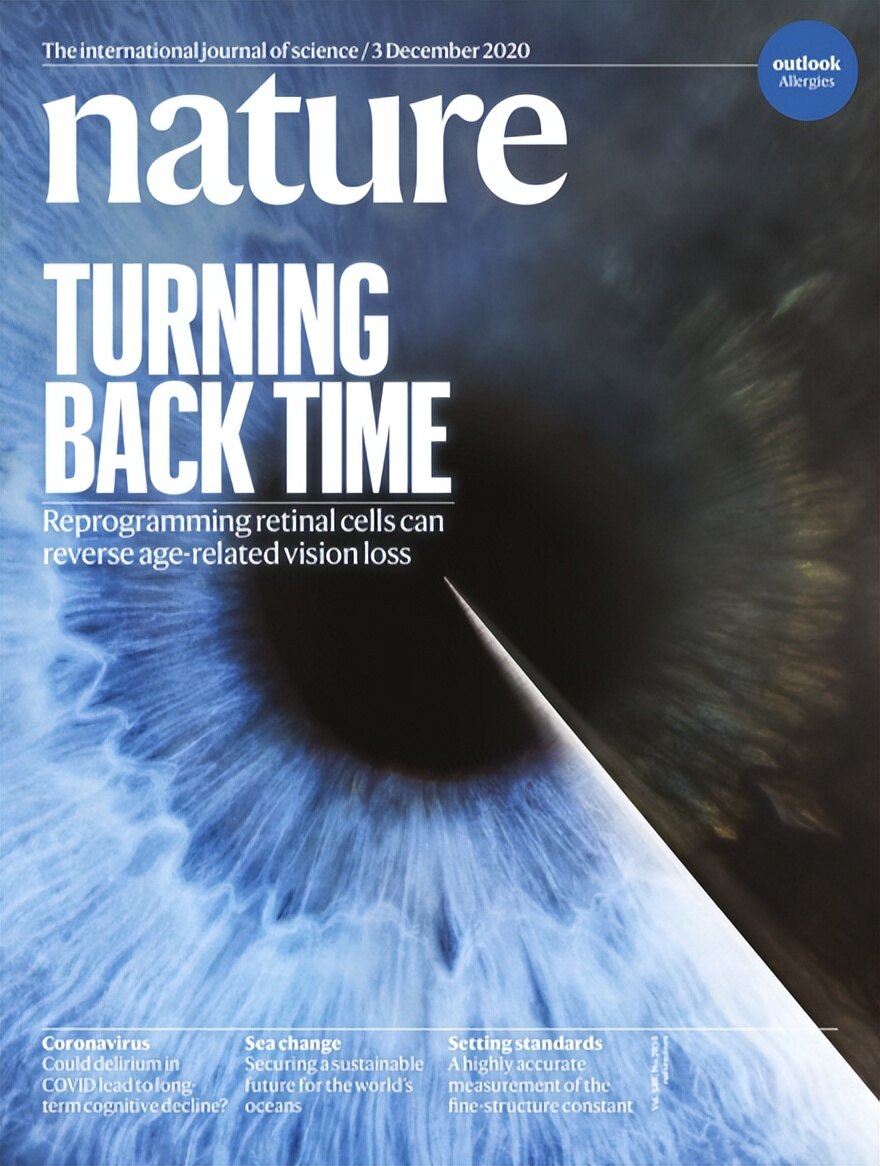 Figure | Current Issue Cover of Nature (Source: Nature)
The "Information Theory of Aging" long advocated by Sinclair provides the theoretical framework for this research. The theory posits that the root cause of aging is not mutations in the DNA itself, but the gradual loss and disarray of epigenetic information (the chemical markers that determine when certain genes are activated or silenced). He once used an analogy: if DNA is the digital information on a CD, then aging is like scratches on the surface of the CD—the information is still there, but it becomes harder to read.
Reprogramming technology is essentially the search for a method to "polish" these scratches, enabling cells to reread their youthful epigenetic instructions. In 2023, Sinclair's team published research in *Cell* further supporting this theory, claiming to demonstrate that the loss of epigenetic information does indeed cause aging in mammals and that this change is reversible.
At the operational level, ER-100 uses adeno-associated virus (AAV) as a vector to directly inject the genes of the OSK three factors into the patient's eyeball, allowing these genes to enter the damaged retinal ganglion cells. For safety, the therapy is designed with a "switch" mechanism: the introduced genes will only be activated when the patient takes a low dose of the antibiotic doxycycline; gene expression will be turned off once the medication is stopped.
In the upcoming trial, patients will take doxycycline for 8 weeks while using steroids to suppress potential inflammatory responses. The trial plans to first test two different doses on up to 6 glaucoma patients, then select one dose for use in up to 6 NAION patients.
Sharon Rosenzweig-Lipson, Chief Scientific Officer of Life Biosciences, told the media that the therapy showed good tolerance in non-human primate models without observed systemic toxicity. In monkeys with induced NAION-like injuries, ER-100 restored epigenetic markers and improved electrical signal transmission in the optic nerve, indicating the therapy can enhance the function of damaged cells. However, she also noted that this treatment cannot replace dead cells; it can only restore functionality to those still alive but functionally compromised.
This small company, located in Boston with a team of less than 20 people, has taken the lead in the longevity technology race with this FDA approval. This field is now attracting the loudest names and the strongest capital in the tech industry.
Altos Labs emerged in 2022 with a financing round of $3 billion; Jeff Bezos is reported to be one of the early investors. NewLimit, co-founded by Coinbase CEO Brian Armstrong, completed a $130 million Series B financing round in 2025. Retro Biosciences, exclusively invested in by OpenAI's Sam Altman with $180 million, is seeking to raise $1 billion in new funding at a $50 billion valuation.
By contrast, Life Biosciences, with cumulative financing of approximately $158 million, is much smaller in scale but has become the first company to advance epigenetic reprogramming technology into human clinical trials.
Investor Karl Pfleger commented, "Reprogramming is like the AI of the biological world — it's the hot spot everyone is investing in." However, he also pointed out that this trial is merely a proof of concept, and there is still a long way to go before practical application: "In an optimistic scenario, it could address certain blindness issues for some people and drive research into other indications. But this does not mean your doctor will be prescribing you a pill to make you young again anytime soon."
Risks and controversies surrounding this technology have always existed. Daniel Ives, CEO of the British startup Shift Bioscience, told MIT Technology Review in an interview that they believe the three-factor combination used by Life Biosciences is "not the optimal version of rejuvenation," as these factors may activate hundreds of downstream genes, which in some cases could cause cells to fully revert to their original stem cell state.
Moreover, the doxycycline switch mechanism used in ER-100, while frequently utilized in experimental animals, has never been tested in humans. Since the switch system contains genetic components from E. coli and the herpes virus, it could potentially trigger an immune response in the human body. NewLimit stated that they are extensively screening for safer gene combinations and expect it will take another two years before being ready for human trials.
Sinclair's reputation in the anti-aging field has also been controversial. As early as 2003, he gained fame for claiming that resveratrol in red wine could activate the longevity-associated Sirtuin protein and co-founded Sirtris Pharmaceuticals. The company was acquired by GlaxoSmithKline for $720 million in 2008, but just five years later, the R&D project was shut down due to failing to achieve the expected results.
Later studies showed that resveratrol produced false positive signals in experiments used to measure Sirtuin activity, and may not actually activate this protein. Critics pointed out the gap between Sinclair's promotion of various "longevity molecules" over the years and the actual scientific evidence. In 2024, a report published in The Wall Street Journal called him an "anti-aging guru" and noted that the company he founded "did not develop as hoped."
However, Sinclair's work in the lab continues to advance. He told the media: "This is not a situation where we need to stare at the error bars on a chart to judge the results. We will know directly if it works. Perhaps within the next few months, we will know for the first time whether age reversal can be achieved in humans."
McLaughlin Looks Ahead to the Long-Term Direction in an Interview. He stated that the company’s epigenetic reprogramming platform has demonstrated potential in preclinical studies of liver diseases (Metabolic Dysfunction-Associated Steatohepatitis, MASH), proving that this technology can work "across organs."
The ultimate goal is to achieve cellular rejuvenation of multiple organs or even the entire body, but the current strategy is to "accumulate evidence organ by organ and indication by indication." He also mentioned that the global aging problem is becoming increasingly severe, with the U.S. fertility rate hitting a record low in 2024 at just 1.6 children per woman, far below the replacement level of 2.1. The situation in Japan is even more serious, with a fertility rate of only 1.15 in 2024. "Extending healthy lifespan is crucial for the economy and society as a whole," McLaughlin said.
From a regulatory perspective, one practical limitation this trial faces is that the FDA does not consider "aging" itself as a disease. This means any therapy aimed at "anti-aging" cannot be approved through the standard clinical trial pathway.
Therefore, Life Biosciences and other similar companies must focus their therapies on treating specific age-related diseases, such as vision loss, liver fibrosis, or neurodegenerative disorders, rather than directly targeting the aging process itself. This is a pragmatic strategy, but it also means that "whole-body rejuvenation" (if it is indeed feasible) is still a long way from clinical application.
Life Biosciences Plans to Begin Recruiting the First Batch of Patients in the Coming Months, with Preliminary Results Expected by the End of 2026 or Early 2027. Regardless of the Outcome, This Trial Will Provide Crucial Data for the Entire Field. If Successful, It Will Demonstrate the Feasibility of Epigenetic Reprogramming in Humans, Laying a Foundation for Future Research; If It Fails or Safety Issues Arise, It Will Also Prompt the Field to Reevaluate Technical Pathways and Theoretical Assumptions.
Longevity technology is moving from the fringe to the mainstream. A few years ago, talking about "reversing aging" sounded like a scam; today, it has become a research field attracting billions of dollars in investment, bringing together Nobel laureates and tech giants. But as with all frontier sciences, it is also fraught with uncertainty, controversy, and the risk of failure. This trial by Life Biosciences is the first rigorous human test of Sinclair's aging theory, and the results are worth watching.
References:
1.https://www.technologyreview.com/2026/01/27/1131796/the-first-human-test-of-a-rejuvenation-method-will-begin-shortly/
2.https://fortune.com/2026/01/30/billionaires-longevity-aging-fda-human-clinical-trial-life-biosciences-jerry-mclaughlin-david-sinclair-harvard-science/
3.https://www.nad.com/news/fda-greenlights-life-biosciences-human-study-setting-up-pivotal-test-for-aging-theory-from-harvards-david-sinclair
Operation/Layout: He Chenlong
This article is a professional academic paper interpretation and does not provide medical advice.