

PUMCH Licenses RDH12 Mutation-Targeted Gene Therapy to Beijing InnoWell Therapeutics for 1.68 Million RMB Plus 5% Royalty

Innovecbio
Gene Editing Delivery Technology and Drug Developer
Recently, Beijing Union Medical College Hospital released a public notice on the transformation of scientific and technological achievements. The hospital plans to transfer patent rights."A Gene Therapy Drug Targeting RDH12 Mutations"The patent rights were transferred to InnoVec Biotherapeutics Inc., with a transfer fee ofRMB 1.68 million + 5% commission on sales. The inventor of this patented technology isSui Ruifang and her team。
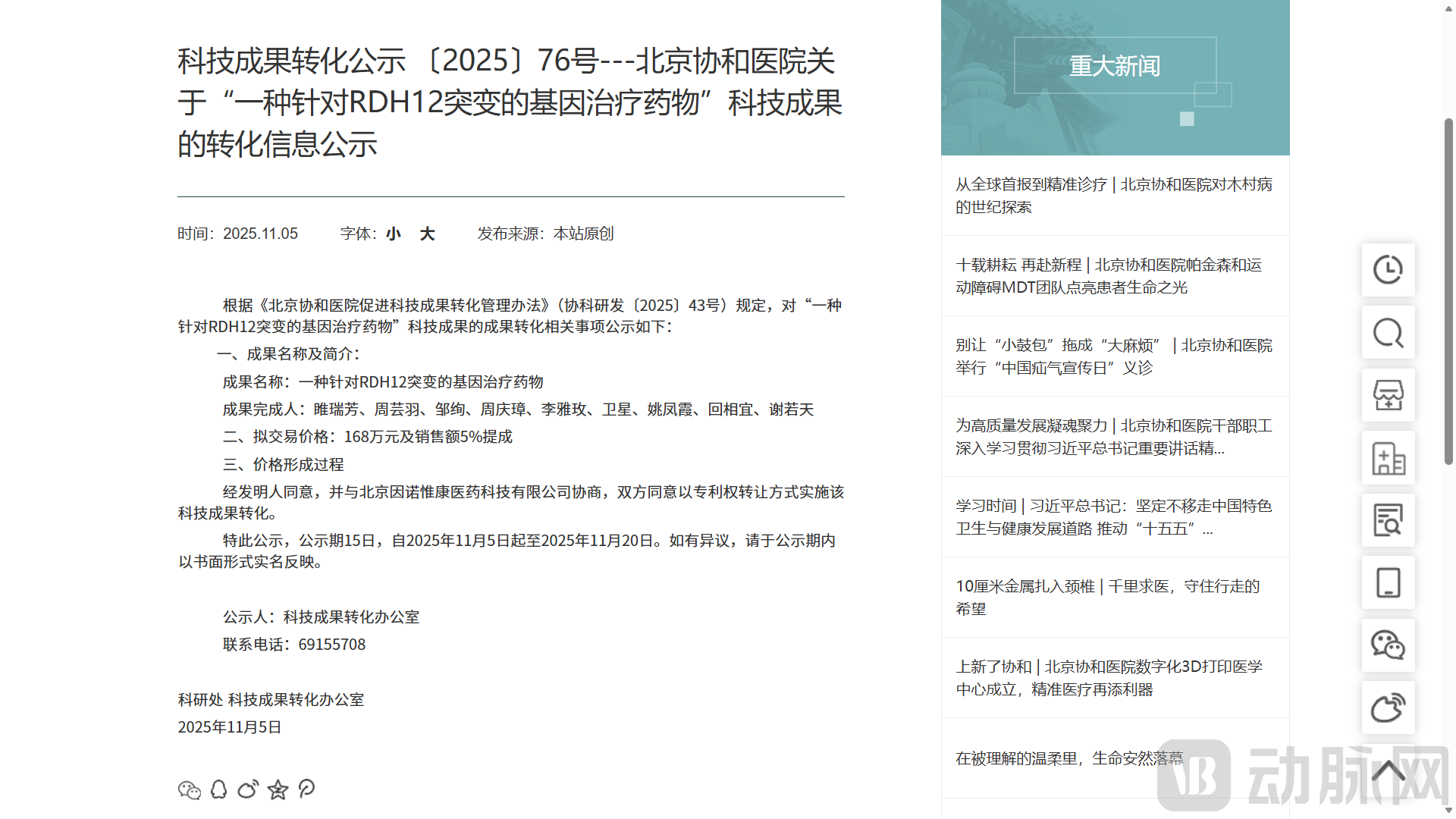
Image source: Official website of Peking Union Medical College Hospital
The assignee of this patent isInnoVec Biotherapeutics Inc., is a company focused onPharmaceuticals and Health SectorAn innovative enterprise. The company focuses onGene Therapy and Drug Delivery TechnologyMainly engaged in the research, development, and transformation of gene therapy-related technologies and products, focusing on providing innovative treatment solutions and technical services for relevant disease areas.
This technology isGene Therapy Technology Targeting RDH12 Gene Mutations Developed by Peking Union Medical College Hospital, Chinese Academy of Medical Sciences, the core is to prepareGene Therapy Drug Targeting the Repair of RDH12 Gene Function, used to treat hereditary retinal degeneration caused by RDH12 gene mutations, falls under the application of gene therapy in the biotechnology field. This technology addresses retinal dysfunction caused by RDH12 gene mutations through the construction of a recombinant adeno-associated virus (AAV) vector-mediated gene therapy drug.
RDH12 Gene Mutations Cause Leber Congenital Amaurosis and Early-Onset Severe Retinal Dystrophy, Hereditary Retinal Degenerative Diseases That Are Clinically Difficult to Treat and Lead to Irreversible Blindness. Patients Often Experience Severe Vision Impairment During Childhood, Progressing to Macular Atrophy, Visual Function Decline, and Eventual Complete Blindness, Placing a Heavy Burden on Families and Society. Currently, There Are No Effective Curative Treatments Available for Such Conditions in Clinical Practice, Making It a Core Challenge in Ophthalmic Diagnosis and Treatment.
The core treatment need for this type of eye disease isAchieve Radical Repair of Genetic Defects, it is necessary to deliver functional genes to retinal photoreceptor cells through a safe and minimally invasive method, efficiently express active RDH12 protein, restore the key enzymatic function of the visual cycle, and achieve improvement in visual function or delay in disease progression. Early intervention is particularly crucial before irreversible damage to the retinal structure occurs during childhood, preserving the patient's visual function.
Currently, clinical monitoring and diagnosis of RDH12 gene mutation-related eye diseases can only be achieved through fundus photography, OCT, ERG, and other methods. There is no targeted cure available. Existing medications for retinal diseases can only alleviate ocular discomfort, and surgeries are limited to structural repair in the late stages, neither of which can reverse vision function damage caused by genetic defects. Patients face challenges throughout the entire course."No medicine to cure, no surgery to treat"The Dilemma.
At the same time, there are still many shortcomings in the existing related gene therapy explorations:Traditional Subretinal InjectionThe method of administration is highly invasive, prone to complications such as retinal damage and bleeding, and is not suitable for pediatric populations.Conventional AAV Vector SerotypesInsufficient targeting of retinal photoreceptor cells, low delivery efficiency; and no codon optimization for the RDH12 gene, making it difficult for the exogenous gene to efficiently express active protein, thus failing to effectively restore its enzymatic function, greatly reducing the therapeutic effect.
In addition,Exclusive Animal Models and Clinical Research Data for RDH12 Gene Mutations Are Lacking, the efficacy and safety of the treatment regimen lack sufficient validation, further constraining the clinical translation process. The叠加of such issues urgently calls for a fundamental, minimally invasive, and highly effective proprietary gene therapy solution in the field of RDH12 gene mutation-related ocular diseases to address the industry's clinical diagnosis, treatment, and intervention challenges.
For RDH12 Gene Mutation Eye DiseaseLack of curative means, inefficient delivery, and significant medication traumaSuch pain points, this patented technology aims toPrecision RepairAt the core, throughGene Optimization, Exclusive Vector, Minimally Invasive DeliveryThree Major Innovations, Building Efficient and Safe Gene Therapy Solutions for Fundamental Disease Intervention.
The core advantages of this technology are as follows:
First,Codon optimization + exclusive expression frame,Achieve high-efficiency expression of highly active proteins.Extract the CDS sequence of the human RDH12 gene and optimize it to obtain RDH12opt. Construct the CB7-RDH12opt-hGHpA expression cassette to ensure the expressed RDH12 protein is complete and active, capable of efficiently catalyzing the key reactions in the visual cycle. Animal experiments confirmed significant recovery of mRNA levels and enzymatic function after treatment.
Second,Customized AAV vector serotypes, leading in targeted delivery efficiency.Innovatively Construct IVT13 Serotype RepCap Plasmid, Enhance Retinal Photoreceptor Cell Targeting by Customizing Capsid Proteins via Gibson Assembly; The Virus Titer Prepared by the Triple-Plasmid Packaging System Reaches 1.0E+13vg/mL, Ensuring Efficient Delivery of Sufficient Functional Genes to Target Cells.
Third,Intravitreal injection, minimally invasive, safe, and widely adaptable.Abandoning invasive subretinal injection and adopting intravitreal injection to avoid direct retinal trauma, reduce the risk of complications, simplify the procedure, adapt to special populations such as children, while balancing therapeutic efficacy and safety.
Fourth,Long-acting and stable treatment, delaying disease progression.AAV Vector-Mediated Continuous Expression of Exogenous Gene Functional Proteins Participates in the Visual Cycle Long-Term; Animal Experiments Show Both Low and High Doses Significantly Improve Enzymatic Function, with High Dose Showing Superior Effects, Effectively Protecting Visual Function and Delaying Disease Progression.
In addition, the technology forms a full-chain intellectual property barrier, with standardized preparation processes, controllable product purity and stability, and has been fully validated in animal models. It combines clinical relevance, safety, reliability, and potential for large-scale transformation, providing an exclusive curative solution for such blinding eye diseases.
With the increasing demand for the treatment of hereditary retinal diseases, the global ophthalmic gene therapy track has entered a period of accelerated development, with enterprises and research institutions in China and abroad focusing onDifferent gene mutation targets, vector technology optimization, and innovation in drug delivery methodsExpand the layout, forming"Broad-spectrum Treatment Exploration + Specific Target Point Research"The competitive landscape, where exclusive treatment options targeting RDH12 mutations have become a new technical breakthrough due to urgent clinical needs.
Roche-Spark Therapeutics:As a pioneer in ophthalmic gene therapy, its core productLuxturna(voretigene neparvovec)It is the world's first approved AAV gene therapy drug, granted approval by the U.S. FDA for the treatment of inherited retinal dystrophy caused by RPE65 gene mutations (including Leber congenital amaurosis). The drug delivers the functional RPE65 gene via subretinal injection to restore the function of retinal photoreceptor cells.
GenAns Biotech:An innovative enterprise in China focusing on the treatment of retinitis pigmentosa, with its self-developedGA001 InjectionYesA Broad-Spectrum Gene Therapy Drug, not limited by specific gene mutations, is suitable for advanced retinitis pigmentosa caused by various reasons. The drug, developed based on chicken opsin protein (cOpn5), delivers genes through intravitreal injection. It has completed the first dosing in trial participants, and clinical results show significant vision improvement in most patients; it has received orphan drug designation from the U.S. FDA, FDA Fast Track Designation (FTD), and its Investigational New Drug (IND) application has been accepted by China's National Medical Products Administration Center for Drug Evaluation (CDE), currently in Phase II clinical trials.
Neurophos:China's First Ophthalmic Gene Therapy Company, Core ProductNFS-01(esonadogene imvoparvovec)Targeting Leber's Hereditary Optic Neuropathy (LHON) caused by MT-ND4 gene mutations, it is the only gene therapy product for this condition currently in clinical development in both China and the United States. It has been granted Orphan Drug Designation by the U.S. FDA and included as a breakthrough therapy by China's CDE, and has now entered Phase III clinical trials.
In summary, this patent technology isExclusive Gene Therapy for RDH12 Mutation-Associated Hereditary Retinal Degeneration, the core achieves radical repair of genetic defects through codon-optimized RDH12 functional gene, IVT13 serotype-specific AAV vector, and minimally invasive intravitreal injection technology,Achieve the core objectives of high-level active expression of RDH12 protein, precise delivery to retinal target cells, and improvement of visual function., breaking the dilemma of the lack of curative treatments for this type of disease in clinical practice.
In the future, with the continuous iteration of gene therapy technology and the advancement of clinical translation, this technology is expected to become the standard treatment for RDH12 mutation-related eye diseases, filling the gap in this niche field; meanwhile, it will also provide insights for the treatment of other monogenic inherited retinal diseases."Target Optimization - Customized Vectors - Minimally Invasive Delivery"A replicable paradigm that promotes the development of ophthalmic gene therapy towards precision, minimally invasive, and personalized directions, bringing hope of recovery to more patients with irreversible blinding eye diseases.