Protego Biopharma Files IPO Prospectus to Advance First-in-Class AL Amyloidosis Therapy PROT-001
FoldRx Pharmaceuticals
Small Molecule Therapy Developer

Protego Biopharma
Small Molecule Therapy Developer

▲May 14-15Shanghai BiopharmaceuticalsInnovators SummitScan to register
Disclaimer: Due to limited level, errors are inevitable, and some information may not be the latest. Please feel free to point out in the comments. This article is only for the introduction of drugs related to medical health.Non-therapeutic program recommendations (if applicable); This article does not constitute any investment advice.。
In 2010, Pfizer acquired FoldRx Pharmaceuticals, Inc. at an undisclosed price.FoldRx Pharmaceuticals. At that time, few people could have predicted that the core asset of this private pharmaceutical companyTafamidis (Tafamidis)Will become laterPfizer's Rare Disease Ace Product, contributing over $6.3 billion in annual sales (2025).
Chlorbenzazole is an orally administered small molecule transthyretin (TTR) stabilizer and is also the world's first approved treatment.Transthyretin Amyloid Cardiomyopathy (ATTR-CM)The drug, which slows disease progression by inhibiting the dissociation of TTR tetramers. According to data from Mose Pharmaceuticals, in the global ATTR-CM field, this drug once occupied more than 90% of the market share.
And behind this success stands a scientist from the world's top research institute, Scripps Research:Jeffery W. KellyPh.D.。

Source: The Scripps Research Institute
Dr. Kelly is the winner of the 2022 "Breakthrough Prize in Life Sciences,"Protein Misfolding and Aggregation (Amyloidosis)The research field has an internationally leading position, and his pioneering work has deeply revealed the role of protein aggregation in the progression of degenerative diseases. His research achievements have laid the scientific foundation for FoldRx Pharmaceuticals, a company founded byRichard LabaudinièrePh.D.Leader, focusing on developing first-in-class small molecule disease-modifying therapies for the treatment of protein misfolding and aggregation-related diseases.
After FoldRx was acquired by Pfizer, Dr. Kelly did not stop his in-depth work in this field. In 2017, heDr. Xin Jiang and Dr. Richard Labaudinière atSantiagoCo-foundedProtego Biopharma, dedicated to developing first-in-class small molecule drugs aimed at reprogramming the protein folding process, focusing on protein misfolding diseases caused by single-gene mutations, including muscular diseases, cardiomyopathy, stroke, nephropathy, retinopathy, ion channel disorders, and various degenerative diseases.

In December 2025, this low-key company announced the completion1.3Billion USD OversubscriptionBRound of Financing, byNovartis Venture Fund (Novartis Venture Fund) andForbionLed the investment to support its core candidate drug, PROT-001, in entering a pivotal clinical trial, targeting an indication even more severe than ATTR and with even fewer treatment options ——Systemic light chain type (ALType) AmyloidosisThis time, can they replicate the miracle of chlorbenzazole?
Although AL amyloidosis is not cancer, its treatment has long relied on drugs for cancers such as multiple myeloma. This is because the disease originates from abnormal plasma cells in the bone marrow, which, although not reaching the level of malignant tumors, continuously secrete structurally abnormalImmunoglobulin Light Chain (light chain,LC). These misfolded light chains form insoluble fibrillar structures and aggregate to form amyloid deposits in organs and tissues throughout the body, ultimately leading to organ dysfunction and even death.
The heart is the most severely affected organ, and amyloid deposition makes the myocardium "stiff," obstructing normal diastolic and pumping functions, eventually leading to heart failure, which is the most common cause of death in patients. Brent Warner, CEO of Protego, once revealed: "These misfolded proteins accumulate in the heart and kidneys, creating mechanical pressure, occupying tissue space, and preventing organs from functioning properly. The core issue is: there is an excess of 'bad' light chains in the body."Even in trace amounts, it exhibits high organ toxicity.。”
Since AL amyloidosis shares the same cellular origin as multiple myeloma (a plasma cell cancer), namely abnormal plasma cell clones, some anti-cancer drugs for myeloma (such as Johnson & Johnson's CD38 monoclonal antibody daratumumab) can be used as treatment options for AL amyloidosis. However, there is currently no drug that can directly target these pathogenic light chains themselves.
Brent Warner, CEO of Protego, once explained to the media that developing small-molecule drugs targeting these misfolded immunoglobulin light chains faces two major scientific challenges:
Light chain protein surfaceLack of Natural Drug Binding Sites;
Causing MisfoldingGene mutations exhibit high heterogeneity among different patients.。
In response, the Protego team based on a discovery by the scientific founderCryptic binding site, a small-molecule oral drug specifically targeting immunoglobulin light chains was rationally designed.PROT-001. According to reports, PROT-001 canSpecific binding and stabilization of immunoglobulin light chains, and at the same time, it can also cover the common light chain variant sequences in the vast majority of patients with AL amyloidosis.
Warner explained: "After PROT-001 binds to the light chain, it stabilizes it, allowing the protein to return to a state where the body can recognize and naturally clear it. Over time, amyloid proteins deposited in organs such as the heart are also expected to gradually regress. More importantly, the drug can bind to the light chain immediately upon its secretion by plasma cells, thereby preventing further aggregation."
This "source interception" mechanism means that PROT-001 may not only alleviate disease symptoms but also holds the potential to achieveDisease Modification, that is, to delay or even reverse the progression of organ damage.
This strategy builds on the pharmacology of stabilizing transthyretin (TTR) with chlorbenzazole.Molecular ChaperoneMechanism, but the challenge is greater. TTR is a structurally stable tetramer, while light chains are monomeric and highly variable.
In the past few years, the field of AL amyloidosis drug development has encountered consecutive setbacks:
In 2019,Takeda PharmaceuticalAnnounced that its oral proteasome inhibitor ixazomib (brand name Ninlaro, approved for multiple myeloma) did not meet the primary endpoint in a Phase III trial for AL amyloidosis.
Irish Biotech CompanyProthenaAfter the Phase II clinical trial failure of the AL amyloidosis project in 2018, the research on its antibody drug Birtamimab was restarted. However, after the Phase III trial results published in May 2025 showed that it failed to improve all-cause mortality in patients, the pipeline was ultimately abandoned and layoffs were announced again. (Further reading:When Wall Street is still talking about cash burn, this Irish company talks about milestone harvest)
July 2025,AstraZenecaAnnounced that its antibody drug Anselamimab did not meet the primary endpoint (all-cause mortality or frequency of cardiovascular hospitalization) in the Phase III CARES study for AL amyloidosis. The company had acquired this asset in 2021 for $150 million through the acquisition of Caelum Biosciences.
Both of the aforementioned monoclonal antibodies attempted to reduce the accumulation of this protein by binding to already deposited amyloid fibrils; however, neither reached the primary endpoint in Phase III clinical trials. Protego believes that the key to the failure lies inIntervention Timing Too Late"When amyloid deposits form, a large number of cells may have already died," noted CEO Warner. "Even if some deposits are cleared, a large amount of toxic light chains continue to attack the remaining cells in circulation."
In contrast, the action of PROT-001 occursBefore amyloid deposition formation, namely targeting upstreamLight Chain Monomer, with greater disease-modifying potential in terms of mechanism.
However, CEO Warner stated that Protego does not intend to replace the existing combination therapy for AL amyloidosis, but rather to offer a new treatment approach.
Data from MoEntropy Pharmaceuticals shows that Protego Biopharma has initiated the first-in-human study of PROT-001 in Australia in the second quarter of 2025. The study, which has been revealed to be a placebo-controlled Phase I trial involving over 100 healthy volunteers, aims to evaluate PROT-001.Safety, Tolerability, Pharmacokinetics, and PharmacodynamicsSituation, the research will adopt itsProprietaryAmyLitePlatformConduct testing and expect to announce results in early 2026.
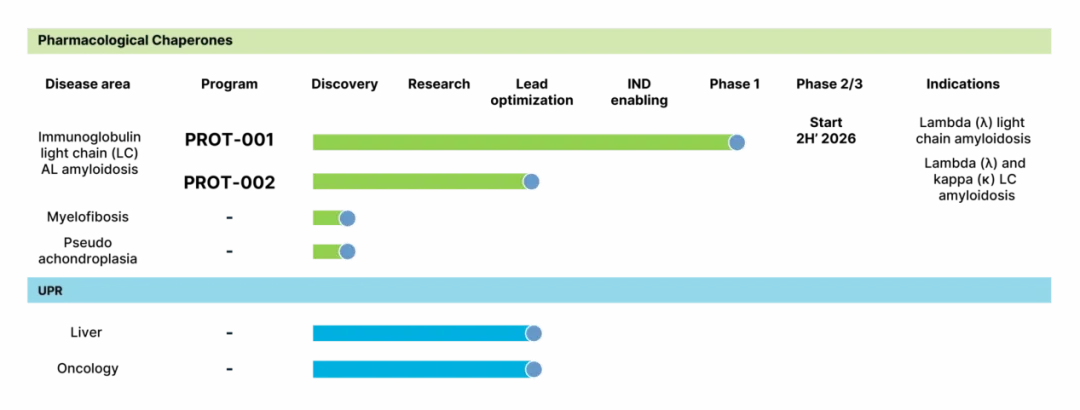
It was also disclosed that the pivotal Phase II/III trial is expected to be launched in the second half of 2026, with the dosing regimen (once or twice daily) depending on the drug's half-life data.
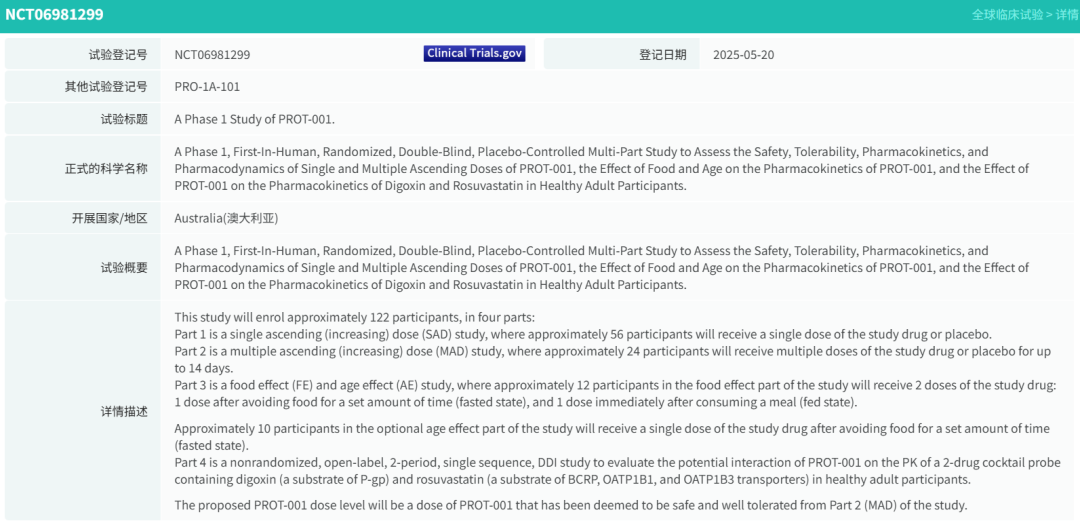
Source: Mosun Medical Data
Notably, Protego BiopharmaCompleted a $51 million Series A financing round in 2021It has remained low-key until the announcement of a $130 million Series B financing round in December 2025, which revealed its progress and demonstrated the team's commitment to scientific rigor.
It is reported that the Series B financing was co-led by Novartis Venture Fund and Forbion, a well-known European life sciences investment institution. New investors include Omega Funds, Droia Ventures, YK Bioventures, and Digitalis Ventures. Existing investors include Vida Ventures, MPM BioImpact, and Lightspeed Venture Partners (Lightspeed Venture Partners) as well as Scripps Research, which also continued its investment, demonstrating their high recognition of Protego's scientific approach and clinical progress. This round of financing also highlighted the active leadership of the company's Executive Chairman Ed Hurwitz and Vida Ventures' partner and Protego's interim Chief Business Officer, Dr. Chris Weyrer, in driving core projects.
The funds raised will be mainly used to advance PROT-001 into the pivotal clinical trial for AL amyloidosis.

According to the company's official website, its molecular chaperone platform has another candidate drug.PROT-002, to coverPatients with both λ and κ light chain types, and explore the application of this platform in diseases such as myelofibrosis and pseudoachondroplasia.
Besides,Protego has also established a second technical pathway: activation through small moleculesUnfolded Protein Response (UPR), enhancing the cell's own protein folding ability, thereby addressing various diseases associated with misfolded proteins.
From FoldRx being acquired by Pfizer to the original team founding Protego, this is another case attempting to convert basic science into life-saving drugs. Tafamidis has proven that this mechanism pathway is feasible, and PROT-001 is stepping into even more complex territory.AL AmyloidosisOn the battlefield. Ahead, there are warnings from failures and also significant unmet clinical needs. Among these patients with AL amyloidosis, someone might be waiting for the birth of the next Tafamidis.
References:
Pharmcube Data;
Moxie Pharma Data pharma.bcpmdata.com (formerly Yaoke Rongyun Data);
https://www.protegobio.com/;
https://www.scripps.edu/faculty/kelly/;
https://www.pharnexcloud.com/zixun/sd_275463;
https://www.takedaoncology.com/newsroom/news-releases/2019/tourmaline-al1-phase3-amyloidosis/;
https://medcitynews.com/2025/12/protego-bio-light-chain-amyloidosis-misfolded-protein-rare-disease-startup/;
https://www.fiercebiotech.com/biotech/protego-biopharma-looks-bring-disease-modifying-al-amyloidosis-prospect-light-130m-series-b;
Other relevant public information (images in the text are from the official company, unless otherwise noted).
This article is intended to provide scientific information to healthcare professionals only, and does not represent the platform's position or make any medication recommendations.