SpyGlass Pharma Raises $172.5M in IPO: Clinician-Engineer Duo Launches Ophthalmic Drug-Device Platform Targeting Glaucoma
SpyGlass Pharma
Drug Delivery Platform Developer

▲May 14-15Shanghai BiopharmaceuticalsInnovators SummitScan to Register
Note:This article does not constitute any investment opinions or suggestions; please refer to official/company announcements for accuracy.This article only introduces drugs related to medical health, not a recommendation of treatment options (if involved), and does not represent the platform's position.Any article reprinted needs to be authorized.
In February 2026, SpyGlass Pharma (Nasdaq: SGP), a clinical-stage ophthalmology biopharmaceutical company, successfully went public on Nasdaq, raising $172.5 million in its IPO. This achievement is particularly noteworthy given the ongoing challenging environment for Biotech financing.
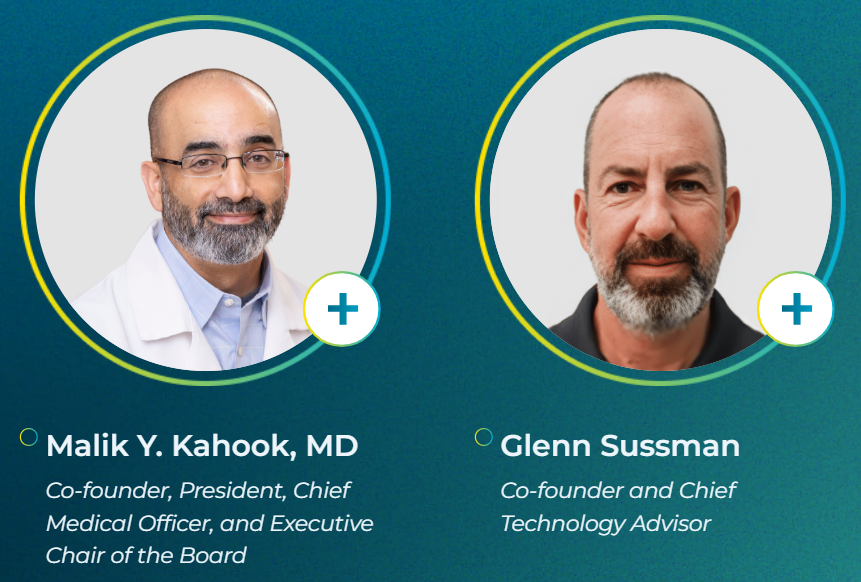
This company isProfessor of Ophthalmology at the University of ColoradoMalik KahookDoctorAndSenior Ophthalmic Instrument SpecialistGlenn SussmanCo-founded in 2019 with the aim ofContinuous Drug Delivery Redefines Chronic Eye Disease TreatmentThe technology platform originates from the Sue Anschutz-Rodgers Eye Center at the University of Colorado Anschutz Medical Campus, achieving long-term disease control and vision protection by integrating known drugs, surgeries, and devices.
Notably, their collaboration did not begin in 2019 but dates back to an earlier industry advisory conference.
The "Golden Combination" of Clinicians and Engineers
At the time, during an advisory meeting held by Alcon, Professor Malik Kahook, who had just become the head of the Glaucoma Service at the University of Colorado, gave a presentation on laser treatment for glaucoma. After the meeting, Glenn Sussman, a research and development engineer at Alcon, approached him to exchange ideas.
"I remember this discussion was very special; he would ask questions and listen carefully, then pose deeper questions," recalled Professor Malik. Glenn admitted, "I noticed the attention and respect other senior doctors gave to Malik, and it was precisely for this reason that I decided to follow up with further discussions with him."
In the more than ten years that followed, the two continued to interact at academic conferences and in joint projects. In 2012, Professor Malik invited Glenn to join a startup company he had incubated.ClarVista Medical, serving as the R&D leader, co-developing a modular intraocular lens system.
Despite the extremely high workload at ClarVista, the two have developed a strong默契 through their complementary skills: one is an ophthalmology clinical expert specializing in glaucoma, and the other is an engineer and team leader with over 30 years of experience in the ophthalmology field. Their long-term cooperation and trust enable them to maintain open communication and mutual support when facing entrepreneurial pressures and technical challenges.
Because of this, whenClarVistaIn2017Year acquired by AlconAfterward, the two did not stop. In 2019, they decided to join hands again and establishSpyGlass Ophthalmics, which is now known as SpyGlass Pharma.
Clinical Pain Points Spur Technological Revolution
Professor Malik Kahook once stated, "The reason we tolerate the side effects of eye drops is the hope that their therapeutic effects will outweigh the adverse reactions." This statement highlights the plight faced by tens of millions of glaucoma patients worldwide.
Glaucoma is a chronic, progressive eye disease primarily caused by the obstruction of aqueous humor drainage in the eye, leading to a sustained increase in intraocular pressure (IOP), which in turn damages the optic nerve and causes irreversible vision loss. Despite the availability of various medications and surgical treatments,Glaucoma remains one of the leading causes of blindness worldwide.。
Particularly challenging is that the disease is typically asymptomatic in its early stages, with many patients only being diagnosed after significant visual field loss has occurred. Even after diagnosis, disease progression remains very common, primarily due to patients' response to the current standard of care.ComplianceVery poor. The current first-line therapy relies on the daily use of intraocular pressure-lowering eye drops, but studies show,Up to80%Patients who cannot take medication regularly, recently50%Complete discontinuation of medication within one yearOnce the treatment is interrupted, uncontrolled intraocular pressure will accelerate optic nerve damage, leading to disease progression.
When eye drops fail to effectively control intraocular pressure, the doctor may recommend surgical intervention, such asMinimally Invasive Glaucoma Surgery (MIGS)However, these solutions are either limited by operational complexity or have a limited degree of blood pressure reduction, making it difficult to meet the long-term blood pressure control goals for patients with moderate to severe conditions.
Professor Malik participated in a survey: although 55% of patients initially preferred eye drops, acceptance quickly reversed when a new therapy was introduced that not only eliminated the need for daily medication but also provided stronger efficacy in lowering intraocular pressure.
In response to this long-standing unmet clinical need, he proposed a bold idea:Insert the medication directly into the eye, implanted once by a doctor, and continuously releasing for three years.。
Centered on this concept, he developed aA Novel Non-Biodegradable, Long-Acting Sustained-Release Intravitreal Drug Delivery System, which can precisely deliver the approved drug (bimatoprost) to the eye. Instead of pursuing a "completely new drug," it cleverly utilizes three well-established elements: the known drug - bimatoprost (approved by the FDA in 2001); the known procedure - cataract surgery (with over 4 million cases annually in the U.S.); and the known device - intraocular lens (IOL).
This strategy significantly reduced R&D risks and paved the way for regulatory pathways. It was revealed that the company plans to go through the FDA.505(b)(2)PathwayLaunch the product into the market.
Data shows that in 2020,SpyGlass PharmaExclusive Global Licensing Agreement Signed with the University of Colorado, obtaining the commercialization rights to the core patent (intraocular drug delivery device) jointly owned by both parties. The company can independently develop, sell, and license to third parties, while the university retains only non-profit research use. This arrangement respects the academic source while granting the company full freedom.
Dual Pipeline Layout, Creating a Treatment Closed Loop
The main product of SpyGlass currently isBIM-IOLSystem, aiming to achieve glaucoma control for several years through a single routine surgery. The device consists of a single-piece hydrophobic acrylic intraocular lens (IOL) integrated with a bimatoprost sustained-release drug pad. The design goal is clear:Simultaneously implanted during cataract surgery, continuously releasing therapeutic doses of bimatoprost for over three years.`, thereby completely freeing patients from the daily burden of eye drops.`
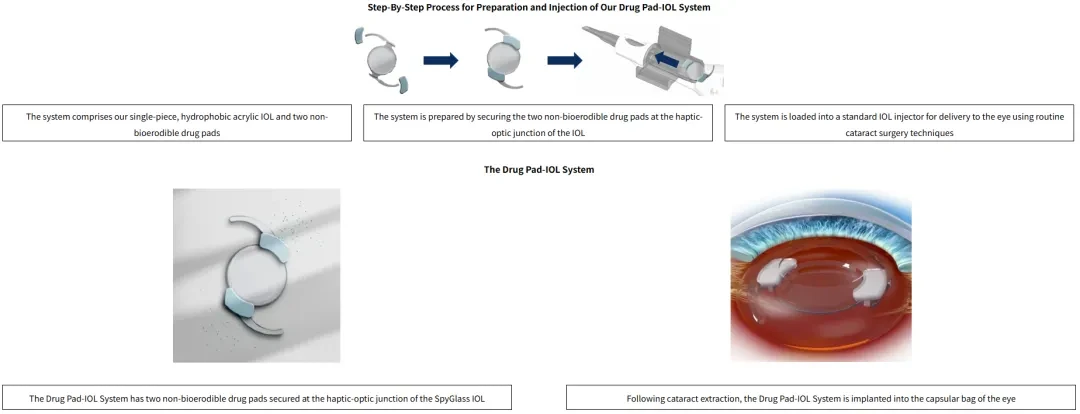
According to the company's vision, ophthalmologistsThis preloaded medication can be directly used in the standard cataract surgery procedure.IOL, without the need for additional learning of complex operations or changes to existing workflows, which is precisely its key advantage over most Minimally Invasive Glaucoma Surgeries (MIGS).
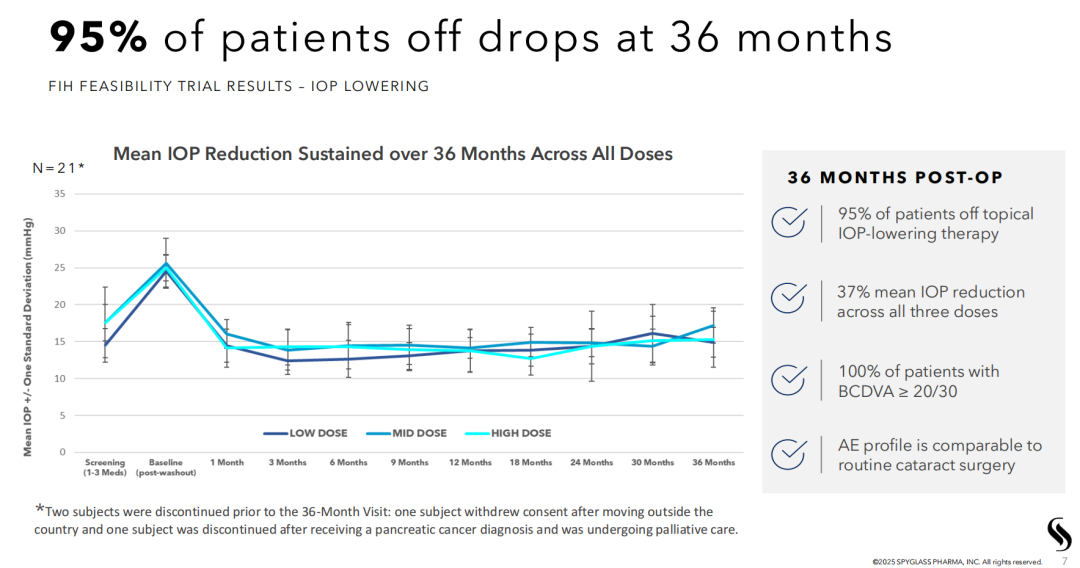
The early clinical data of the project is encouraging: in the company's first-in-human study, evaluable patients achievedAverage Intraocular Pressure (IOP) Reduce37%, and no product-related adverse events occurred; the best-corrected visual acuity (BCDVA) of all patients reached or was better than 20/30 at 36 months.95%The evaluable patients in36All glaucoma eye drops were completely discontinued after several months., showing the potential to be free from long-term dependency on eye drop medications.
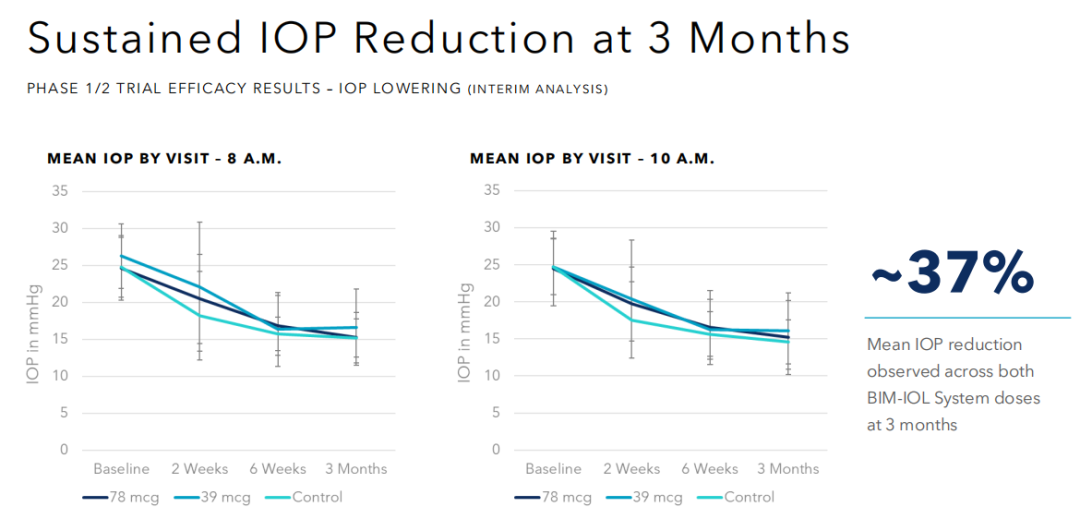
Subsequent multicenter, randomized, controlled Phase I/II trials further validated its safety and efficacy: patients receiving 78 mcg and 39 mcg doses of BIM-IOL achieved37%And36%The averageIOPReduction, and97%The subjects have discontinued all IOP-lowering eye drops., while all patients' BCDVA reached or was better than 20/40, with overall good tolerance.
Based on these positive results, SpyGlass initiated two registrational Phase III clinical trials in July 2025, each planning to enroll approximately 400 patients across 45 clinical centers. The company expects to complete full enrollment by 2027, and if the Phase III data is successful, plans to submit a New Drug Application (NDA) via the FDA 505(b)(2) pathway in 2028.
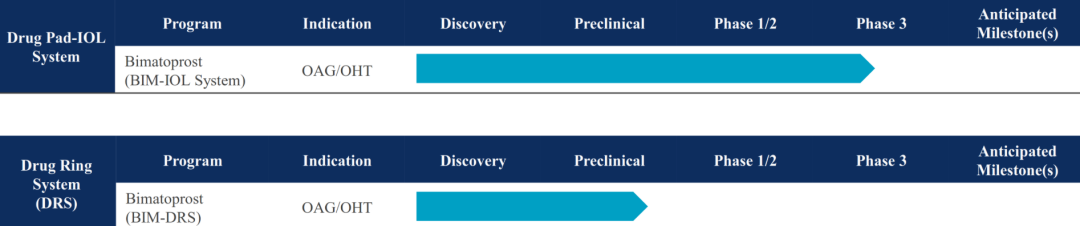
But SpyGlass' ambition doesn't stop there. The second product it is developingBIM-DRS(Drug Ring System)It is a novel, non-biodegradable, intraocular lens-independent annular sustained-release implant designed to continuously release bimatoprost for at least three years.
Unlike BIM-IOL, BIM-DRS can be achieved throughIndependent Minimally Invasive Surgical Implantation, without relying on cataract extraction surgery, thereby covering a broader patient population, including pseudophakic patients who have undergone cataract surgery, open-angle glaucoma (OAG) patients, or ocular hypertension (OHT) patients.
The system is engineered to beRemovable and Replaceable, theoretically supporting on-demand repeated treatment, which is expected to achieve lifelong management of glaucoma. Notably, BIM-DRS can also be used for re-intervention in patients who have already received BIM-IOL treatment, forming a complementaryTreatment Closed LoopCurrently, in vitro studies have confirmed its compatibility and positional stability in the human eye. Animal experiments are ongoing, and if results are positive, the company plans to initiate the first human trial in 2026.
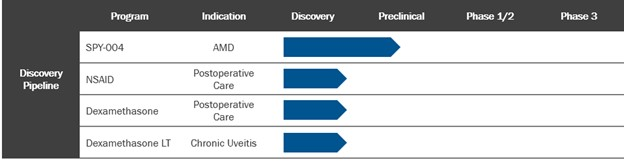
Beyond bimatoprost, SpyGlass Pharma is evaluating its technology forOther High-Incidence Eye DiseasesMarket feasibility and technical feasibility, includingAge-related Macular Degeneration (AMD), postoperative ophthalmic care, and chronic uveitis. These conditions also face treatment challenges such as poor compliance or frequent injections, and are expected to benefit from long-acting sustained-release drug delivery.
At the same time, the company's Drug Pad-IOL (drug-loaded pad-intraocular lens) system is designed to be compatible with mainstream intraocular lens materials and optical designs. Although management estimates internally that approximately 90% of glaucoma patients receive standard monofocal IOLs during cataract surgery, the company is also committed to making its platform adaptable to premium IOLs, including multifocal and astigmatism-correcting lenses, laying the foundation for future expansion to a broader population.
Business Logic: Turning Good Technology into Good Business
The uniqueness of SpyGlass product strategy lies in:Seamlessly integrate into the existing surgical system without challenging it。
Data shows that among approximately 10,000 doctors routinely performing cataract surgeries in the United States,Only about one-third routinely perform minimally invasive glaucoma surgery (MIGS) in combination.MIGS). Reasons include high training thresholds, complex operations, and disruption of workflow.
The design of BIM-IOL precisely avoids these obstacles by integrating a sustained-release drug pad onto the intraocular lens, without requiring additional surgical steps, special training, or workflow changes.Can be directly implanted in routine cataract surgery。
This means that the remaining approximately two-thirds of cataract surgeons who do not routinely perform MIGS surgeries can also provide long-term IOP control for glaucoma patients during a standard procedure, therebySignificantly Expand the Potential Service Population。
In terms of payment, the company cleverly utilizes the existing system: cataract surgeries continue to use the CPT codes familiar to doctors, while the implanted drug component will apply for a dedicated reimbursement code (J-code), with the goal of being included in Medicare Part B (which covers outpatient drugs). This meansDoctors do not need to change the charging process, and the estimated out-of-pocket burden for patients is expected to be very low, significantly lowering the threshold for implementation.. According to its estimates, the total addressable market (TAM) in the United States is as high as130Billion US dollars。
Capital Boost: The Confidence Vote Behind the IPO
In February 2026, SpyGlass Pharma successfully raised $172.5 million through its IPO, demonstrating market recognition of its ability to address significant unmet needs and its clear commercialization pathway. Amid a cooling Biotech investment climate, its translation model—starting with clinical needs, leveraging an engineering platform as a fulcrum, and ensuring compatibility with medical insurance reimbursement—exhibits notable scarcity value. Despite facing Phase III validation and competitive challenges, BIM-IOL, with the unique advantage of a single surgery eliminating the need for eye drops for three years, has the potential to reshape the glaucoma treatment paradigm.
Source: Mosun Pharmaceutical Data
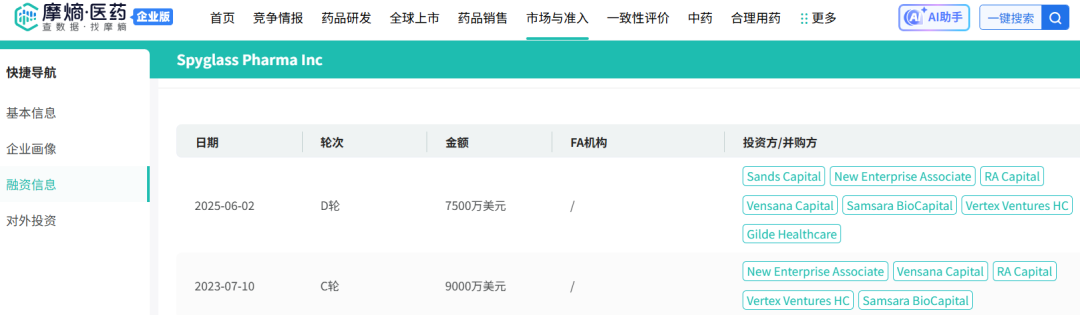
According to data from MaxEntropy Pharma, previous investors in SpyGlass Pharma include Sands Capital, Vertex Ventures HC, NEA, RA Capital, and others. As of the close on February 25, 2026, the company's market value was $930 million.According to the monitoring by PharmRing, companies that have laid out glaucoma indications in and outside of China include AbbVie, Santen Pharmaceutical, Alcon,Nicox, QLaris Bio, Thea Pharma, Glaukos, Mati Therapeutics, Myra Vision, Istar Medical, Eye Tech Care, Ocumension, Hiscare, Longmu Medical, Zhejiang Unimed, etc.
References:
Moxie Pharma Data pharma.bcpmdata.com (formerly Yaoke Rongyun Data);
https://ir.spyglasspharma.com/news-releases/news-release-details/spyglass-pharma-announces-closing-initial-public-offering-and;
https://news.cuanschutz.edu/ophthalmology/drug-delivery-platform-spyglass-for-glaucoma-patients;
https://theophthalmologist.com/issues/2019/articles/may/joining-forces-start-up-success/;
Other relevant public information (images in the text are from the official company, unless otherwise noted).
This article is intended to provide scientific information to healthcare professionals only, and does not represent the platform's position or any medication recommendations.