Yuvezzi™, the First Dual-Action Eye Drop for Presbyopia, Launches in the U.S.; Zhaoke Ophthalmology Holds Greater China Rights

Tenpoint Therapeutics
Ophthalmic Treatment Drug Developer

Recently, Tenpoint Therapeutics, Ltd.Announcement:YUVEZZI™ (Clinical stage former name)BRIMOCHOL™ PF) has now been launched in the United States for the treatment of presbyopia in adults.YUVEZZIIs the first and only approved dual-active-ingredient eye drop, combining carbachol./Brimonidine Tartrate Two Active Ingredients,2.75%/0.1%`, the combination of the two achieves potent and long-lasting efficacy, while also demonstrating good tolerability and safety.`
YUVEZZI™ Convenient medication, once a day, in a single-dose disposable package, no refrigeration required. The product is preservative-free and can be used in conjunction with other ophthalmic topical medications and contact lenses, offering a more convenient treatment option for the large population of presbyopia patients.

Presbyopia is common among the population.45In the population aged above, nearly90%Suffering from presbyopia.[1]Presbyopia-induced near vision blur can cause eye fatigue, weakness, headaches, and limit daily activities.[2][3][4]Currently, most patients with presbyopia rely on eyeglasses to correct their near vision. Many patients with presbyopia may not particularly enjoy wearing glasses. Those who previously wore contact lenses, or have undergone laser surgery, as well as those who are passionate about sports, might be interested in more convenient methods to improve near vision.

Under normal circumstances, the eye adjusts the depth of focus by changing the shape of the lens and contracting the pupil. This adjustment mechanism allows light to focus on the retina when viewing nearby objects, thereby maintaining clear near vision.[5]Presbyopia patients, due to age-related factors, experience a decline in the elasticity of the lens and other structural changes, causing the lens to inadequately adjust for near focus, which leads to the typical age-related blurred vision for near objects.[6]
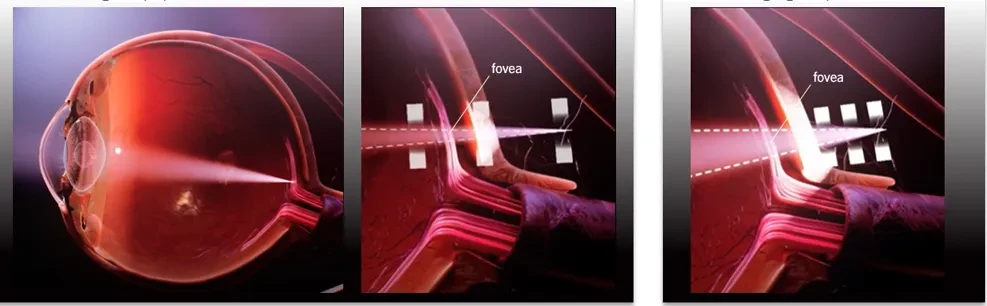
Figure: Presbyopia Imaging Principle
Miotics aim to improve near vision by reducing the pupil diameter and increasing the depth of focus, thereby treating presbyopia.[7][8][9]Pupil constriction can produce a pinhole effect, allowing light to converge better on the retina even when the lens's accommodative function is impaired.[10][11]

YUVEZZIIt is a two-component eye drop that treats presbyopia through the combined action of carbachol and brimonidine.[12]It achieves pupil contraction through two mechanisms of action, thereby enhancing the miosis effect: carbachol contracts the iris sphincter.[13]; Brimonidine inhibits the dilator muscle of the iris[14]Brimonidine can also increase the bioavailability of carbachol and prolong its duration of action.[15]In addition, brimonidine can relax the tonic contraction of the ciliary muscle and enhance the selectivity of pupil action.[12]In addition, brimonidine affects aqueous humor dynamics, which can impact the action of carbachol in the iris.CNMaintain a higher concentration.[17]
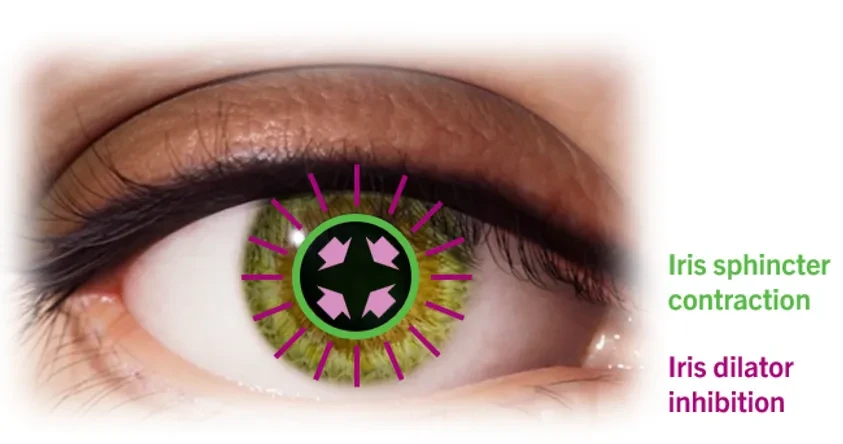
Fig: YUVEZZI is a two-component eye drop, where carbachol contracts the iris sphincter muscle and brimonidine inhibits the iris dilator muscle.

The FDA approval of YUVEZZI's marketing application was based on the completion of two pivotal Phase III trials, BRIO I and BRIO II.

BRIO IThe clinical trial adopted a crossover design with a single dose.BRIMOCHOL™ PFCompared with the two monotherapies (2.75%Carbachol,0.1%(Brimonidine Tartrate) for comparison, each subject was treated for at least3After a ten-day washout period, all subjects were sequentially administered the full regimen.3Types of eye drops. The design ensured that baseline pupil size, ocular surface issues, residual lens accommodation, and other patient characteristics were consistent across the three groups. The study included182Number of subjects, including45-80Years old with phakic or pseudophakic eyes, emmetropic eyes (±0.5Refractive power), with a baseline near vision ≤20/50, Distance vision ≥20/25. After the baseline test, the drug solution was dripped, and10Multiple time-point vision tests within hours.[16]
After administration1、2、4、6Hour,BRIMOCHOL™ PFThe efficacy was significantly better than that of single-agent carbamylcholine and brimonidine.BRIMOCHOL™ PFThe medication group reached51%The subjects reached the presetFDAEndpoint: Increase ≥ from baseline before administration15A letter (3Line), and the distant vision decline does not exceed5A letter (1). This isFDAStandard efficacy endpoints in clinical trials for the treatment of presbyopia.[16]
For patients with presbyopia who hope to get rid of glasses, another practical efficacy endpoint is near vision (BUCNVA) Reach20/40and above patient ratio. InBRIO-IIn the study,BRIMOCHOL™PFThis ratio after administration1Hours as85%,6Hour is65%,10Hours still maintained at49%。[16]
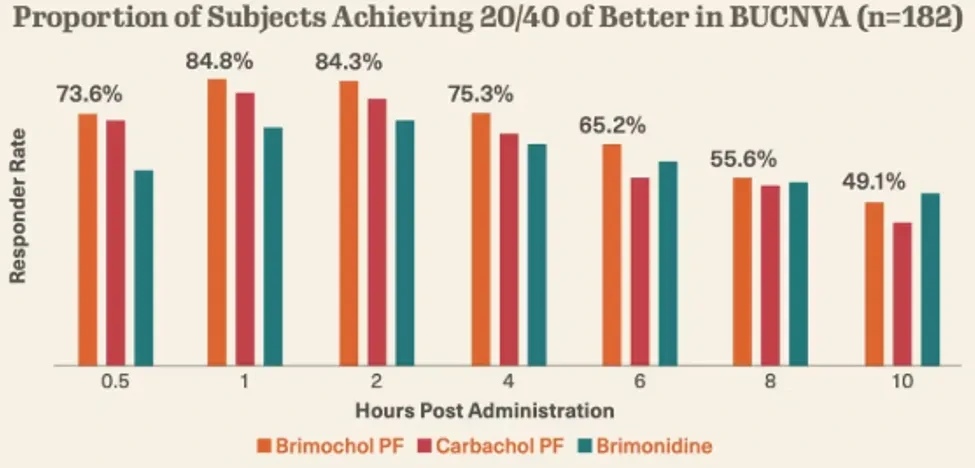
Figure: Proportion of population achieving 20/40 uncorrected near visual acuity (BUCNVA) with BRIO I, YUVEZZI, 2.75% carbachol, and 0.1% brimonidine tartrate, respectively

Decreased distance vision5Within a few letters isFDAAn important safety indicator for all presbyopia-correcting eye drops.4Distance裸眼远视力 (BUCDVA)ETDRSThe average change in the number of letters from baseline,BRIO-I In the study, no decrease in the average binocular distance visual acuity was observed for all three formulations. This suggestsBRIO IIn the trial,The improvement in near vision in each medication group did not come at the expense of distant vision.[16]
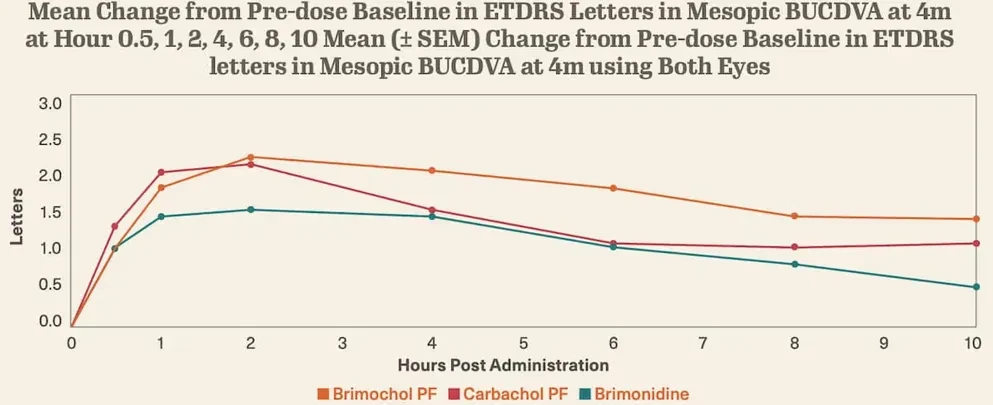
Figure: Mean change from baseline in BUCDVA ETDRS letter score at 4 meters in each treatment group in the BRIO I clinical trial
No serious treatment-related adverse events were observed in all treatments, including no cases of retinal detachment.BRIMOCHOL™ PF The most common symptom in the group was eye irritation (14% Patient) and headache (9%). No patients withdrew from the study due to tolerability issues.[16]

BRIO IIA two-arm, multi-center, randomized, double-blind controlled study on safety and efficacy, aiming to compareBRIMOCHOL™ PFCombined with solvent eye drops, used for treating presbyopic patients with phakic or pseudophakic eyes (Clinical trial number:NCT05135286). The study was conducted in the United States.47Research centers recruited a total of629Subject.[18]
BRIO IIReached an agreement with the United StatesFDA, European Medicines Agency (EMA) and the UK Medicines and Healthcare products Regulatory Agency (MHRA) Pre-specified primary endpoint: Compared with the solvent control group, from the time of dosing to8At all observation time points within hours, near vision significantly improved with statistical significance (p≤0.008)。[18]
BRIMOCHOL™ PFSignificantly reduced pupil size at all time points, with clinically and statistically significant improvement. The miosis effect8Hours later, it gradually subsides. The degree of pupil constriction weakens in the later part of the day. During the period of12No rapid tolerance to visual or pupil effects was observed during the months of the dosing phase.[18]
During the12During the months of daily dosing,BRIMOCHOL™ PFOverall tolerability was good, with no treatment-related serious adverse events occurring.[18]

In 2022,Tenpoint Therapeutics Limited andVisus Therapeutics, Inc.(2024Year12Month,Tenpoint Therapeutics,Ltd.AndVisus Therapeutics, Inc.Completed the merger and renamed toTenpoint Therapeutics,Ltd.)As forBRIMOCHOL™ PFProduct Rights Signing Cooperation. Currently, Tenpoint Therapeutics Limited ownsBRIMOCHOL™ PFGreater China, South Korea and several ASEAN countries[19], Australia, New Zealand, and several Middle Eastern countries[20]DevelopmentAnd commercial rights. Progress in China, Tenpoint TherapeuticsBRIMOCHOL™ PFClinical Trials in ChinaIIThe enrollment has been completed as scheduled. In other regional markets, Tenpoint Therapeutics LimitedBRIMOCHOL™ PFHas achieved licensing partnerships in multiple countries and regions, including Hong Kong, Macau, Taiwan, South Korea, Indonesia, Singapore, Thailand, Vietnam, Australia, and New Zealand.
- Scroll up and down to view references -
[2] Wolffsohn JS, Leteneux-Pantais C, Chiva-Razavi S, et al. Social media listening to understand the lived experience of presbyopia: systemic search and content analysis study. J Med Internet Res. 2020;22(9):e18306.
[3] Markoulli M, Fricke TR, Arrvind A, et al. BCLA CLEAR Presbyopia: epidemiology and impact. Contact Lens Anterior Eye. 2024;47(4):102157.
[4] Mancil GL, Bailey IL, Brookman KE, et al. Optometric clinical practice guideline care of the patient with presbyopia. Reference guide for clinicians. J Am Optom Assoc. 2011;1:458.
[5] Motlagh M, Geetha R. Physiology, accommodation. In: StatPearls [Internet]. Treasure Island (FL): StatPearls Publishing. Updated November 15, 2022. Accessed July 15, 2025. https://www.ncbi.nlm.nih.gov/books/NBK542189/.
[6] National Eye Institute. Presbyopia. Updated December 4, 2024. Accessed February 12, 2026. Presbyopia. https://www.nei.nih.gov/eye-health-information/eye-conditions-and-diseases/presbyopia.
[7] Grzybowski A, Raumviboonsuk V. Pharmacological treatment in presbyopia. J Clin Med. 2022;11:1385.
[8] Haghpanah N, Alany R. Pharmacological treatment of presbyopia. Eur J Tranls Myol. 2022;32(3):10781.
[9] Naroo SA, Woods CA, Gil-Cazorla R, et al. BCLA CLEAR presbyopia: management with scleral techniques, lens softening, pharmaceutical and nutritional therapies. Cont Lens Anterior Eye. 2024;47:102191.
[10] Manion GN, Stokkermans TJ. The effect of pupil size on visual resolution. In: StatPearls. [Internet] Treasure Island (FL): StatPearls Publishing. Updated February 28, 2024. Accessed July 15, 2025. https://www.ncbi.nlm.nih.gov/sites/books/NBK603732/.
[11] Charman WN. Pinholes and presbyopia: solution or sideshow? Ophthalmic Physiol Opt. 2019;39:1-10.
[12] YUVEZZI prescribing information. Tenpoint Therapeutics; 2026.
[13] Ishikawa H, DeSantis L, Patil PN. Selectivity of muscarinic agonists including (±)-aceclidine and antimuscarinics on the human intraocular muscles. J Ocul Pharmacol. 1998;14(4):363-374.
[14] Tatsui S, Ishikawa H, Shimizu K, Mashimo K. Pre- and postsynaptic effects of brimonidine on isolated rabbit iris dilator muscles. Clin Ophthalmol. 2016;10:845-849.
[15] Verhoeven RS, Burke J, Schiffman R. Pharmacodynamics of brimochol, a combination product for the treatment of presbyopia. Invest Ophthalmol Vis Sci. 2022;63:1819-F0435.
[16] Yeu E, Koetting C. Study offering new hope for medical presbyopia correction. Ophthalmology Times. 2023 Oct 27.
[17] Verhoeven RS, Burke J, Schiffman R. Nonclini- cal pharmacokinetics and pharmacodynamics of Brimochol, a combination product for the treatment of presbyopia. Invest Ophthalmol Vis Sci 2022;63(7):1819 – F0435.
[18] Tenpoint Therapeutics Announces Positive Topline Data from Phase 3 Pivotal Study, BRIO-II, of BRIMOCHOLTM PF for the Treatment of Presbyopia. https://tenpointtherapeutics.com/
[19] Including: Brunei, Cambodia, Indonesia, Laos, Malaysia, Myanmar, Philippines, Singapore, Thailand, Timor-Leste, Papua New Guinea, and Vietnam.
[20] Including: Saudi Arabia, the United Arab Emirates, Qatar, Bahrain, Kuwait, and Oman
Copyright © 2026 PHARMCUBE. All Rights Reserved. Disclaimer: The information in this WeChat article is for general reference only and should not be used directly as decision-making content. PharmaCube assumes no responsibility for any loss incurred by any party due to the use of the content herein.