

AbelZeta’s Bispecific CAR-T Therapy C-CAR039 Demonstrates Median Progression-Free Survival Exceeding 5 Years in Long-Term Follow-Up of Relapsed/Refractory B-NHL Patients
AbelZeta
Developer of Immune Cell and Stem Cell Therapy Products

April 30, 2026
eMedClub News
In recent years, CAR-T cell therapy has achieved revolutionary breakthroughs in the field of hematological malignancies. However, approximately half of patients with relapsed/refractory B-cell non-Hodgkin lymphoma (R/R B-NHL) still experience disease progression around six months after receiving CD19 single-target CAR-T treatment, with antigen escape being an important mechanism of resistance. How to further enhance the depth and durability of CAR-T treatment remains a direction of ongoing exploration in the field.
Cellular Biomedicine Group (AbelZeta) presented the long-term follow-up data of its core product C-CAR039 (C-CAR039, a CD20/CD19 dual-target autologous CAR-T product, generic name: Prizloncabtagene autoleucel) for the treatment of R/R B-NHL at the 2026 European Society for Blood and Marrow Transplantation (EBMT) Annual Meeting held at the end of March this year. The results showed,At a median follow-up of 53.9 months, the median progression-free survival (PFS) reached 60.1 months (5 years)., with a 4-year overall survival (OS) rate exceeding 65%, and no new safety signals detected. This long-term data has pushed the clinical benefits of this dual-target CAR-T to new heights.
Long-term Follow-up Validates Durable Efficacy: Over Half of Patients Achieve 5-Year Progression-Free Survival
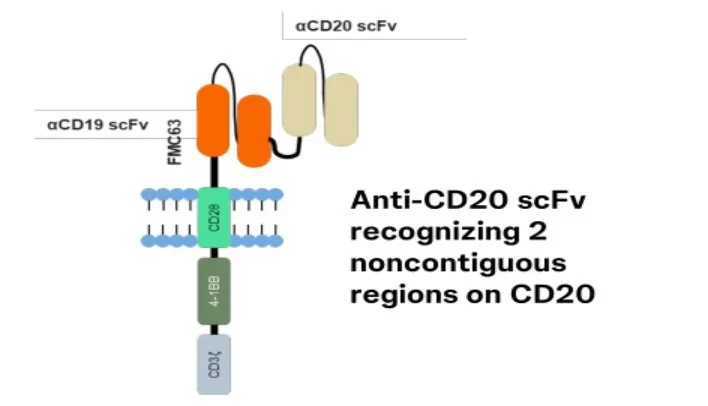
C-CAR039 is a second-generation autologous CAR-T product independently developed by Cellular Biomedicine Group (Shanghai) Ltd, targeting CD20 and CD19 with a 4-1BB co-stimulatory domain. The dual-target design aims to overcome tumor recurrence caused by heterogeneous antigen expression and antigen loss in CD20/CD19. The data presented here are from the long-term follow-up of a Phase I investigator-initiated clinical trial (IIT, NCT04317885, etc.) conducted across four centers in China.
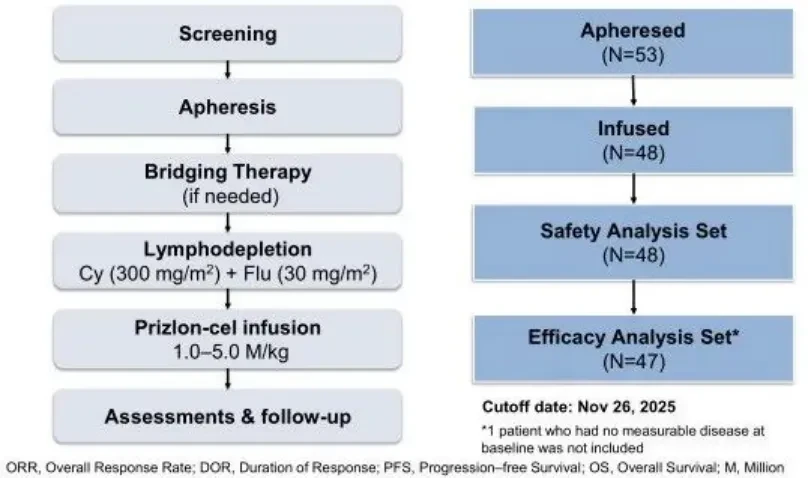
The study enrolled a total of 48 patients with R/R B-NHL, of which 44 (91.7%) had relapsed or refractory large B-cell lymphoma (LBCL) with a poor prognosis. These patients had a median of 3 prior lines of therapy, 70.8% were refractory, 75% were in Ann Arbor stage III/IV, and their baseline conditions were extremely severe.
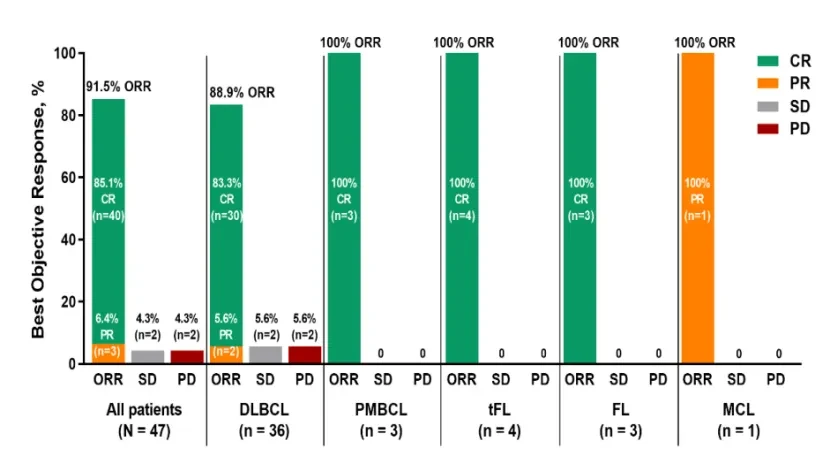
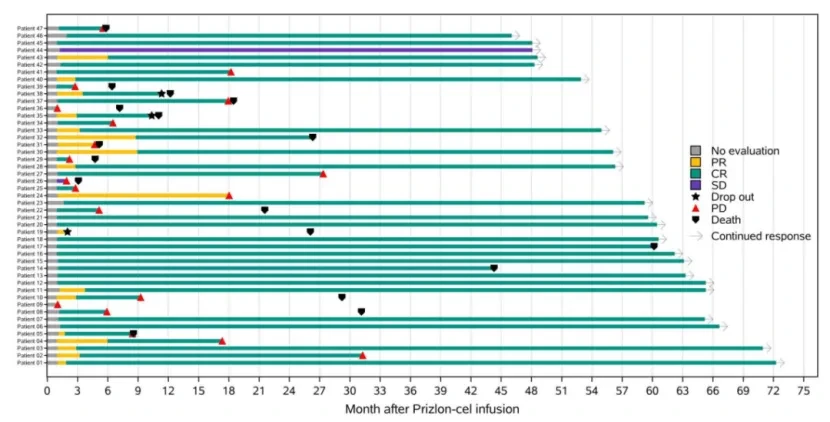
As the follow-up time extended to a median of 53.9 months (range 3.1-72.2 months), C-CAR039 demonstrated unexpectedly durable efficacy.Among all 48 patients, the objective response rate (ORR) was 91.5%, and the complete response rate (CR) reached 85.1%.; In the LBCL subgroup (43 cases), the ORR and CR rates were 90.7% and 86.0%, respectively. Notably, many patients who initially achieved only partial response (PR) gradually converted to CR during subsequent follow-ups, demonstrating the sustained effect of dual-target CAR-T in deeply eliminating tumors.
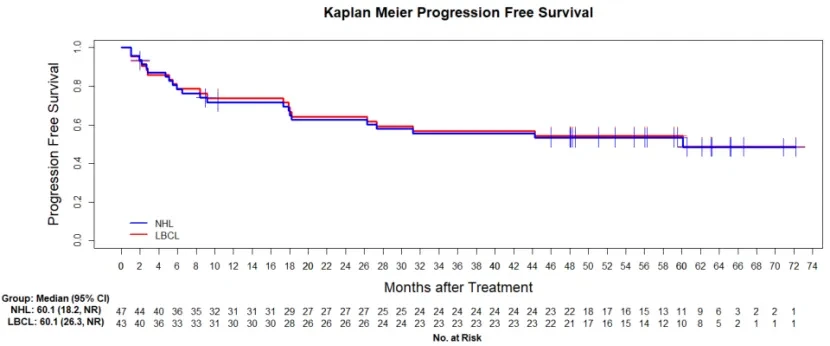
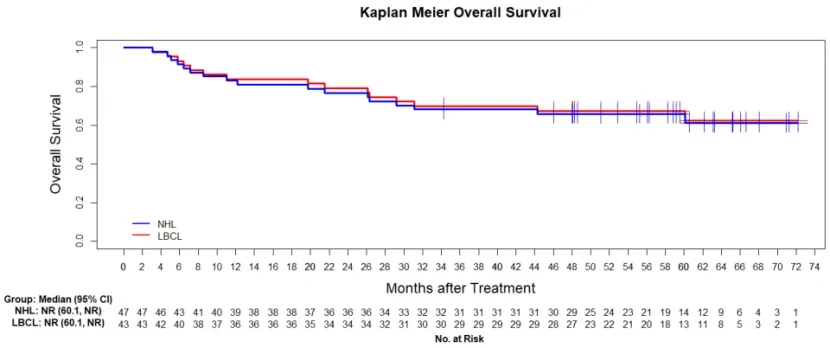
In terms of long-term survival benefits, the median PFS for all patients was as long as 60.1 months (approximately 5 years), with a 4-year PFS rate estimated by Kaplan-Meier at 53.3%; the 4-year PFS rate for LBCL patients also reached 54.2%. The median overall survival (OS) has not yet been reached, and the 4-year OS rates for all patients and LBCL patients were 65.9% and 67.4%, respectively. This means that even for patients with primary refractory lymphoma who failed multiple lines of treatment, C-CAR039 is expected to help more than half achieve disease-free progression survival of over 4 years, with nearly 70% of patients surviving beyond 4 years.
In LBCL patients, 28 cases (65.1%) were still alive at nearly 4.5 years, of which 20 cases (46.5%) remained in continuous remission without receiving any subsequent anti-lymphoma treatment. No disease progression occurred in patients followed up for more than 3 years after treatment.These data strongly demonstrate that C-CAR039 can provide patients with long-term, stable disease control without reliance on additional therapeutic interventions, exhibiting potential "curative" characteristics.
Long-term safety is stable and controllable, with clear clinical management points.
# Efficacy and Long-Term Safety of Cell Therapy: C-CAR039 UpdateIn addition to efficacy, long-term safety is the cornerstone for evaluating whether cell therapy can be widely applied. The updated data show that the safety profile of C-CAR039 is consistent with previous reports, with no new safety signals observed. The overall incidence of cytokine release syndrome (CRS) was 93.8%, but severe CRS of grade ≥3 occurred in only one case (2.1%). The incidence of immune effector cell-associated neurotoxicity syndrome (ICANS) was 6.3%, all of which were grade 1-2, with no events of grade ≥3. This low severe toxicity profile is related to the design of the 4-1BB co-stimulatory domain used in the product and the potentially more balanced T-cell activation brought by the dual-targeting mechanism.
During long-term follow-up, the most common Grade ≥3 adverse events remained hematologic cytopenias, with neutropenia accounting for 83.3% and leukopenia for 50%. However, most patients' cytopenias recovered within 90 days post-infusion, and by Day 365, only two cases had persistent severe cytopenia. Clinically, it is notable that beyond 90 days post-infusion, more than half of the patients experienced infectious events, among which the incidence of herpes zoster infection was relatively high (18.8%). This suggests that prolonged B-cell deficiency following CAR-T therapy may pose a risk of delayed infections. It is recommended to enhance preventive antiviral therapy for infections such as herpes zoster in subsequent clinical management.
Significant Acceleration in Clinical Progress, Global Clinical Data Revalidated
Since the enrollment of the first patient, C-CAR039 has completed long-term follow-up in a Phase I investigator-initiated trial (IIT) in China, accumulating 53.9 months of follow-up data. Based on this robust clinical evidence, the registrational clinical study (NCT05800977) for C-CAR039 is actively enrolling patients in China to conduct pivotal trials targeting relapsed/refractory large B-cell lymphoma (R/R LBCL).Chinese patients are expected to be the first to benefit from this domestically innovative cell therapy with international competitiveness.
In 2023, Cellular Biomedicine Group (Shanghai) Ltd. entered into a global collaboration and licensing agreement with Johnson & Johnson, under which Johnson & Johnson is responsible for the global development of C-CAR039 (code name JNJ-90014496) outside of Greater China. At the EBMT meeting in March 2026, Johnson & Johnson presented the results of the global Phase 1b (NCT05421663) clinical and translational medicine study of JNJ-90014496. To date, Johnson & Johnson has consecutively disclosed preliminary data from the global Phase 1b dose exploration study at the EHA in June 2025, ASH in December 2025, and EBMT in March 2026. According to the update on clinicaltrials.gov as of April 2026, this clinical trial is expected to enroll over 400 patients across more than 30 global clinical sites.
In the 51 patients from the global Phase 1b trial data published by Johnson & Johnson, the ORR reached 91%, with a CR rate of 75%., showing a clear advantage in efficacy compared to commercially available CD19 single-target CAR-T. Biomarker analysis also indicates that C-CAR039 maintains a high CR rate of over 80%, even in conditions with low expression of CD20 or CD19 and in immunosuppressive tumor microenvironments (such as TEX and FMAC subtypes) traditionally considered to have poor responses to CAR-T.These data validate the mechanism advantage of the dual-target from a global multicenter perspective, and also lay the foundation for subsequent registration.
Dual-Target CAR-T Poised to Reshape the Long-Term Treatment Landscape for Lymphoma
For patients with relapsed/refractory large B-cell lymphoma, the median PFS of existing CD19 single-target CAR-T therapies is typically between 3-7 months, with a 4-year PFS rate of approximately 30%-47%. The 53.9-month follow-up data recently announced for C-CAR039—showing a median PFS of 5 years and a 4-year PFS rate exceeding 53%—is among the leading long-term data for all CAR-T products currently available. Although differences in patient baseline characteristics exist across studies, making non-head-to-head comparisons should be done cautiously, the mechanistic advantages of the dual-target strategy in overcoming antigen escape and enhancing the depth of remission have been strongly supported by clinical data.
With the advancement of registrational studies and continuous updates from long-term follow-ups,C-CAR039 is expected to become the new benchmark for the treatment of relapsed/refractory B-cell lymphoma, once again demonstrating the irreplaceable unique advantages of CAR-T compared to other modalities, offering true long-term survival hope for patients worldwide.。
*Data sources for this article: 2026 EBMT Conference Poster (median follow-up of 53.9 months), Blood journal (2025;145:1526-1535), EHA 2025, and ASH 2025 meeting reports.*
Statement
Disclaimer: This article aims to convey industry development information and explore the frontier progress of biomedicine. The content of the article represents the author's viewpoint, and does not represent the position of EMedClub, nor does it constitute any value judgment, investment advice, or medical guidance. If necessary, please consult a professional for investment or visit a正规 hospital for medical advice.

DianDian "Share”、“Like"and"In Progress"Give me a little recharge~"