HuaDao CAR-Tcell IPO: Layout of Local Whole Industry Chain in China, Aiming to Break the High Price Barrier of CAR-T
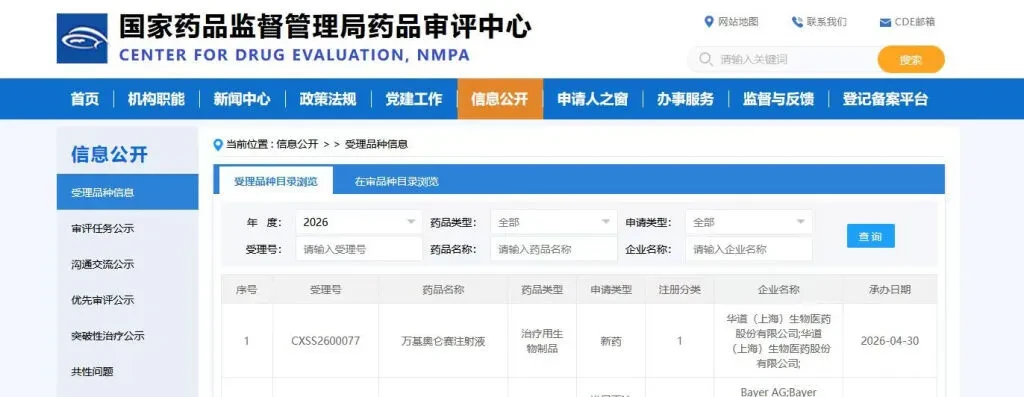
On April 30, the Center for Drug Evaluation under the National Medical Products Administration announced that the marketing application for HuaDao CAR-Tcell's first Class 1 new drug—Wanjio Olunsa Injection, a CAR-T cell therapy for refractory and relapsed non-Hodgkin lymphoma—has been officially accepted. This drug is intended for treating refractory and relapsed non-Hodgkin lymphoma. On April 2, the website of the China Securities Regulatory Commission revealed that HuaDao CAR-Tcell had submitted an initial public offering (IPO) and listing tutoring filing report to the Shanghai Securities Regulatory Bureau.
How dare a company, whose drug hasn't even been marketed yet, push for an IPO? Moreover, it has signaled that after going public, its pricing will be "just over 200,000 yuan, aiming to break the price range of CAR-T products already on the market in China, which are between 999,000 and 1.29 million yuan."
In response to the questions from the Health Client of the People's Daily, Yu Xuejun, Chairman and General Manager of HuaDao CAR-Tcell, introduced that in 2015, at the inception of the company, the founding team decided to initiate independent innovation of core technologies across the entire industry chain while advancing drug research and development. The aim was to break the import monopoly from the source and pave the way for "affordable pricing."
Yu Xuejun told the reporter: "As a breakthrough tumor treatment technology of the 21st century, CAR-T therapy is moving from the laboratory to clinical applications. However, core equipment, consumables, and reagents in the global industry are almost entirely monopolized by European and American companies. In the field of cell therapy, the root cause of high costs lies in the 'full-chain reliance on imports.' A set of imported GMP cell production equipment costs over 2.5 million yuan and can only prepare treatments for 25 to 30 patients per year. The unit price of imported disposable consumables exceeds 100,000 yuan, and the cost of viral vectors ranges from 15,000 to 30,000 US dollars. These cumulative costs make it difficult for CAR-T drugs to be priced below one million yuan."
After repeated efforts, on June 27, 2023, the entire industrial chain production technology of HuaDao CAR-Tcell passed the associated technical review by the Center for Drug Evaluation of China. From this moment on, Yu Xuejun believed that he had led his team to fully打通了从底层技术到最终产品的每一个环节, establishing a complete, fully automated, closed-cell production technology entirely their own, while also developing corresponding reagents, consumables, and pharmaceutical packaging materials.
"This means that we have fully mastered the entire set of production technology in our own hands," said Yu Xuejun. "As everyone knows, cell-based drugs themselves are an entirely new category of pharmaceuticals, and the industrial technology is something completely new as well. We are also the first company in China to submit a full industry chain technology change before the confirmatory clinical trial—everything is new."
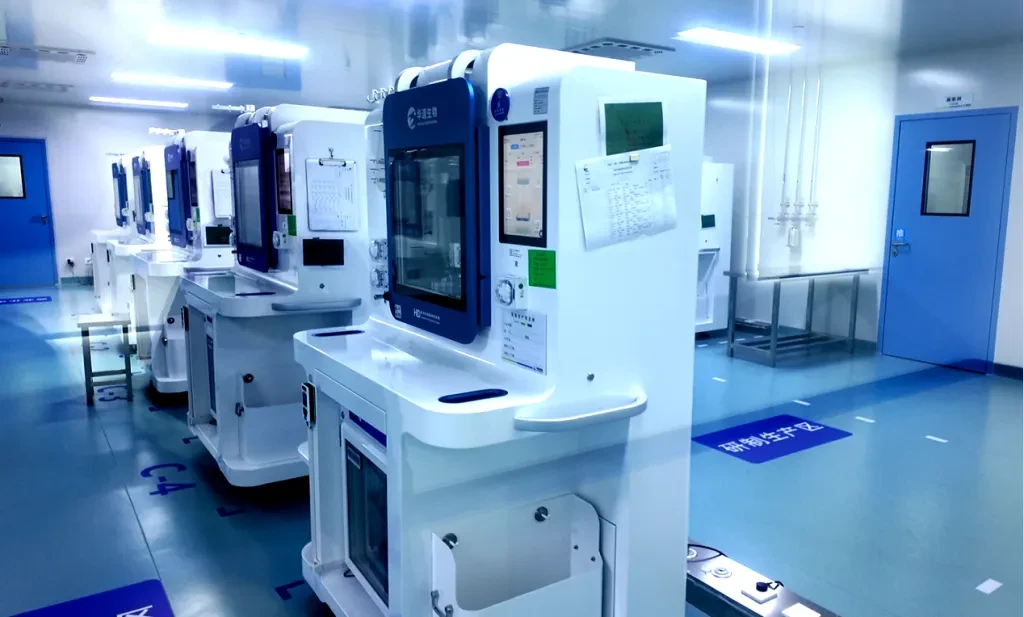
Ant Workstation independently developed by HuaDao CAR-Tcell (Photo by Yin Wei)
In the new factory of HuaDao CAR-Tcell, reporters saw the "Ant Workshop" independently developed by HuaDao. Yu Xuejun introduced: "This set of unmanned production, fully automatic and fully enclosed cell drug intelligent manufacturing equipment completely replaces imported core equipment. Not only is the cell production technology more advanced, but the manufacturing cost is also only about one-tenth of that of imported products. This system can increase production capacity to over 50 times that of traditional methods, while also raising the success rate of cell production from around 80% traditionally to 99%, further reducing the unit manufacturing cost. Currently, the designed annual production capacity of the phase II production base under construction can reach 9,000 person-doses, far exceeding the highest annual capacity of less than 300 person-doses for domestically marketed products in China."
To design this system, Yu Xuejun spent every day in the laboratory and workshop, personally overseeing every step—from the blueprint design of core equipment to the formula adjustment of reagent materials, from the optimization of production processes to the establishment of quality control standards.
So, when HuaDao CAR-Tcell's entire industry technology change application was approved, the excitement and emotion felt by all HuaDao employees were indescribable. "We have now completed the confirmatory clinical trial, held a communication meeting with the CDE regarding the drug marketing application, and have formally submitted the marketing authorization application."
"Although the specific clinical trial data cannot be disclosed for now, what can be revealed is that the CAR-T cells produced by HuaDao CAR-Tcell with fully independent industrial technology can stand up to a 'head-to-head' superiority comparison with related cell drug products already on the market both in China and internationally, whether in terms of safety or efficacy data. This indirectly proves the advancement and reliability of our fully independent industrial technology." In this regard, Yu Xuejun appeared extremely confident.
He also revealed that currently, apart from the first HD CD19 CAR-T product for refractory and relapsed non-Hodgkin lymphoma being at the marketing application stage, HuaDao CAR-Tcell has four other CAR-T drugs targeting different types of cancers that have entered Phase I-II clinical trials. These include two CAR-T cell therapies for solid tumors aimed at reducing postoperative metastasis and recurrence in the future. The pricing of the first drug will serve as the basis for the pricing of subsequent products.
By the end of 2025, HuaDao CAR-Tcell will launch the layout of five major industrial bases across China, covering the five regions of East, North, South, Southwest, and Northwest China, enabling patients to receive standardized CAR-T treatment close to home and addressing the pain points of strong time sensitivity and cold chain transportation for cell drugs.
Whether this全产业链自主创新 approach, regarded by many in the biopharmaceutical industry as a far-fetched idea, will ultimately succeed in bringing cell therapy drugs—once considered "astronomically expensive luxuries"—into an affordable price range for ordinary people is a result worth watching.
Editor: Li Yimeng
Editor-in-Chief: Xu Tingting
Proofread by: Wu Xingru