



On May 12, multiple media reports stated that Hei Yongjiang, Executive President and Global Chief Medical Officer of CSPC, officially resigned recently and has started his personal entrepreneurial journey in Shanghai.
Data from Tianyancha shows that Shanghai Huisibo Biomedical Technology Co., Ltd. was established in Qingpu District on April 13, 2026, with Hei Yongjiang as the legal representative.
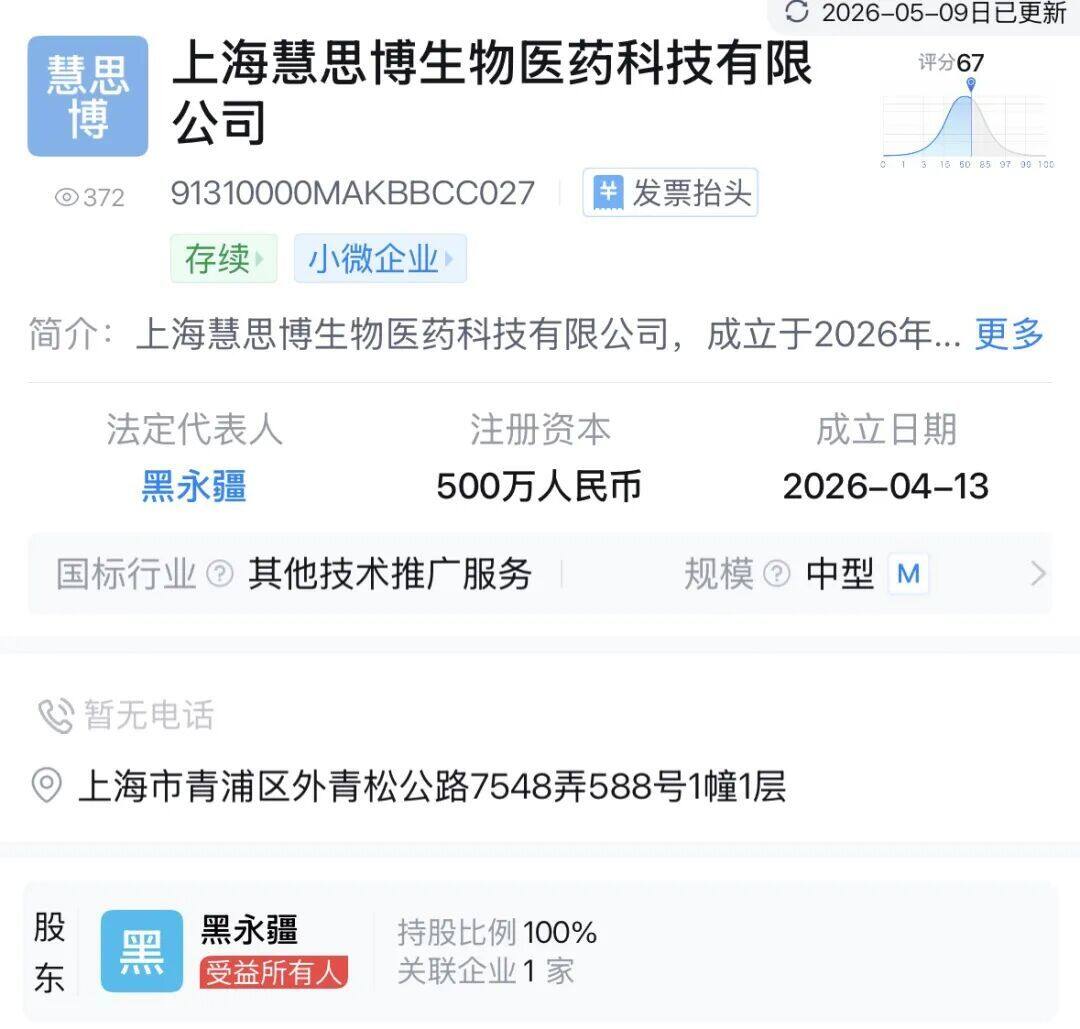
This company has a registered capital of 5 million yuan, with business scope covering multiple fields such as technical services, technology development, natural science research and experimental development, medical research and experimental development, and belongs to the industry of science and technology promotion and application services.
As a senior expert with nearly 30 years of in-depth experience in the clinical development and medical affairs of innovative oncology drugs in the pharmaceutical industry, Hei Yongjiang's career is a benchmark in the field. Holding a Bachelor of Medicine from Shihezi Medical College, a Master’s degree in Pharmacology from West China University of Medical Sciences, and a Ph.D. in Pharmacology from the University of British Columbia in Canada, his career spans multinational pharmaceutical companies and China-based innovative drug enterprises, combining global operational perspectives with localized practical experience.
Personnel Changes After the Second Generation Takes the Helm
He Yongjiang began his pharmaceutical career at Bristol-Myers Squibb, then joined Roche as the U.S. Medical Director; later, he worked at Novartis as the Senior Global Brand Medical Director for Oncology; he also worked at Amgen for nearly a decade, holding key positions such as Executive Medical Director for Global Oncology Development and Medical Affairs.
He also has work experience in Chinese pharmaceutical companies. After returning to China, he served as the Chief Medical Officer at Qilu Pharmaceutical, then quickly moved to Zai Lab, and subsequently held senior executive positions at Guangzhou Yuheng Biotechnology Co., Ltd., Wuxi Zhikang Hongyi Biotechnology Co., Ltd., and CSPC, where he was responsible for clinical development and medical strategy.
It is reported that Hei Yongjiang has achieved remarkable success in the clinical trials and global development of drugs across multiple technological pathways, including small molecules, large molecules, and ADCs, with particularly profound influence in the field of innovative oncology drugs.
The question that the market is most concerned about at present is whether Hei Yongjiang, as the global chief medical officer with profound influence in the field of innovative drug clinical development, will have a short-term impact on CSPC after his departure?
Data shows that Hei Yongjiang worked at CSPC for only one and a half years (December 2024 – April 2026), during which he mainly promoted the oncology pipeline and international clinical layout. Since 2025, CSPC has added five outbound BD deals, generating licensing revenue of 1.789 billion yuan, marking a nearly 99-fold year-on-year increase.
Reporters found that since 2025, CSPC has had four core senior executives leave, involving R&D, management, and subsidiary leadership.
Liu Yongjun, who left in December 2024, joined CSPC in September 2024 as Executive President and Global R&D President. However, he resigned after only three months. Although the timing was slightly earlier than 2025, the impact of his departure extended into 2025, marking the beginning of a wave of executive changes. He subsequently founded "Xiaolu Biotech," focusing on autoimmune diseases.
On December 19, 2025, Zhang Cuilong resigned. Zhang Cuilong joined the CSPC system in 1996 and has worked for nearly 30 years, serving as CEO. He stepped down from his positions as Chief Executive Officer and Vice Chairman of the Board due to a work transfer, transitioning to an executive director role. This marks the gradual shift of the "first-generation" professional managers to the second line.
In November 2025, Pan Weidong, the former chairman of CSPC, resigned from his positions as chairman and director due to personal affairs and will no longer hold any position in the company after resignation.
Hei Yongjiang's departure has once again drawn industry attention — he has now founded Shanghai Huisibo Biopharmaceutical Technology Co., Ltd. In March this year, Zhang Yiwei was appointed as executive director, seen as part of the ongoing optimization of the management team.
Notably, Cai Lei, the son of founder Cai Dongchen, will officially assume the roles of Vice Chairman of the Board, Executive Director, Chief Executive Officer, and Authorized Representative of CSPC PHARMACEUTICAL GROUP LIMITED starting from December 19, 2025.
This personnel adjustment marks a new phase for CSPC PHARMACEUTICAL GROUP LIMITED entering the "second-generation leadership," and the company's major personnel "shake-up" also happens to occur after the second-generation leadership took the helm.
Before officially taking office, Cai Lei had served as the Executive President of CSPC, Vice President of the U.S. R&D Division, and President of the Pharmaceutical Product Sales Division, leading overseas R&D and sales operations.
After taking the stage, Cai Lei led CSPC to focus on three major directions: innovative drug research and development, international layout, and business integration, promoting the company's transformation from a "generic drug giant" to an "innovation-driven" pharmaceutical enterprise.
In terms of talent strategy, CSPC advocates a transformation from "individual-driven" to "system-driven," continuously promoting the platformization of the R&D system and the rejuvenation of the management team, reducing reliance on individual senior executives.
A 10% decline in performance
Since 2023, CSPC has completed over 10 BD deals, covering hot fields such as ADC, siRNA, and GLP-1 small molecules, with a dense pace of overseas expansion and considerable transaction benefits.
However, according to the latest annual report data, CSPC PHARMACEUTICAL GROUP LIMITED's performance has seen a significant decline. The data shows that in 2025, CSPC's revenue was 26.006 billion yuan, a year-on-year decrease of 10.4%. Net profit was 3.876 billion yuan, a year-on-year drop of 10.66%. Its R&D investment increased against the trend by 11.9% to 5.809 billion yuan, accounting for 28.2% of the revenue from finished drug products. The company stated that the decline in performance was mainly due to the impact of core products such as Duomisu and Jinyouli being included in centralized procurement.
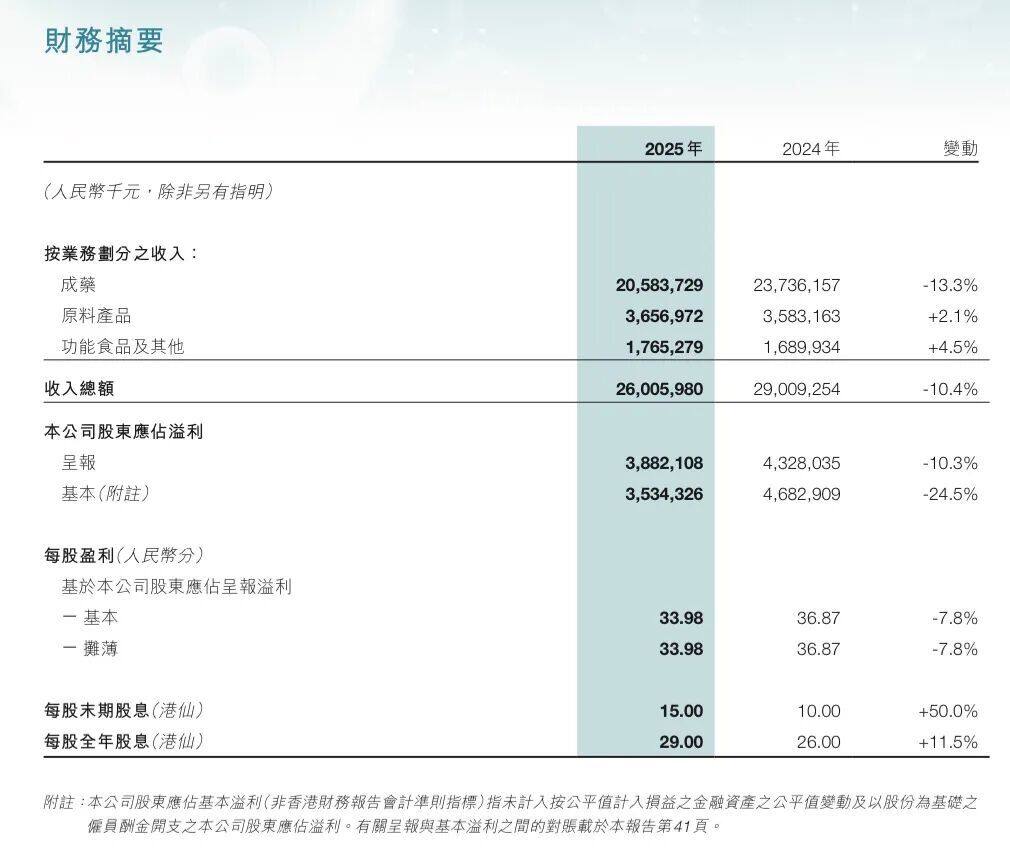
Specifically, CSPC, which is in the midst of a transformation, is experiencing a divergence with its older products under pressure and new products showing slow progress. Revenue from areas such as the nervous system, anti-tumor, anti-infection, cardiovascular, and digestive metabolism saw a year-on-year decline, with only the respiratory system and other fields achieving growth.
For example, in 2025, the core product Enbipu faced a price reduction due to adjustments in the National Reimbursement Drug List negotiations, leading to a decline in sales revenue. The prices of its key oncology drugs, Doxil and Jin Youli, plummeted by 89% and 58% respectively in the centralized procurement process, causing a sharp 60.8% drop in oncology business revenue.
Despite the impressive growth rate of CSPC's newly listed products, they have not yet become the core driver of the group’s performance. Among the newly approved products in the past two years, Mingfule shows the highest growth potential. As a groundbreaking innovative drug in the cerebrovascular field, it perfectly complements the flagship product Enbipu: while Enbipu focuses on neurorepair and brain protection after the acute phase of cerebral infarction, Mingfule precisely targets thrombolytic therapy within the golden 4.5-hour window of the acute phase. The synergy between the two will further solidify CSPC's leading position in the stroke treatment sector.
Besides, the company's other R&D and marketed products are still dominated by generic drugs and biosimilars, which also marks that CSPC's strategic transformation to a fully innovative pharmaceutical enterprise has not yet been truly completed.
Moreover, CSPC had already invested in popular fields like PD-1 and GLP-1 as early as 2018, but the results have been slow to materialize. The PD-1 drug Ansuixing was only approved for marketing in 2024, by which time the competitive landscape had become extremely crowded.
Entering the Transition Pain Period
Cai Lei has placed his hope for innovation on Sinopharm.
In 2004, Cisen was spun off from CSPC and became an independent entity focusing on caffeine and health products as its main business. It successfully went public on the A-share market in 2019. From 2023 to 2025, Cisen spent a total of approximately 2.97 billion yuan in two phases to acquire 80% of the equity of Jushi Biologics, a CSPC subsidiary specializing in cutting-edge biopharmaceutical R&D such as ADCs and mRNA vaccines. Through this acquisition, Cisen entered the innovative drug sector, becoming the core vehicle for CSPC's innovation transformation.
In November 2023, the company officially changed its name to "CSPC Innovative Pharmaceuticals Co., Ltd.," with the stock abbreviation remaining as "Xin Nuowei," marking its strategic transformation from a traditional API enterprise to an innovative drug platform.
In December 2025, CisenBio took another critical step by jointly establishing Runshi Bio with Zhongqi Pharmaceutical, injecting all of CSPC's GLP-1 target pipelines into the new company. Thus, CisenBio completed its full transformation into "CSPC's core platform for innovative drugs."
The injection of innovative drug assets once brought an explosive growth in market value to Newlink Pharma – its market value surged from less than 10 billion yuan to breaking through the 50 billion yuan mark, demonstrating the capital market's high expectations for its transformation prospects.
However, behind the brilliant market value lies the heavy pressure of transformation pain. Jushi Bio, which was incorporated into the system, reported a net loss of 727 million yuan in 2024, directly dragging down CSPC's innovative sector from profit to loss, resulting in a total loss of 304 million yuan that year. Xinuo Wei has thus entered the "painful period" of transformation.
The latest released 2025 annual report shows that CSPC Xinyao achieved operating revenue of 2.158 billion yuan, a year-on-year increase of 8.93%, but the attributable net profit was -241 million yuan, marking the second consecutive year of losses.
In December 2025, CSPC Innovation announced its push for a Hong Kong stock listing. The prospectus clearly stated that the funds raised would be used to support biopharmaceutical research and development and commercialization. Industry insiders believe that this move is aimed at finding a long-term "lifeline" for the company’s continuously cash-burning innovative drug business.