Chinese Dual-Payload ADCs Take Center Stage with Record-Breaking License-Out Deals in May 2026

Phrontline Biopharma
Antibody-Drug Conjugate (ADC) Developer

Qilu Pharmaceutical
Specialty Formulations and Active Pharmaceutical Ingredients (API) Developer
As one of the largest and most influential events in the global oncology field, the 2026 American Association for Cancer Research Annual Meeting (AACR 2026) recently concluded successfully in the United States. At this year's meeting, the overall热度 of the ADC (antibody-drug conjugate) field continued to rise, with over 400 ADC-related abstracts submitted. Among these, dual-payload ADCs became one of the core focuses. Chinese pharmaceutical companies, with their deep involvement, made a significant impact in this wave of global innovation.
Dual-Payload ADC, as the name suggests, is based on the traditional ADC "antibody-linker-payload" structure, conjugating two payloads with different mechanisms of action onto the same antibody molecule to achieve synergistic tumor-killing effects.
Traditional single-payload ADCs have demonstrated significant efficacy, but they still fall short when facing the two major challenges of tumor heterogeneity and drug resistance. The emergence of dual-payload ADCs aims to address these pain points. For example, one payload may kill tumor cells by damaging DNA, while another may inhibit cell division by blocking microtubule polymerization. The two work synergistically, delivering a "one-two punch" that leaves tumor cells struggling to cope.
At this year's AACR annual meeting, Chinese pharmaceutical companies stood out with particularly impressive performances. According to statistics, more than 100 Chinese pharmaceutical companies participated, showcasing over 250 innovative achievements, among which dual-payload ADC projects became one of the highlights.
Phrontline Biopharma Presents Preclinical Data for TJ106, a Bispecific Dual-Payload ADC Targeting HER2. The drug addresses resistance challenges faced by existing therapies such as Enhertu. TJ106, with its unique bispecific antibody design, can simultaneously bind to two different epitopes of the HER2 protein, enabling more effective drug delivery into tumor cells. It carries two payloads with distinct mechanisms of action—a topoisomerase I inhibitor and a microtubule inhibitor—creating a synergistic cytotoxic effect. Data shows that TJ106 demonstrates superior antitumor activity compared to DS-8201a across various tumor models with different HER2 expression levels. Notably, it effectively inhibits tumor growth in Enhertu-resistant models, highlighting its potential as a next-generation HER2-targeted therapy.
Qilu Pharmaceutical Presents Preclinical Data on Its Self-Developed Bispecific Dual-Payload ADC Drug LUA006
Biocytogen Presents Preclinical Research Data for Its Self-Developed Bispecific Dual-Payload ADC Drug BCG048. The drug targets ITGB6 and B7H3, which are highly co-expressed in various solid tumors. The bispecific antibody, developed through the RenLite mouse platform, not only binds to both targets simultaneously but also enhances endocytic efficiency, achieving precise targeting. BCG048 incorporates two complementary payloads: a topoisomerase I inhibitor and a microtubule inhibitor. Through a synergistic effect, it broadens the killing range of heterogeneous tumor cells and effectively overcomes resistance mechanisms associated with single payloads. Research data shows that BCG048 exhibits significant anti-tumor activity in patient-derived tumor xenograft (PDX) models, surpassing benchmark ADC drugs in efficacy. It remains highly effective even in tumor models with low expression of ITGB6 or B7H3, offering a new treatment option for patients with solid tumors co-expressing ITGB6/B7H3.
DuoXi Biologics Highlighted its Next-Generation FRα-Targeted Dual-Payload ADC Drug DXC011 at the AACR Annual Meeting. The drug aims to address clinical pain points faced by the marketed drug Elahere, such as high toxicity, narrow therapeutic window, and single indication. DXC011 uses the humanized antibody DXA011, equipped with an optimized cleavable linker and dual-functional payload, enhancing anti-tumor efficacy through complementary cytotoxic mechanisms while potentially overcoming single-mechanism resistance. Data shows that DXC011 not only demonstrated potent activity in ovarian cancer models but also exhibited significant efficacy across various solid tumor models, including gastrointestinal tumors, supporting its potential for broader clinical applications. Additionally, it showed good tolerability and superior safety in preclinical models, achieving a dual improvement in both efficacy and safety.
Yafei Biologics Showcased Its Globally First-in-Class TME-Activated Dual-Payload ADC Drug IMD2146. This innovative drug conjugates a pan-RAS inhibitor and a topoisomerase I inhibitor (DXd) to an EGFR-TROP2 bispecific antibody via a TMEA linker. The TMEA linker leverages the high expression of legumain in the tumor microenvironment for specific activation, enabling precise dual-payload release while addressing CMC challenges with its high hydrophilicity, achieving a uniform structure with DAR 8+8. Data indicates that IMD2146 demonstrates superior efficacy over single-payload ADCs in KRAS mutant models and retains antitumor activity in Topo1i-resistant models. It exhibits excellent stability in plasma and shows good tolerability in preclinical toxicology studies, offering a potential breakthrough solution for RAS-driven tumor treatment.
In addition, DualityBio has showcased its novel dual-payload TA-MUC1-targeted antibody-drug conjugate DB-1326, demonstrating potent anti-tumor efficacy in preclinical tumor models; Henlius’ Hanjugator camptothecin platform employs an effective and low-toxicity design to maximize antibody functionality and offers a potentially best-in-class EGFR/cMet bispecific antibody-drug conjugate; RemeGen's Payload Recycling ADC (PR ADC) is a novel ADC platform designed to reduce free payload toxicity and enhance the therapeutic index.
These achievements not only demonstrate the technical strength of Chinese pharmaceutical companies in the ADC field but also highlight China's rise in global innovation in cancer drugs.
Despite the tremendous potential of dual-payload ADCs, their research, development, and industrialization still face numerous challenges. First, the design and preparation of dual-payload ADCs are more complex, requiring precise control over the ratio and conjugation sites of the two payloads to ensure drug stability and efficacy. Second, the pharmacokinetics and toxicology profiles of dual-payload ADCs are more intricate, necessitating more in-depth research and evaluation. Additionally, the clinical development of dual-payload ADCs also encounters higher thresholds, demanding more rigorous trial designs and stricter regulatory requirements.
However, these challenges have not slowed the development of dual-payload ADCs. With continuous technological advancements and the accumulation of clinical data, dual-payload ADCs are expected to become the new standard for next-generation cancer treatment.
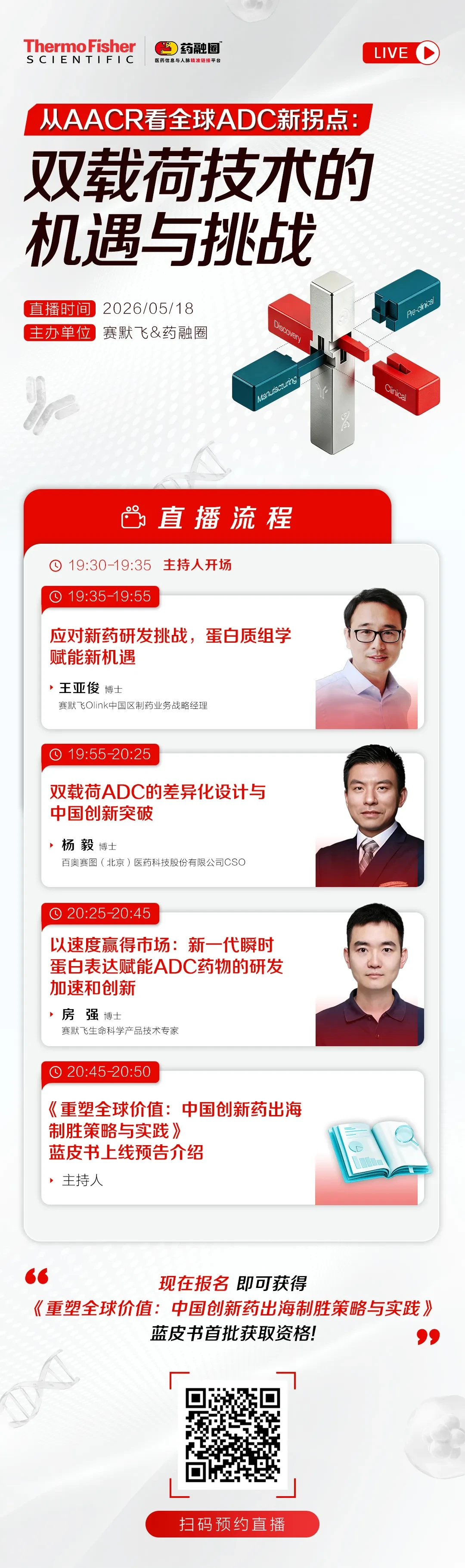
To delve into the latest advancements and future trends of dual-payload ADCs, PharmaCircle, in collaboration with Thermo Fisher, will host an event on5Month18Day19:30-20:50Host [From AACR to the New Inflection Point of Global ADC: Opportunities and Challenges of Dual-Payload Technology】Online Seminar. This seminar will inviteDr. Yi Yang, CSO of Biocytogen (Beijing) Pharmaceutical Technology Co., Ltd.,Dr. Wang Yajun, Strategic Manager of Thermo Fisher Olink's Pharmaceutical Business in China, and Dr. Fang Qiang, Technical Expert of Thermo Fisher's Life Science Products, will provide an in-depth analysis of the technological innovation, clinical progress, and industrial opportunities of dual-payload ADCs based on the latest data from AACR 2026. Whether you are a researcher, BD lead, clinical expert, or investor, this seminar will offer valuable insights and inspiration. Click to reserve your spot for the live stream and tune in at 7:30 PM on May 18 to explore new paradigms in cancer treatment with industry pioneers!

Thermo Fisher重磅发布|May 20
"Blue Paper on **Reshaping Global Value: Winning Strategies and Practices for China's Innovative Drugs Going Global** to be Released Soon!"
This blue book will:
In-depth Decoding of the Panorama of China's Innovative Drug Exports
From Path Selection to Model Evolution: A Clear Guide on "How to Go Global"
Selected Benchmark Case Studies
Decoding the Key Decisions and Strategic Logic Behind a Successful Overseas Expansion
Facing the Core Challenges of Globalization
Focus on "Geopolitical Risks" and "Regulatory Barriers," Providing Actionable Solutions
Empower Chinese Biopharmaceutical Enterprises
Building Global Competitiveness from the Ground Up, Accelerating Innovation to Benefit Patients Worldwide
Live Streaming Process