

Phase III Race Heats Up: 18 Trispecific TCE Candidates in Clinical Development Spanning Oncology and Autoimmune Diseases

Johnson & Johnson
Medical Device R&D and Manufacturer

Zelgen
Innovative Drug Research and Development, Manufacturer

May 24, 2026
eMedClub News
Currently, the evolution of the TCE industry is mainly in two directions: one isTechnical LevelThe, from BiTE, "2+1" avidity-enhanced, TCR-pMHC/ImmTAC to multispecific/costimulatory TCE; another isIndicationsFrom hematological tumors to solid tumors and autoimmune diseases, in the field of solid tumors, Amgen's Tarlatamab and Immunocore's Tebentafusp have both been approved by the FDA for marketing. In the autoimmune field, no products have been approved yet, but many companies in China have already advanced their pipelines to clinical stages.
In the process of continuous iteration and upgrading of technology, the molecular structure and target design of TCE have been continuously optimized, breaking away from the functional limitations of traditional bispecific TCEs, among which multispecificity...(Triple Antibody, Quadruple Antibody)TCE shows an accelerated development trend by increasing co-stimulatory targets.(such as CD28, 4-1BB)Multiple tumor antigen targets or immune microenvironment modulation targets can simultaneously achieve precise tumor recognition, efficient T-cell activation, and improvement of the immunosuppressive microenvironment, among other multifunctional capabilities. This not only effectively enhances treatment efficacy and reduces the risk of tumor antigen escape but also optimizes safety.
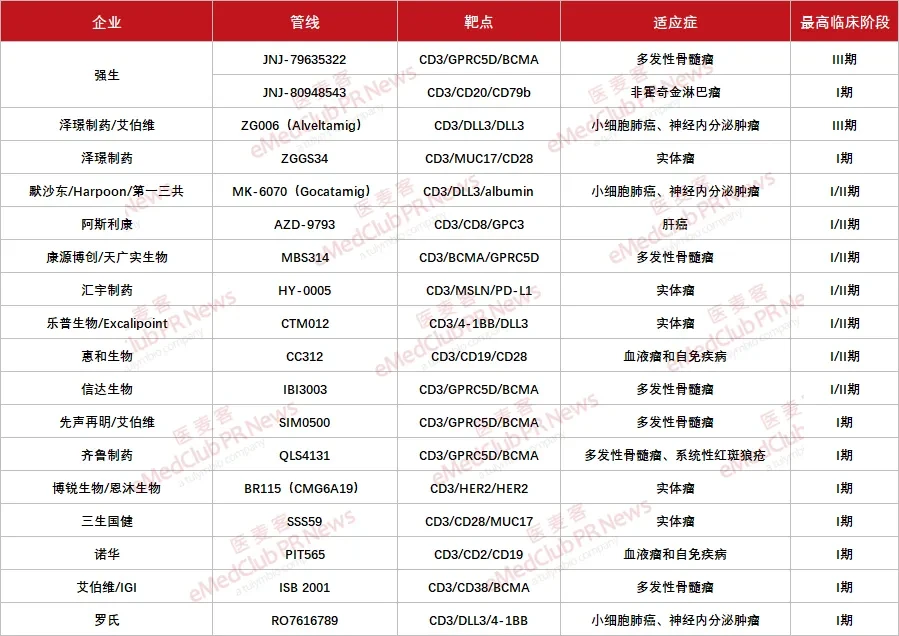
This article reviews 18 trispecific TCEs from China and abroad.(TCE Tri-specific Antibody)Representative Pipeline(Incomplete statistics)Currently, Johnson & Johnson's JNJ-79635322 and Zelgen/AbbVie's ZG006(Alveltamig)All have alreadyIn Phase III Clinical Stage, ranking among the first tier, with most pipelines entering the early clinical stage, overall showing "a few leading pipelines at the forefront and the vast majority of pipelines continuously advancing in clinical stages."」The Distinctive Pattern.
Hematological tumors as the main battlefield,
Solid Tumors and Autoimmunity as New Growth Poles
From the distribution of indications,Hematological tumors represented by multiple myeloma are undoubtedly the main battleground for trispecific TCEs., attracting numerous domestic and international companies to establish a presence, including Johnson & Johnson, Keynovo/Biotheus, Innovent Biologics, Simcere Zaiming, Qilu Pharmaceutical, and AbbVie, among others. Some of these companies have already advanced to Phase I/II clinical trials.
Small cell lung cancer is one of the hotspot indications in the field of solid tumors.Zelgen/AbbVie, Merck/Harpoon/Daiichi Sankyo, Roche and other companies all focus on DLL3 as the core target. Among them, Zelgen's ZG006 is a trispecific TCE targeting two different DLL3 epitopes and CD3, with the potential to become the best in its class.(Best-in-Class)The Potential of Molecules.

Pipeline products from companies such as Huihe Bio, Qilu Pharmaceutical, and Novartis simultaneously cover hematological tumors and autoimmune diseases like systemic lupus erythematosus. These pipelines typically target B-cell antigens such as CD19 and CD20, utilizing TCE to eliminate abnormal B cells, marking an important expansion of TCE technology into non-oncology fields.
"CD3/TAA/TAA" is the mainstream,
Diversified Target Combinations
The core advantage of trispecific TCE lies in its multi-target synergistic effects.The mainstream strategy is still the "CD3/TAA/TAA" architecture., aiming to enhance tumor cell-specific binding by combining two TAAs, reduce off-target toxicity, and potentially overcome drug resistance issues caused by single-target antigen loss or heterogeneous expression.
Currently, more than half of the clinical pipelines adopt this model, and the selection of TAAs is becoming increasingly differentiated, including BCMA, GPRC5D, CD20, CD79b, CD19, HER2, DLL3, MUC17, MSLN, CDH3, CLDN6, etc. Based on this framework, the introduction of immune co-stimulatory molecules to enhance T-cell activity has become an important trend. This design theoretically enhances the sustained killing ability of T-cells by simultaneously activating the first and second signals of T-cells, while reducing the risk of cytokine release syndrome caused by overactivation.
CD28 and 4-1BB are the two most commonly used co-stimulatory molecules., each has multiple projects under research. The representative pipelines of the former include Huihe Bio's CD3/CD19/CD28 trispecific antibody CC312, and 3SBio's CD3/CD28/MUC17 trispecific antibody SSS59; the representative pipelines of the latter include Roche's CD3/DLL3/4-1BB trispecific antibody RO7616789, and MicroPort Pharma/Excalipoint’s CD3/4-1BB/DLL3 trispecific antibody CTM012, etc.
In addition,The design of functional module integration is also an optimization strategy for TCE tri-specific antibodies.For example, MK-6070, which Merck acquired for $680 million through the purchase of Harpoon, extends the drug's circulation time in the body by incorporating an anti-albumin domain, leveraging the long half-life characteristic of albumin to further enhance the drug’s stability and pharmacokinetic properties.
In addition to trispecific TCEs, companies represented by Baili Tianheng are exploring tetraspecific TCEs, with pipelines already in clinical stages, such as GNC-038.(CD3/4-1BB/PD-L1/CD19)For example, this is the world's first tetra-specific antibody drug to enter clinical development, with indications covering acute lymphoblastic leukemia, non-Hodgkin lymphoma, systemic lupus erythematosus, rheumatoid arthritis, etc., and it is currently in Phase I/II clinical trials.
Editor-in-Chief | Xun
Proofread by Xun
References:
1. Corporate official website and public materials

Exciting Events
Press and hold to scan the QR code and participate immediately ↓



DianDian "Share”、“Like" and "In View”
Give me a little charge~