CICC: Hang Seng Index Quarterly Review Boosts Coverage of Industrials and Healthcare; Six Stocks Likely Added to Stock Connect
BeOne
Developer of Molecular Targeted and Immune Anti-Tumor Drugs
Hansoh Pharma
Pharmaceutical Research, Production, and Sales
Akeso
Innovative Antibody Drug Developer
According to the Zhisheng Finance APP, CICC released a research report stating that Hang Seng Index Company announced the results of its regular quarterly index adjustments. This adjustment covers major flagship indices in Hong Kong stocks such as Hang Seng, SOE Index, and Hang Seng Technology Index. In terms of industry coverage and representation, the market coverage of the industrial and healthcare sectors has increased. According to the industry classification of Hang Seng Index Company, after this adjustment of Hang Seng Index, the coverage of the healthcare sector increased from 38.8% to 44.3%, and the coverage of the industrial sector increased from 54.3% to 56.0%.
In addition, the Hang Seng Composite Index, which directly determines the investable scope of Stock Connect, has also been adjusted. Based on the adjustment of the Hang Seng Composite Index and the additional requirements for inclusion in Stock Connect, the bank expects that six stocks may meet the inclusion criteria for Stock Connect. Minimax-W, which is being added to the Hang Seng Composite Index this time, will not be included in Stock Connect during the June review due to its weighted voting rights structure, which requires an additional condition of being listed for at least six months and 20 trading days. It is expected to be included in Stock Connect in August.
CICC's main points of view are as follows:
Index Adjustment: Hang Seng Index Includes BeOne Medicines, J&T Express-W, and Chalco; Hang Seng China Enterprises Index Includes Hansoh Pharma and Akeso; Hang Seng Tech Index Includes Zhipu and Minimax-W
Changes in constituent stocks: BeOne Medicines (06160), J&T Express-W (01519), and Chalco (02600) included in the Hang Seng Index; Hansoh Pharma (03692) and Akeso (09926) included in the Hang Seng China Enterprises Index, Zhipu (02513) and Minimax-W (00100) included in the Hang Seng TECH Index.
1) Hang Seng Index:This adjustment includes BeOne Medicines (weight 1.30%), J&T Express-W (weight 0.30%), and Chalco (weight 0.24%), increasing the number of constituent stocks to 93 after the adjustment.
2) Hengsheng State-Owned Enterprises:This adjustment includes Hansoh Pharma and Akeso, with inclusion weights of 0.46% and 0.76%, respectively, while the number of constituent stocks remains unchanged at 50 after the adjustment.
3) Hengsheng Technology:This adjustment includes Zhipu and Minimax-W, with inclusion weights of 0.53% and 0.36%, respectively. The number of constituent stocks remains unchanged at 50 after the adjustment.
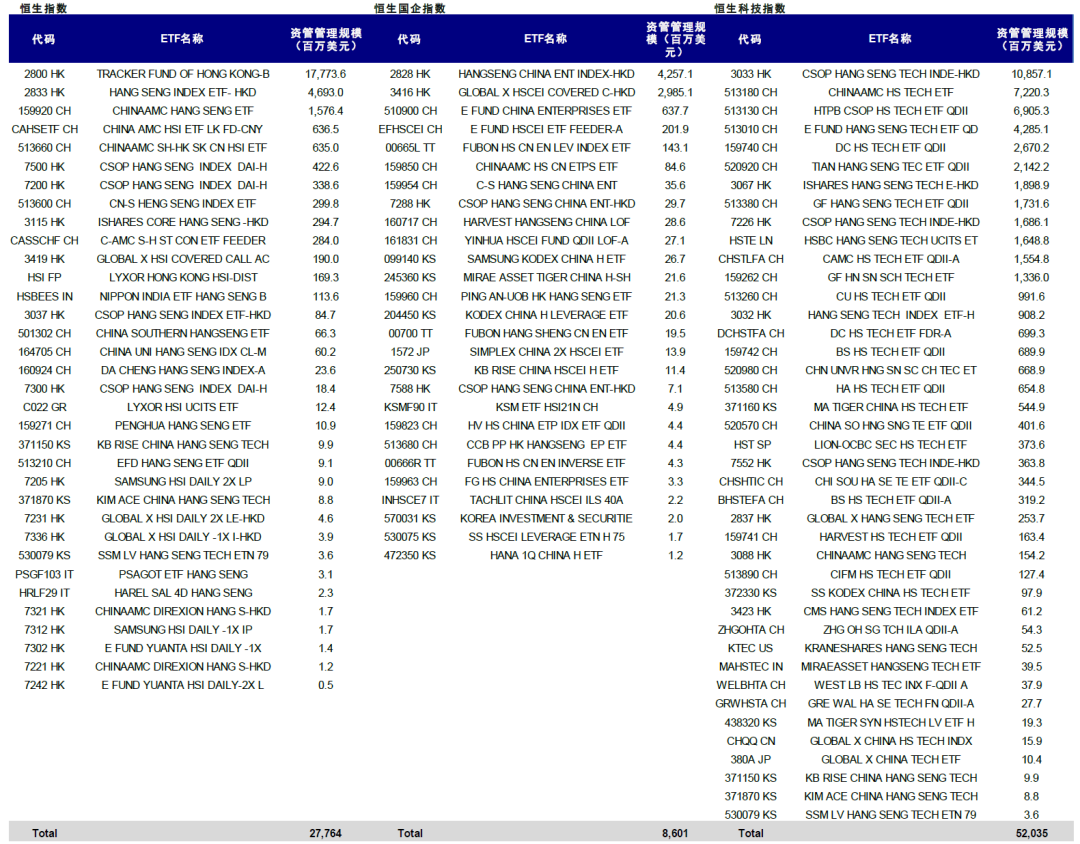
Capital Flow Estimation:Based on the Bloomberg compilation, the scale of ETF funds tracking the Hang Seng Index is approximately US$27.76 billion, while the scale of ETFs tracking the China Enterprises Index and the Hang Seng Tech Index is approximately US$8.6 billion and US$52.04 billion, respectively. Combining the changes in the above components and weightings, as well as the average daily trading volume of individual stocks over the past three months, the bank estimated the potential impact of passive fund changes.
How will Zhipu and MiniMax-W perform after being included in Hengke?
The inclusion of two large model companies, Zhipu and Minimax-W, in the Hang Seng Tech Index this time is in line with expectations and also aligns with the direction of the Hang Seng Index Company to optimize the Hang Seng Tech Index to embrace "new technology."
The medium- to long-term trend depends on industry trends and fundamentals. Two large AI model companies performed strongly after their listings, driven by growth expectations and AI narratives. Using the Price-to-Sales (P/S) ratio for evaluation, the revenue yield (S/P) of Zhipu and Minimax is comparable to the one-year government bond interest rate.
Valuation is a dimension of short-term sentiment and whether it is overextended or not. In the short term, from the perspective of the track's fundamentals, the large AI models are still in the early stages of industrial development, with vast industry space. Technological iteration, scenario penetration, and commercial implementation still offer ample room for imagination. Compared to the internet bubble at the beginning of this century, the current global AI demand is close to that of 1998-1999, investment intensity and corporate investment capacity are nearing those of 2000, and the secondary market is similar to 1997-1998. Looking ahead, the Q2 earnings reports in July for U.S.-listed Chinese stocks may become a critical juncture. If AI remains the core mainline throughout the year and there is no trend change in track prosperity, then short-term fluctuations caused by factors such as lifting of restrictions might instead create a better price window for medium to long-term deployment.
Adjustment of HKEX Connect Eligible Stocks: Six Expected to Meet Inclusion Criteria
This is a quarterly index adjustment, so for the Hang Seng Composite Index, which adjusts semi-annually, only stocks that meet the fast inclusion mechanism will be considered for inclusion. Based on this adjustment of the Hang Seng Composite Index and additional requirements for inclusion in the Shanghai-Hong Kong Stock Connect, it is estimated that six stocks may meet the scope for inclusion in the Stock Connect. Minimax-W, entering the Hang Seng Composite Index this time, will not be included in the Stock Connect during this June review due to its weighted voting rights structure, requiring an additional listing period of at least six months and 20 trading days. If it subsequently meets the market capitalization and trading volume requirements, it could be included in the Stock Connect in August.
Adjusted Index Characteristics: Increase in Healthcare, Information Technology, and Industrial Sectors; Decline in Financial and Consumer Sectors
Index Expansion:The number of Hang Seng Index constituent stocks has increased to 93. According to the consultation results released by Hang Seng Indexes Company in March 2021[4], the number of Hang Seng Index constituent stocks will increase to 80 by mid-2022, and ultimately be fixed at 100. Currently, it is still expanding towards this goal.
Industry Coverage and Representation:Market coverage in the industrials and healthcare sectors has improved. According to the industry classification of Hang Seng Indexes Company (i.e., the seven industry classifications), after this adjustment of the Hang Seng Index, the coverage of the healthcare sector increased from 38.8% to 44.3%, and the coverage of the industrials sector increased from 54.3% to 56.0%.
Industry Share:Healthcare, Information Technology, and Industrials See Increased Representation, While Finance, Consumer Goods, Utilities, and Telecommunications Decline. Following this adjustment, the weighting of new economy sectors in the Hang Seng Index slightly increased from 47.5% to 48.9%. At the sector level, the representation of Healthcare, Industrials, and Information Technology rose from 3.6%, 11.5%, and 14.8% to 4.7%, 11.8%, and 15.5%, respectively. However, the Finance sector and the Utilities and Telecommunications sector saw their weightings decline, dropping from 33.8% and 6.7% to 32.5% and 6.4%, respectively.
Schedule Adjustment: Officially Effective on June 8
The above index adjustment results will officially take effect on June 8th (Monday). During this period, some active funds may still take certain arbitrage operations based on the announced adjustment results, but passive funds will choose to adjust their positions on the trading day before the effective date (i.e., June 5th) in order to minimize tracking errors. The bank expects that the trading volume of relevant stocks may show "abnormally high volumes" much greater than usual at that time, especially towards the closing.
Chart: After this adjustment, the coverage of Hang Seng Index on healthcare and industrial sectors has improved.
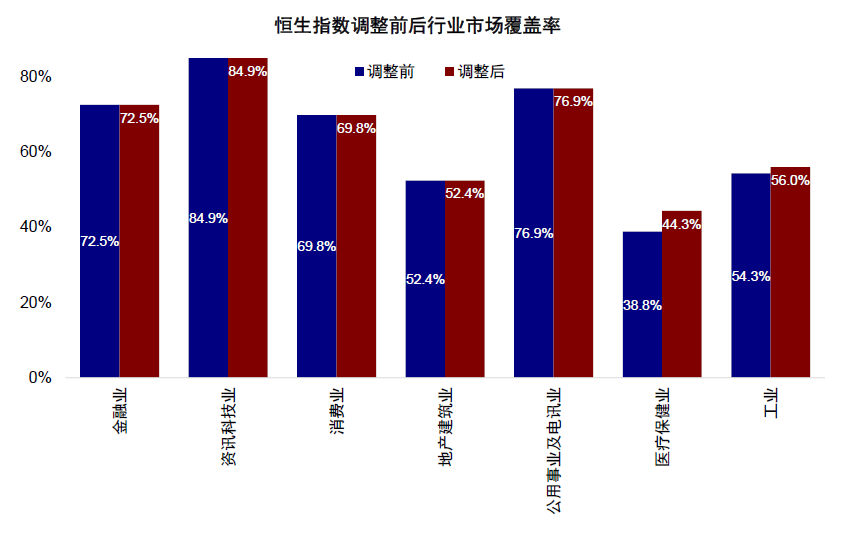
Chart: In the industry share, the proportions of information technology, healthcare, and industry have increased, but the proportion of finance has declined.
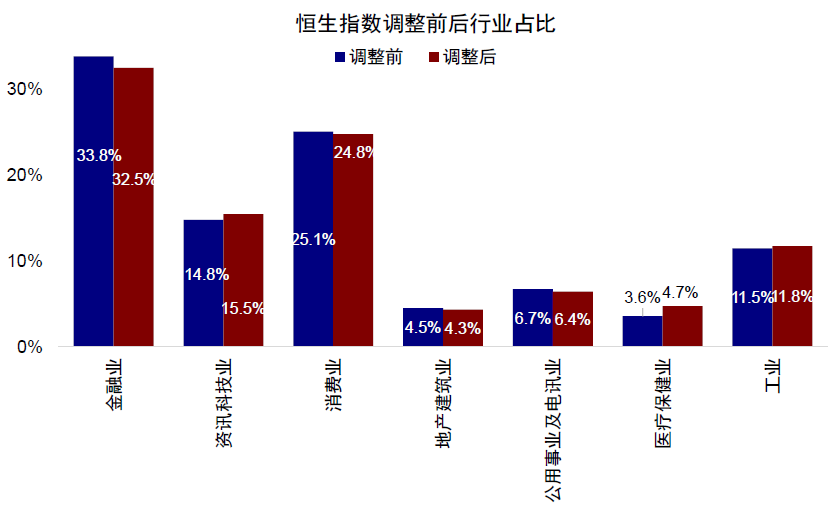
Chart: Scale of ETF Funds Tracking the Hang Seng Index, Hang Seng China Enterprises Index, and Hang Seng Tech Index