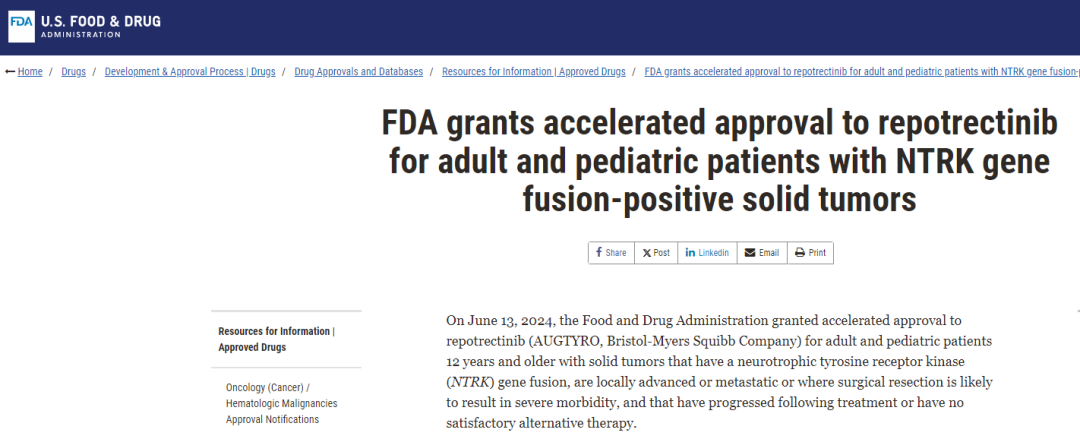
On June 13, 2023, the U.S. FDA approvedBristol Myers SquibbOral Tyrosine Kinase Inhibitor (TKI)Augtyro (repotrectinib, ripretinib)For the treatment of locally advanced, metastatic, or surgically unresectable disease that may lead to severe illness, disease progression after treatment, or lack of satisfactory alternative therapies.Adults and pediatric patients 12 years of age and older with solid tumors, whose tumors are positive for neurotrophic tyrosine receptor kinase (NTRK) gene fusion.
This approval is mainly based onTRIDENT-1 TrialThe results. TRIDENT-1 is a global, multicenter, single-arm, open-label, multi-cohort Phase 1/2 clinical trial designed to evaluate the safety, tolerability, pharmacokinetics, and antitumor activity of Augtyro in patients with locally advanced or metastatic NTRK gene fusion-positive (NTRK1/2/3) solid tumors.The study enrolled 88 patients, of whom 48 had received TKI treatment and 40 had not.In patients who have not received TKI treatment, the median follow-up time was17.8 months, the objective response rate (cORR) reached58%. Among them,15% of patients achieved complete response (CR), and 43% of patients achieved partial response (PR).In patients who had received TKI treatment, the median follow-up time was 20.1 months.cORR is 50%Among them, 50% of patients achieved PR, and no patients reached CR. Additionally, 42% of patients who achieved remission remained in remission one year after receiving Augtyro treatment, with an mDOR of 9.9 months.The most common adverse reactionsDizziness, taste disorders, peripheral neuropathy, constipation, dyspnea, fatigue, ataxia, cognitive impairment, myasthenia, and nausea.Augtyro (repotrectinib) is a novel tyrosine kinase inhibitor (TKI) with a unique structure and mechanism of action. It can specifically bind to and inhibit tyrosine kinase receptors such as NTRK and ROS1, thereby blocking the signaling pathways mediated by these receptors and inhibiting the growth and spread of tumor cells. This distinctive mechanism of action allows Augtyro to overcome various genetic mutations that confer resistance to other TKIs, demonstrating significant cytotoxic effects on tumor cells harboring NTRK or ROS1 gene fusions.
In November 2023, it was approved for the first time for the treatment of adult patients with locally advanced or metastatic ROS1-positive non-small cell lung cancer (NSCLC).