

Pfizer's Absence Opens Door for Yangtze River Pharma and Humanwell to Challenge Hengrui's First-to-File Esketamine Injection in China's Billion-Dollar Anesthesia Market
Pfizer
Pharmaceutical R&D Developer
Yangtze River Pharmaceutical Group
Pharmaceutical and Health Service Providers
Hengrui Pharma
Innovative and High-Quality Pharmaceutical Developer
The anesthesia and analgesic drug market, worth tens of billions, once again sees a "battle of the three kings."
Recently, Yangtze River Pharmaceutical Group Co., Ltd. and Yichang Humanwell Pharmaceutical Co., Ltd. have received approval for the market entry of their generic Esketamine Hydrochloride Injection (Category 3), which is considered to have passed the quality and efficacy consistency evaluation. The injection is indicated for use in combination with sedative anesthetics to induce and maintain general anesthesia. As early as November 2019, Hengrui Pharma obtained the first domestic generic approval for Esketamine Hydrochloride Injection in China. With Yangtze River Pharmaceutical and Yichang Humanwell now securing their market entry, this product has entered a "three-way competition" era.


Esketamine Hydrochloride Injection, developed by Pfizer, is a rapidly acting anesthetic and analgesic drug with promising applications in surgical anesthesia, acute and chronic pain management, and ICU sedation and analgesia. Since Pfizer's original product has not been marketed in China, the Esketamine Hydrochloride Injection market has been exclusively dominated by the first generic manufacturer, Hengrui Pharma. With the entry of Yangtze River Pharmaceutical Group Co., Ltd. and Yichang Humanwell Pharmaceutical Co., Ltd., the three major giants in the field of anesthetic and analgesic drugs will engage in a new competition over this significant product.
Due to the slow pace of product iteration, anesthetic and analgesic drugs generally have long life cycles, with an overall stable market landscape. Facing the historical opportunity of expanding demand both inside and outside the operating room, the application scenarios for anesthetic and analgesic drugs are broad, offering substantial market potential. Accelerating the follow-up replication of key varieties while actively developing innovative products to maintain competitiveness has become the surefire strategy for leading companies to continuously increase their market share.
Ketamine is a classic intravenous anesthetic drug, first developed by the former epilepsy drug giant Parke-Davis in 1962. It has both anesthetic and analgesic effects and is widely used in the fields of anesthesia and critical care. Notably, Parke-Davis was once the oldest and largest pharmaceutical company in the United States until it was acquired by Warner-Lambert in 1970. In 2000, Pfizer acquired Warner-Lambert for $90 billion.
After acquiring Parker Davis, Pfizer continued to develop the dextrorotatory enantiomer of ketamine—dexketamine, also known as Esketamine. As a chiral cyclohexanone derivative with analgesic properties and anesthetic effects at higher doses, Esketamine primarily exerts its analgesic action by blocking N-methyl-D-aspartate (NMDA) receptors and is suitable for use in combination with hypnotics to induce and maintain general anesthesia.
Compared with ketamine, esketamine has the characteristics of high potency, strong receptor affinity, and fewer adverse reactions in the nervous system. It also has controllable pharmacokinetics and can treat refractory depression, benefiting even patients who are unresponsive to various antidepressants. Currently, Pfizer's Esketamine Hydrochloride Injection has been launched in Australia, Germany, the Netherlands, and other countries under the trade name Ketanest S, but it has not yet been introduced to the Chinese market.
Due to the absence of the original research drug in the Chinese market, Hengrui Pharma's Esketamine Hydrochloride Injection was the first to file for marketing approval under the new Category 3 in June 2018, which was accepted by the CDE and included in the priority review and approval list two months later. In November 2019, Hengrui Pharma's Esketamine Hydrochloride Injection became the first domestically produced drug to be approved for marketing in China, filling the gap in this field ahead of the original research drug. The following year, the drug was included in the National Reimbursement Drug List (NRDL) after negotiations. As of the announcement at that time, Hengrui Pharma had invested approximately RMB 19.51 million in R&D expenses for this project.
Data from MiNe Network shows that in the terminals of China's public medical institutions, the sales of Esketamine Hydrochloride Injection reached approximately 170 million yuan in 2021, with a growth rate exceeding 137%. In 2022, the sales of Esketamine Hydrochloride Injection exceeded 200 million yuan, representing a year-on-year increase of 18.8%, indicating promising market potential. However, Hengrui Pharma's exclusive blockbuster product soon faced competition. In November 2022, Yangtze River Pharmaceutical Group Co., Ltd. submitted a Class 3 generic drug marketing application for Esketamine Hydrochloride Injection, securing the position as the second domestically produced version. In January 2023, Yichang Humanwell Pharmaceutical Co., Ltd.'s production application for Esketamine Hydrochloride Injection was accepted by the CDE, closely following suit.
Sales of Esketamine Hydrochloride Injection in Chinese Public Medical Institutions in Recent Years (Unit: Ten Thousand Yuan)
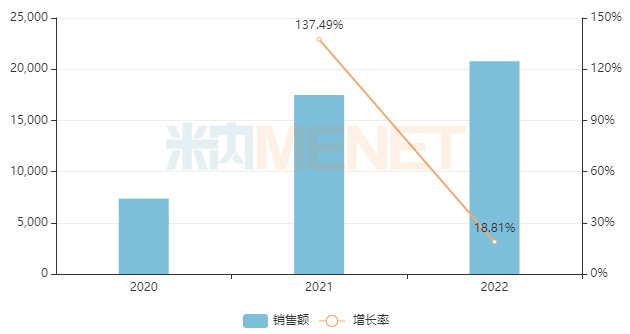 Source: MiNei Network's Competitive Landscape of Drug Terminals in Chinese Public Medical Institutions
Nowadays, with the recent approval and market entry of latecomers, the "battle of the three giants" for Esketamine Hydrochloride Injection has officially begun. In this niche market, Hengrui Pharma has taken the lead, and with the addition of Yangtze River Pharmaceutical Group Co., Ltd. and Yichang Humanwell Pharmaceutical Co., Ltd., the future market potential of this product cannot be ignored under the continuous support of domestic giants in China. Notably, due to its ability to exert antidepressant effects through multiple mechanisms, the market growth ceiling for Esketamine is expanding.
In April 2023, the former Xi'an Janssen (now Johnson & Johnson Innovative Pharmaceuticals) announced that its esketamine hydrochloride nasal spray (brand name: Spravato) had been approved for marketing in China. It will be used in combination with oral antidepressants to alleviate depressive symptoms in adult patients with major depressive disorder who have acute suicidal ideation or behavior. Public information shows that this is the Spravato (esketamine) nasal spray developed by Xi'an Janssen, which was approved for marketing in the United States in 2019. It is the first antidepressant with a new mechanism of action approved by the U.S. FDA in 30 years.
In response to the revolutionary treatment that Esketamine has brought to the field of depression, a group of pharmaceutical companies in China, including Hengrui Pharma, have made strategic moves. In October 2021, Hengrui Pharma initiated a Phase Ib clinical trial (Registration No.: CTR20212471) to evaluate the safety, tolerability, and pharmacokinetic characteristics of HS-10345 ((R)-Ketamine Hydrochloride Nasal Spray) in patients with treatment-resistant depression. The Drug Clinical Trial Registration and Information Disclosure Platform shows that this clinical trial was completed in October 2022. Additionally, companies such as Enwa Pharma and Prudent Pharma are also conducting clinical trials on this drug.
Currently, the monopoly of Hengrui Pharma on esketamine hydrochloride injection, a promising product, has been broken by Yangtze River Pharmaceutical Group Co., Ltd. and Yichang Humanwell Pharmaceutical Co., Ltd. How the three leading oligarchs in the anesthetic industry will make their next moves is awaited by the industry with great interest. Moreover, the esketamine hydrochloride injection developed by Sinopharm Guorui Pharmaceuticals and Chengdu Better Pharmaceutical Co., Ltd. has also entered the clinical trial stage. It is not hard to foresee that market competition for this product will become increasingly intense in the future.
Medications for the nervous system are mainly used for anesthesia, pain relief, or treating organic diseases of the nervous system, and are a key细分 market in the global pharmaceuticals sector.Field. According to data from BioPharma Dive, the global market for nervous system drugs is expected to grow at a compound annual growth rate (CAGR) of 5.9% from 2016 to 2025, eventually reaching $129 billion. Meanwhile, statistics from MiNeiNet show that in China's three major terminals and six key markets, the market size of chemical drugs for the nervous system has recently exceeded 100 billion yuan, accounting for approximately 10% of the market share.
Specifically, neurological drugs can be further divided into subclasses such as anesthetics, analgesics, antiepileptics, tranquilizers, and antiparkinsonian drugs, among which anesthetics and analgesics have maintained a relatively fast growth trend in recent years. According to statistics from the MIR DATABANK, the sales revenue of chemical anesthetic agents in Chinese public medical institutions has exceeded 10 billion yuan in recent years.
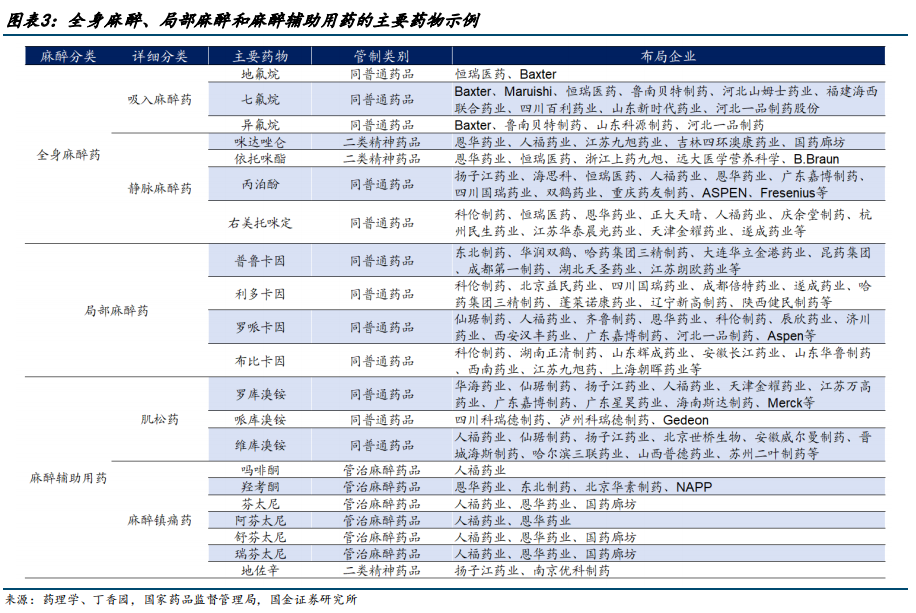
Research reports from Guojin Securities show that, according to clinical applications, anesthetics can mainly be divided into general anesthetics, local anesthetics, and anesthetic adjuncts. The mechanisms of action, regulatory barriers, and corresponding competitive landscapes vary across these subcategories. However, it is not difficult to observe that Hengrui Pharma, Yangtze River Pharmaceutical Group Co., Ltd., Renfu Pharmaceuticals, Enhua Pharmaceuticals, and Hisun Pharmaceuticals are the main players in the field of anesthetic sedatives, frequently appearing as representative companies in various subcategories of anesthetic drugs.
Anesthetic and analgesic drugs are one of the key disease areas that Hengrui Pharma focuses on. In 2023, this segment generated RMB 3.743 billion in revenue for the company, representing a year-on-year increase of 12.21%, and accounting for 16.40% of total revenue. Currently, Hengrui Pharma is strategically focusing on three main areas: inhaled anesthetics, muscle relaxants, and sedatives, maintaining a leading position in the inhaled anesthetic market. In addition to key generic drugs such as dexmedetomidine, cisatracurium, sevoflurane, and butorphanol, Hengrui Pharma's innovative drug pipeline is driving its second growth phase.
In December 2019, Remimazolam Tosilate for Injection, a short-acting sedative-hypnotic drug independently developed by Hengrui Pharma and the first of its kind in China, was approved for marketing. It became the company's first Class 1 new drug in the field of neurology. In the terminal public medical institutions in China, the sales of Remimazolam Tosilate for Injection have been growing rapidly. In 2021, it exceeded 100 million yuan, increased to 160 million yuan in 2022, and achieved another year-on-year growth of 79% in the first half of 2023, with market potential exploding. In January 2024, Targiniq ER Injection, a Class 1 new analgesic drug independently developed by Hengrui Pharma, was approved for marketing, becoming another key player in expanding its presence in the anesthetic and analgesic drug market.
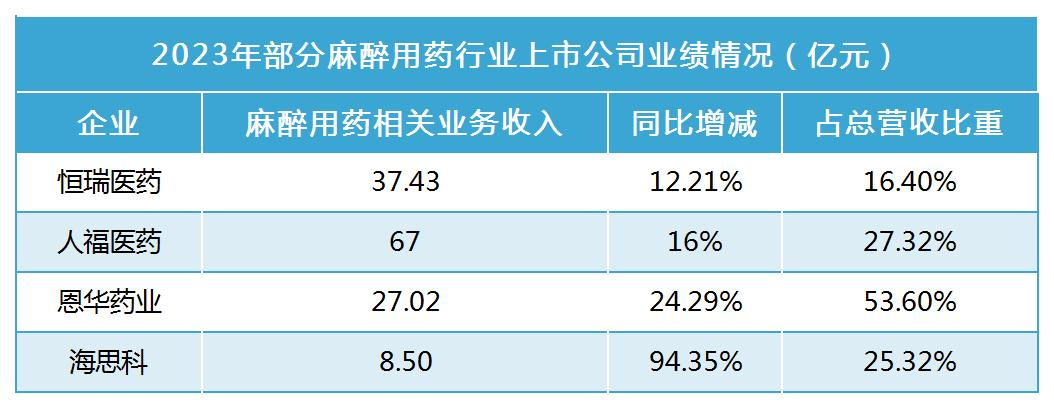
In terms of revenue from businesses related to anesthetic drugs, Hubei Humanwell Pharmaceutical undoubtedly holds a dominant position in this niche market. In 2023, Yichang Humanwell Pharmaceutical Co., Ltd., a subsidiary of Humanwell, continued to promote the clinical application of its products across multiple departments. During the reporting period, the company's anesthetic products achieved sales revenue of approximately RMB 6.7 billion, representing an increase of about 16% compared to the same period last year. Among this, revenue from non-surgical departments reached approximately RMB 2.03 billion, marking a year-on-year growth of around 39%.
According to statistics from Menet, Hubei Humanwell currently leads in three subcategories of the nervous system drugs market with six blockbuster products: In addition to injectable remifentanil hydrochloride firmly holding the top brand position in anesthetics, the market share of alfentanil hydrochloride injection has also increased. Moreover, hydromorphone hydrochloride injection and nalbuphine hydrochloride injection remain among the top 5 and top 6 brands in analgesics, respectively, with their market shares increasing by 1.59% and 0.64% in 2023. The ranking of the innovative drug, injectable remimazolam besylate, rose by four places to become the 14th top brand in tranquilizers, with its market share growing by 0.63%.
After the divestiture of its pharmaceutical commercial assets, Enhua Pharmaceutical's revenue contribution from its anesthetic business has become increasingly prominent. In 2023, Enhua Pharmaceutical's anesthetic revenue reached approximately 2.702 billion yuan, a year-on-year increase of 24.29%, accounting for 53.6% of total revenue. Starting with anesthetic sedatives, Enhua Pharmaceutical's two core sedative products are Midazolam and Etomidate. In recent years, Enhua Pharmaceutical has gradually expanded into analgesic anesthetic drugs, with opioid drugs such as Remifentanil, Sufentanil, Oxycodone, Alfentanil, and Oliceridine Fumarate successively approved for marketing. Due to strict national control over these drugs, which have high regulatory barriers, Enhua Pharmaceutical faces a relatively favorable competitive landscape.
Although Yangtze River Pharmaceutical Group Co., Ltd. is a non-listed company and its specific performance cannot be known to the public, market data clearly reflects its significant presence in the anesthetic drugs market. The latest data from MiNe Network shows that among the top 20 brands of nervous system drugs in key provinces and cities’ public hospital terminals from Q1 to Q3 of 2023, the Dezocine Injection from Yangtze River Pharmaceutical Group was the only brand with sales exceeding 1 billion yuan, maintaining its leading position.
At the same time, Yangtze River Pharmaceutical Group Co., Ltd. has quickly secured a position in the non-controlled, high-profile anesthetic and sedative market with dexmedetomidine. In addition, the company’s Dyclonine Hydrochloride Jelly is an exclusive product, and its Propofol Medium/Long Chain Fat Emulsion Injection was selected during the fourth round of national procurement in China. In the future, as new products such as Etomidate Lipid Emulsion Injection are successively approved, Yangtze River Pharmaceutical's anesthetic product line will become even more comprehensive, further solidifying its leading position.
From the perspective of market competition and future market size, the entry barrier for anesthetic and analgesic drugs is relatively high. Whether leading pharmaceutical companies can seize the first-mover advantage is key to gaining market share. At the same time, innovative drug projects that require long incubation periods will undoubtedly become a crucial factor for pharmaceutical companies to break through intense market competition and a major highlight for future growth. Leading anesthetics companies such as Hengrui Pharma, Yangtze River Pharmaceutical Group Co., Ltd., and Renfu Pharmaceutical are driving the accelerated evolution of this niche market landscape.

www.yyjjb.com.cn
Insight into Industry Trends
"Pharmaceutical Economy Newspaper"
Academic Official Account
Focus on the Frontier of Oncology Academia
Terminal Official Account