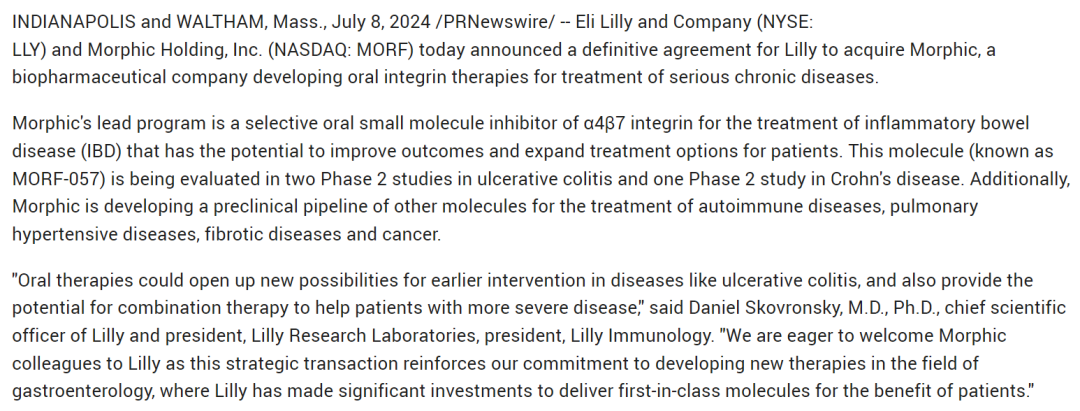
Eli Lilly is further deepening its presence in the Inflammatory Bowel Disease (IBD) field.Local time this Monday,Eli Lilly and Company(NYSE: LLY) and biopharmaceutical companyMorphic(NASDAQ: MORF) jointly issued a statement, Eli Lilly will invest $3.2 billion in cash to acquire Morphic Therapeutic, enhancing its drug portfolio for inflammatory bowel disease and expanding its influence in the multi-billion-dollar market.According to the agreement, Eli Lilly and Company will initiate a tender offer to acquire all outstanding shares of Morphic Therapeutic, Inc. at $57 per share, which represents a premium of nearly 80% over the company's closing stock price on Friday. The total deal is valued at approximately $3.2 billion. Following the announcement, shares of Morphic surged nearly 75% in early trading to $55.62 per share. As of press time, Morphic’s total market value was approximately $2.8 billion, with its stock price rising over 92% year-to-date.The transaction has been approved by the boards of directors of both companies and is expected to be completed in the third quarter of 2024.(Source: Eli Lilly and Company Official Website)Daniel Skovronsky, Chief Scientific Officer of Eli Lilly and Company, President of Lilly Research Laboratories, and President of Immunology, noted that we warmly welcome colleagues from Morphic Therapeutic to join Eli Lilly. This strategic transaction will strengthen our commitment to developing new therapies in the field of gastroenterology. The company has already made significant investments in this area, aiming to deliver a series of FIC molecules targeting inflammatory bowel disease.Inflammatory Bowel Disease (IBD) is a type of autoimmune disorder, clinically characterized by chronic gastrointestinal inflammation, primarily including Crohn's Disease (CD) and Ulcerative Colitis (UC). This disease can affect individuals of any age group, with more than 6.8 million people globally suffering from IBD. According to an analysis report by Fortune Business Insights, the global market size for IBD treatment was $26.55 billion in 2023 and is projected to grow to $44.08 billion by 2032. On the other hand, the prevalence of IBD continues to rise worldwide.Eli Lilly is optimistic about this market. According to Reuters, Eli Lilly believes that in addition to its blockbuster weight-loss drug Zepbound and diabetes medication Mounjaro, the IBD drug Omvoh is also one of its future growth drivers. Omvoh (mirikizumab-mrkz) infusion/injection was approved in October 2023. It is the first and only IL-23p19 antagonist used for treating adults with moderate to severe active ulcerative colitis (UC).And through this transaction,Eli Lilly and Company is set to acquire another new asset, MORF-057, Morphic Therapeutic's oral IBD candidate treatment. Compared with other injectable therapies, including last year’s approved IBD drug Omvoh, this newly acquired oral candidate is expected to offer patients a more convenient dosing option.Morphic is a biopharmaceutical company established in 2015, developing a series of treatments for severe chronic diseases such as autoimmune disorders, cardiovascular and metabolic diseases, fibrosis, and cancer.Oral Integrin Small Molecule Therapy.The company got off the ground with investments from Timothy Springer, Schrödinger, and ShangPharma Investment Group. Subsequent investors included the venture capital arms of Pfizer and AbbVie, and it went public on Nasdaq four years after its establishment.The company is co-founded by an immunologist, a Harvard professor, and one of the founding investors of Moderna.Timothy SpringerBased on laboratory findings, Timothy Springer's lab was the first to discover that integrin antagonists can induce an agonist response and exacerbate disease conditions. Based on these findings, they developed a new class of antagonistic integrin inhibitors that stabilize the required integrin conformation. Integrins are important cell surface receptors involved in cell proliferation, differentiation, adhesion, and migration, playing crucial roles in various pathological processes, including inflammation.Figure | Timothy Springer (Source: Morphic Therapeutic official website)According to the description on the official website, the therapeutic potential of integrins has been recognized for many years, and integrin inhibitors have been approved for the treatment of various diseases, including inflammatory bowel disease, multiple sclerosis, psoriasis, and dry eye disease, among others.However, these drugs are all injectables and locally administered, which limits the therapeutic potential of integrins. Therefore, our goal is to develop a new type of highly effective and safe oral integrin inhibitor.Based on this, Morphic developed the MInT (Morphic Integrin Technology) platform, an effective drug discovery platform that combines the company's core capabilities in integrin biology, structural analysis, therapeutic design, and translational development with ongoing research contributions from Timothy Springer’s laboratory. Leveraging proprietary technology in developing molecules that stabilize specific conformations of integrin receptors, its discovery capabilities span all 24 members of the integrin family, including both integrin inhibitors and activators. The company has also partnered with Schrödinger to combine unique compound libraries with computational power, enabling new designs for integrin targets.Using the MInT platform, Morphic has developed multiple oral integrin pipelines, including the lead pipeline MORF-057 and other preclinical candidates. MORF-057 is a highly specific oralα4β7Small molecule inhibitor, currently in the clinical research stage. There are currently three mid-stage studies evaluating the drug as a potential treatment for inflammatory bowel disease. Among them, EMERALD-2 is a randomized, double-blind, placebo-controlled clinical Phase IIb trial, initiated in November 2022, aiming to study the efficacy of MORF-057 in patients with moderate to severe UC.The trial data is expected to be released in the first half of 2025.
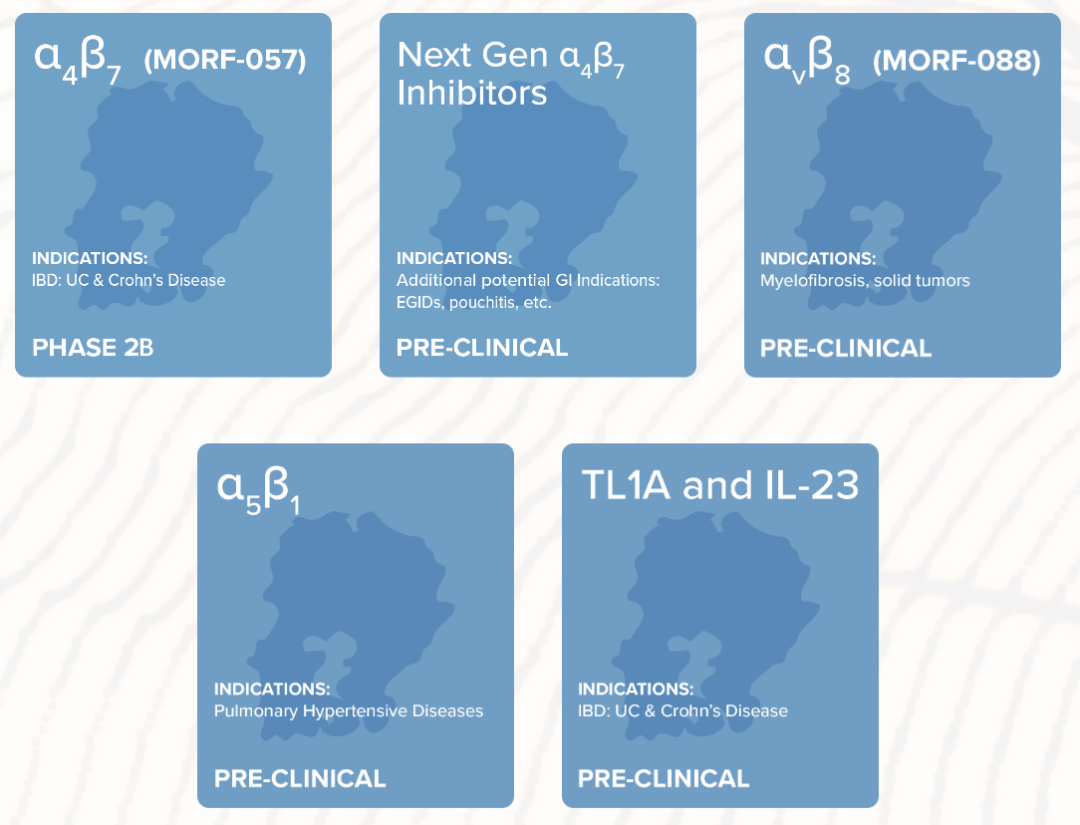
Figure | Pipeline under research (Source: Morphic Therapeutic company website)
Previously, in a Phase IIa interim study involving 35 adults with moderate to severe ulcerative colitis, MORF-057 demonstrated positive results, with a clinical remission rate of approximately 26%. These data suggest that the efficacy of this oral medication may be roughly equivalent to Takeda's lucrative gut disorder drug Entyvio, which is administered via intravenous or subcutaneous injection.At the time, some analysts believed that this oral property might attract the attention of large pharmaceutical companies seeking new therapies for immune system diseases.And that's indeed the case. Daniel Skovronsky pointed out, "Oral therapies can open up new possibilities for early intervention in diseases like ulcerative colitis, while also providing opportunities for combination therapies to help patients with more severe conditions."Analysts believe that once MORF-057 is approved, it is highly likely to capture the market share of Entyvio.As of March 31, in Takeda Pharmaceutical's last fiscal year, the sales of Entyvio were approximately 801 billion yen, equivalent to 5 billion US dollars.1.https://investor.lilly.com/news-releases/news-release-details/lilly-acquire-morphic-improve-outcomes-patients-inflammatoryDisclaimer: This article aims to convey the latest information in life sciences and healthcare industry, and does not represent the platform's position. It does not constitute any investment opinions or recommendations. Please refer to official/company announcements. This article is not a recommendation for treatment plans. If you need guidance on treatment options, please visit a正规医院 for medical consultation.