Recently, a company within Zhongguan Village Life Science ParkMoleculeMindIndependently Developed Industrial-Grade AI Protein Generation Large Model——NewOrigin (Darwin) Unveils Latest Industrial Achievements and Launches Five Major Scenario Solutions Derived from Industrial Projects.
NewOrigin Large ModelYesThe world's only AI protein foundational large model integrating sequence, structure, function, and evolution, with billions of parameters, has learned vast amounts of highly professional and complex multimodal data, and can "custom-design" functional proteins according to industrial application needs.
Estimated reading time: 8 minutes
In China's bi materials sector, where we have a significant advantage, AI has helped leading synthetic biology companies optimize key proteins that are of great commercial value and involve industry bottlenecks. Without using industrial scenario data, the efficiency of these proteins was increased fivefold in less than six months. This protein, which has been continuously modified for decades, is now expected to achieve another performance leap, further driving a substantial increase in yield and a significant reduction in cost, thereby further enhancing China's competitive edge in this field.
In the field of innovative drug research and development, AI simultaneously conducts multi-objective optimization on the stability and expression levels of protein vaccines. Animal experiments show that the neutralizing antibody titer produced by the vaccine is several times higher than that of publicly patented and related large pharmaceutical companies' protein vaccines, breaking through related vaccine stability patents. Another pipeline of cytokines designed by AI maintains tumor suppression activity while reducing toxicity (reducing peripheral activity) by hundreds of times; the tolerated dose in monkey experiments reaches dozens of times that of similar pipelines.
The ultra-high difficulty problem that has troubled the industry for decades was quickly solved by AI, and the value of AI for Science in industrial development is becoming increasingly prominent. Driven by AI technology, a revolution in the field of biomanufacturing is quietly arriving. The pattern of protein evolution that has continued for billions of years has undergone a qualitative change—protein evolution is no longer a slow and uncertain process of random mutations but has transformed into innovative customization based on specific functions.
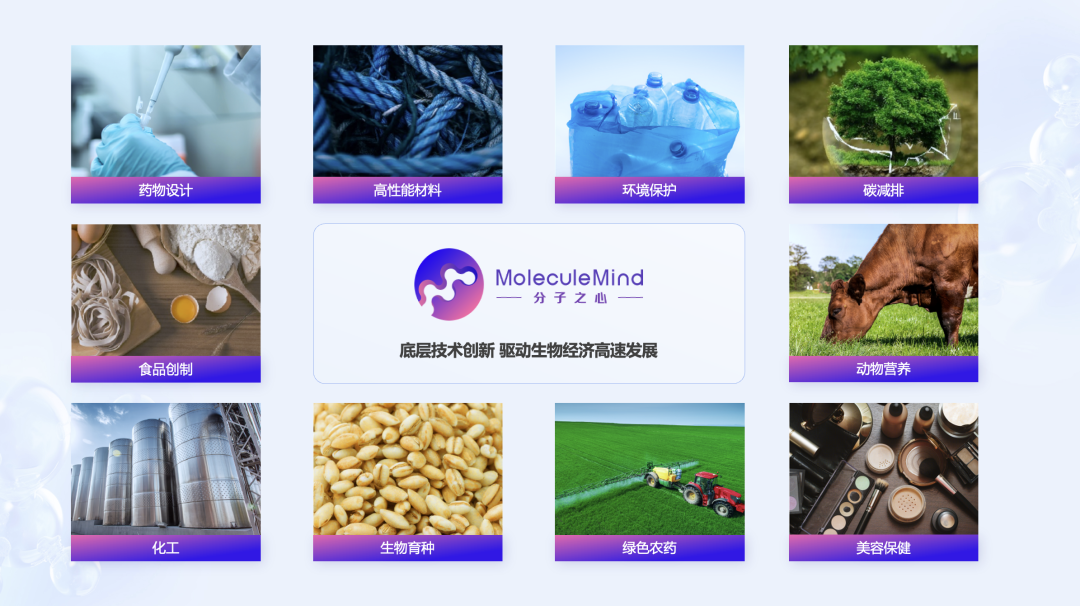
The AI driving force behind this transformation is the NewOrigin (Darwin) large model.. This is a large-scale industrial AI protein generation model independently developed by MoleculeMind, and it is alsoThe world's only AI protein foundation large model integrating sequence, structure, function, and evolution. It has billions of parameters, learned from a vast amount of highly professional and complex multimodal data, and can adapt to industrial application needs,"Customized on Demand" Functional Proteins。NewOrigin Large Model Features High Success Rate, High Versatility, and Low Usage Threshold,Only a few dozen molecules need to be generated to obtain ideal candidate molecules, effectively avoiding the dependence on large-scale wet lab experiments required by traditional methods, and efficiently solving the problem of protein generation in the biotechnology industry. Moreover, biologists without an AI algorithm background can interact with large models through conversational formats to conveniently obtain ideal proteins.Currently,MoleculeMind has widely applied the NewOrigin large model to innovative drug research and development, materials, food, chemical industry, agriculture, and other fields., significant breakthroughs have been made in various high-difficulty industrial tasks such as large-molecule drug design, optimization of protein stability under extreme conditions, enzyme activity optimization, enzyme-specific substrate docking, and de novo protein design, and these achievements have been validated in real production systems.To accelerate industrial applications, MoleculeMind has launched five solutions based on industry project experience, targeting classic application scenarios in innovative drug development and bio-manufacturing industries. By leveraging advanced AI protein large models, molecular dynamics simulations, quantum chemistry, and other scientific computing methods, it establishes an end-to-end, low-barrier industrial application pathway:>>Antibody Affinity Optimization SolutionIn the field of innovative drug development, antibody affinity optimization is one of the key factors to enhance drug targeting and efficacy while reducing side effects. This solution can predict antibody-antigen binding sites based on AI protein technology, and combine molecular dynamics simulation with quantum chemistry techniques to analyze the dynamic changes during the antibody-antigen binding process and evaluate the affinity between different antibody variants and antigens. This guides antibody mutation to generate variants with higher or lower affinity. It will effectively improve the success rate of antibody design, significantly shorten the R&D cycle, reduce costs, and accelerate the drug's journey from the lab to clinical trials and market launch.>> Optimization Solutions for Protein Stability in Extreme EnvironmentsMost protein products, such as enzymes and vaccines, need to be stored and used under specific conditions. In extreme environments like high temperature, high pressure, strong acid, or strong base, proteins are highly prone to inactivation or denaturation. This solution, based on AI technology and molecular dynamics simulations, analyzes the complex relationships between protein sequences, structures, and stability. By predicting thermodynamic stability parameters of proteins, such as melting temperature (Tm) values and folding free energy, it accurately identifies key residues or regions affecting stability. Subsequently, using AI algorithms, it enhances the tolerance of proteins to environmental factors like temperature, pH, and organic solvents without significantly altering their activity, resulting in proteins with higher stability. This will help broaden the application of proteins across more fields.>>Enzyme Activity Optimization SolutionEnzymes, as biological catalysts, have wide applications in industrial production. Through AI protein design technology and quantum chemistry calculations, the structure of enzymes can be accurately predicted, identifying their active sites and catalytic mechanisms. Guided by this, enzymes with higher activity and stronger selectivity can be designed. Multi-objective optimization can simultaneously target substrate binding affinity, product release rate, and more, comprehensively enhancing enzymatic catalytic performance to improve yield and product quality while reducing production costs.>>Enzyme-Specific Substrate Docking SchemeEnzyme-Substrate Docking Analysis: A Key to Understanding Enzyme Catalytic Mechanisms and Optimizing Reaction Conditions>>De Novo Protein Design SchemeDe Novo Protein Design Offers Infinite Possibilities for Innovation in the Bioeconomy. For instance, biomolecules such as enzymes and antibodies with entirely new functions can be designed for applications in disease treatment, material synthesis, petrochemicals, food creation, and agricultural production. Using AI-driven de novo protein design technology, it is possible to directly design completely new proteins that do not exist in nature based on specific needs, or to redesign new protein structures while retaining only the functional sites. MoleculeMind has already applied this technology to design green fluorescent protein (GFP), achieving functionality similar to natural GFP using less than half the number of amino acids. This exploration began earlier than ESM3's efforts in this direction, and utilized fewer amino acids, demonstrating stronger design capabilities.Currently,NewOrigin and these scenario solutions are being progressively integrated into the MoleculeOS platform.MoleculeOS is the world's first fully functional AI protein prediction, optimization, and design platform independently developed by MoleculeMind. It can be widely used in the research and design of peptides, antibodies, enzymes, and small proteins, designing protein products with specific functions through generative rather than discovery-based methods. The philosophy and approach of continuous innovation will bring disruptive changes to the fields of drug design and bio-manufacturing.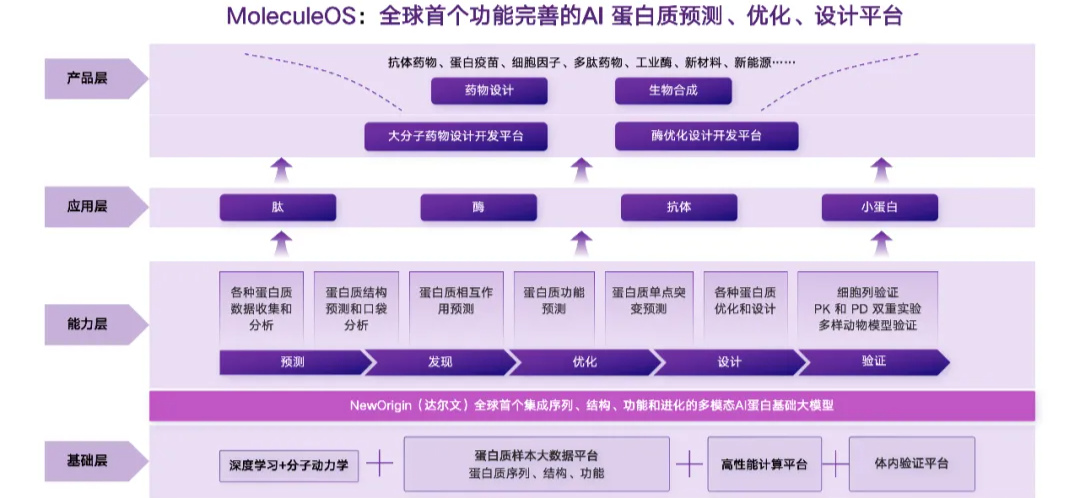 Technological innovation is in the genes of MoleculeMind.Professor Xu Jinbo, the founder of MoleculeMind, is a leading figure in the global AI protein field.In 2016, he invented the RaptorX-Contact method, which was the first in the world to prove that AI could significantly improve the accuracy of protein structure prediction. Professor John Moult, the founder and organizer of CASP (the most authoritative global protein structure prediction competition), stated that this research "has a significant impact on the field" and demonstrated "what deep learning can achieve with proteins." The reason for Moult’s comments lies in the fact that after RaptorX-Contact achieved a groundbreaking breakthrough, it inspired DeepMind, under Google, to launch AlphaFold. As a result, Professor Jinbo Xu has been hailed by the industry as the "pioneer of AI protein folding."After 2018, Professor Xu Jinbo further expanded his research field, aiming at protein modification and design with more industrial application value, and successively launched more than ten world-leading technologies, such as,The First Algorithm Capable of Simultaneously Predicting Protein Side Chains and Designing Sequences, a single-sequence structure prediction algorithm with performance comparable to ESMfold, a complex prediction algorithm with accuracy surpassing AlphaFold3, etc., and innovatively integrates AI with molecular dynamics, quantum chemistry, and other technologies to solve scientific and industrial problems. These technologies have demonstrated world-leading performance in tests, with related achievements published multiple times in scientific journals and the Proceedings of the National Academy of Sciences, and validated through wet lab experiments. They have been deeply applied by internationally renowned pharmaceutical companies and biotech firms.AI is driving breakthroughs in fundamental scientific research while propelling the industrial application of cutting-edge scientific achievements, accelerating industrial upgrading. Life sciences represent the most tightly integrated and fruitful research field combined with artificial intelligence, as well as a key area for the industrial implementation of AI technology. Jensen Huang, CEO of NVIDIA, stated at the 2024 World Government Summit: "The era when everyone had to learn computing has passed; human biology is the future. With continuous advancements in new technologies and algorithms, artificial intelligence and data have made remarkable progress in the field of life sciences, with increasingly widespread applications in medicine, genetic research, drug development, and disease prevention."