Eli Lilly Terminates Phase II Trial of BTLA Monoclonal Antibody LY3361237 in Systemic Lupus Erythematosus Due to Lack of Efficacy

Eli Lilly
Global Pharmaceutical R&D and Production Company

Recently, the clinicaltrials.gov website showed that Eli Lilly terminated a Phase II study (NCT05123586) of BTLA monoclonal antibody LY3361237 for the treatment of moderate active systemic lupus erythematosus (SLE) due to lack of efficacy.
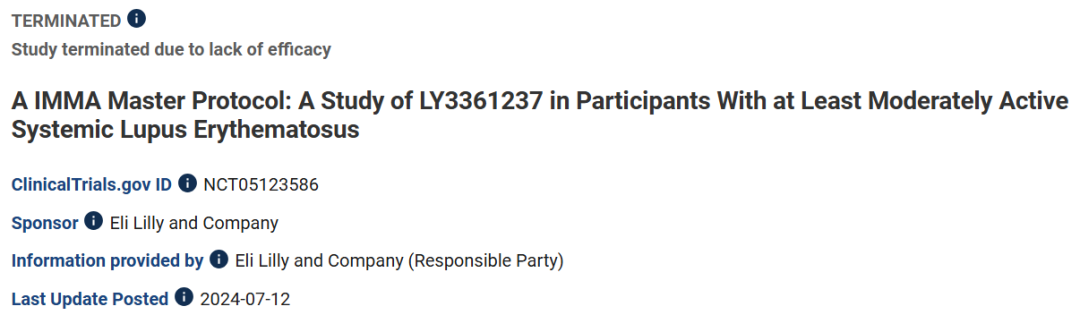
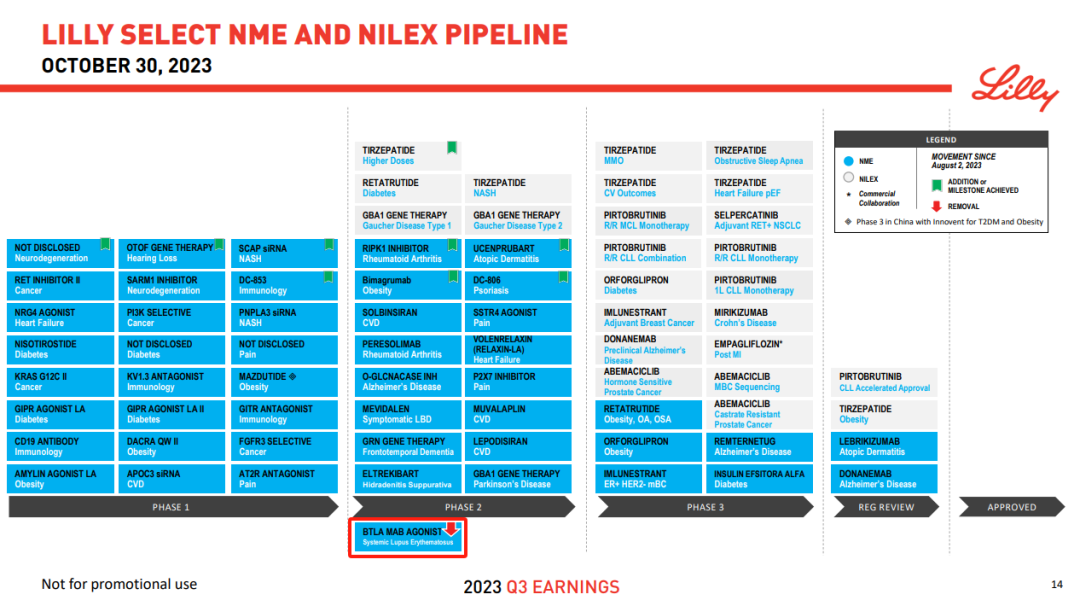
This study is a multicenter, randomized, double-blind, placebo-controlled clinical trial. The study was initiated in March 2022 and completed by the end of December 2023, with an actual enrollment of 85 patients. In fact, when Eli Lilly announced its Q3 2023 financial report, it removed the LY3361237 pipeline for the treatment of SLE.
In the field of SLE treatment, Eli Lilly's development experience has not been smooth. In February 2023, the Phase II ISLAND study of Rezpegaldesleukin (NKTR-358), an IL-2 therapy that Eli Lilly acquired for $400 million, failed to meet its primary endpoint in treating SLE. Subsequently, Eli Lilly terminated the deal.
In January 2022, based on the key results of two pivotal Phase III trials (SLE-BRAVE-I and SLE-BRAVE-II), Eli Lilly decided to terminate the development of the JAK inhibitor baricitinib for the SLE indication.
Tracing back to 2014, Eli Lilly terminated the development of tabalumab, a BAFF monoclonal antibody, after two pivotal Phase III trials showed insufficient efficacy. Its primary indication was SLE.
Not only Eli Lilly, but also new drugs from other companies have stumbled in the development of SLE indications. In November 2023, Roivant and Priovant announced that the Phase II study of JAK1/TYK2 inhibitor brepocitinib for the treatment of moderate to severe active SLE did not meet the primary endpoint of SRI-4 response rate. Based on these results, Roivant plans to terminate the research on brepocitinib in SLE.
SLE is a typical systemic autoimmune disease, commonly known as the "uncurable cancer," and currently has no cure. Its pathogenesis is complex, mainly involving the overproduction of autoantibodies by B cells in the body, which form immune complexes in vivo, causing damage to multiple systems and organs throughout the body, including renal failure, central nervous system involvement, and hematological system impairment.
Copyright © 2024 PHARMCUBE. All Rights Reserved.
Welcome to forward, share, and reasonably cite. When citing, please clearly indicate the source of the article in a prominent position;For reprint, please leave a message or send a message to the WeChat Official Account backend, and indicate the name and ID of the official account.