On July 15, according to foreign media reports, Roche shared the weight-loss drug acquired from Carmot Therapeutics.CT-388TheMoreClinical Phase 1b Data ShowsHigher doses have not yet reached their peak at 6 months.
Specific data released on Monday showed that all patients taking 22 milligrams of the drug reported a weight loss of at least 5% at 24 weeks.45% of patients reported a weight loss of at least 20%.。
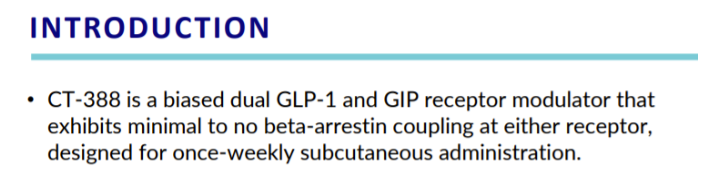
CT-388 is a cAMP signaling-biased dual GLP-1 and GIP receptor agonist administered subcutaneously once weekly for long-term weight management and glycemic control.The mechanism of action of this therapy is related to Eli Lilly'stirzepatideSimilar, the latter2Sales in Q1 2024 were $1.81 billion.
Roche's upcoming presentation at the 2024 EASD (Annual Meeting of the European Association for the Study of Diabetes) The abstract published onThe weight loss effect of GLP-1/GIP agonists did not reach a stable level at 24 weeks, which means it may achieve better weight loss results than the previously announced average weight loss rate of 18.8%.
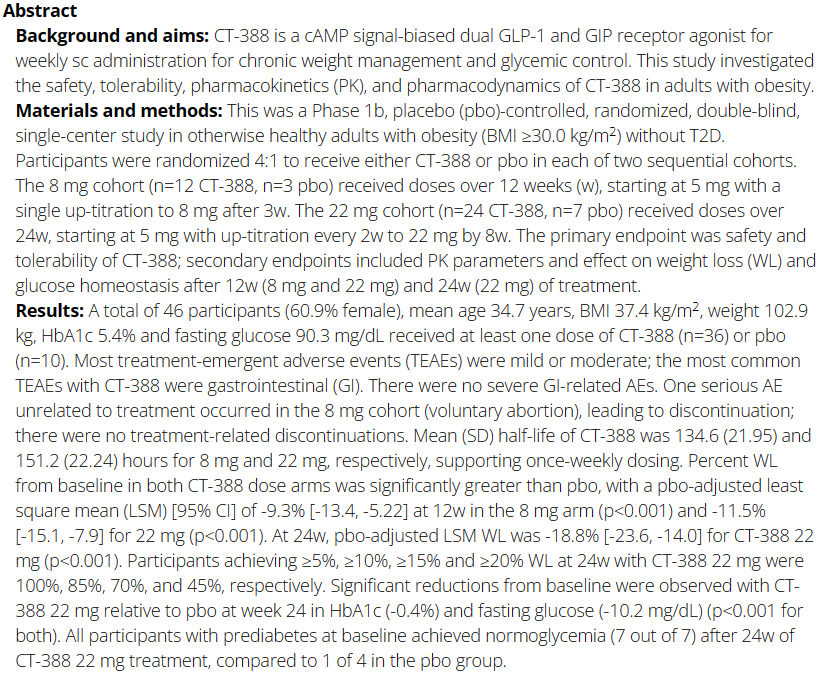
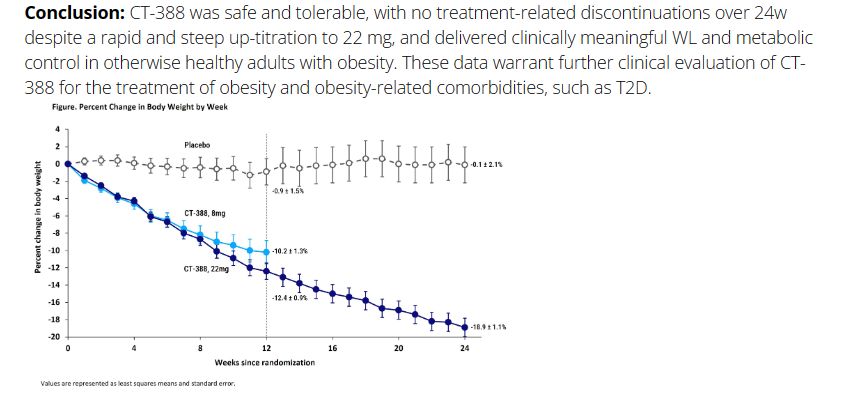
CT-388ResearchThis is a Phase 1b, placebo (pbo)-controlled, randomized, double-blind, single-center study. The subjects are otherwise healthy obese adults (BMI ≥30.0 kg/m2) without type 2 diabetes.46 participants (60.9% female)Participants were randomized 4:1 to receive either CT-388 or placebo (pbo) in two sequential cohorts. The 8 mg cohort (n=12 CT-388, n=3 pbo) received doses over 12 weeks (w), starting at 5 mg with a single dose increase to 8 mg after 3 weeks. The 22 mg cohort (n=24 CT-388, n=7 pbo) received doses over 24 weeks, starting at 5 mg and escalating every 2 weeks to reach 22 mg by Week 8.Primary EndpointThe safety and tolerability of CT-388;Secondary EndpointIncluding PK parameters and the effects on weight loss (WL) and glucose homeostasis after 12 weeks (8 mg and 22 mg) and 24 weeks (22 mg) of treatment.Most treatment-emergent adverse events (TEAEs) were mild or moderate; the most common TEAE with CT-388 was gastrointestinal (GI). No severe GI-related AEs occurred. There were no treatment-related discontinuations.The mean (scaled) half-lives of 8 mg and 22 mg CT-388 were 134.6 (21.95) hours and 151.2 (22.24) hours, respectively, supporting once-weekly dosing. The baseline WL percentages for both dose groups of CT-388 were significantly higher than pbo. At Week 12, the pbo-adjusted least squares mean (LSM) [95% CI] was -9.3% [-13.4, -5.22] (p<0.001) for the 8 mg group and -11.5% [-15.1, -7.9] (p<0.001) for the 22 mg group. At Week 24, the pbo-adjusted LSM WL for CT-388 22 mg was -18.8% [-23.6, -14.0] (p<0.001).Participants achieving WL ≥5%, ≥10%, ≥15%, and ≥20% at 24 weeks with CT-388 22 mg were 100%, 85%, 70%, and 45%, respectively.。Compared with pbo, CT-388 22 mg showed reductions in HbA1c (-0.4%) and fasting blood glucose (-10.2 mg/dL) from baseline at week 24.Significantly reduced (all p<0.001)After 24 weeks of treatment with CT-388 22 mg, all participants who had prediabetes at baseline (7 out of 7) achieved normal blood glucose levels, compared to 1 out of 4 in the placebo group.CT-388 was safe and well-tolerated, with no treatment-related discontinuations observed within 24 weeks, despite rapid dose escalation to 22 mg., and achieved clinically significant weight loss and metabolic control in otherwise healthy obese adults. These data warrant further clinical evaluation of CT-388 for the treatment of obesity and obesity-related comorbidities, such as type 2 diabetes.
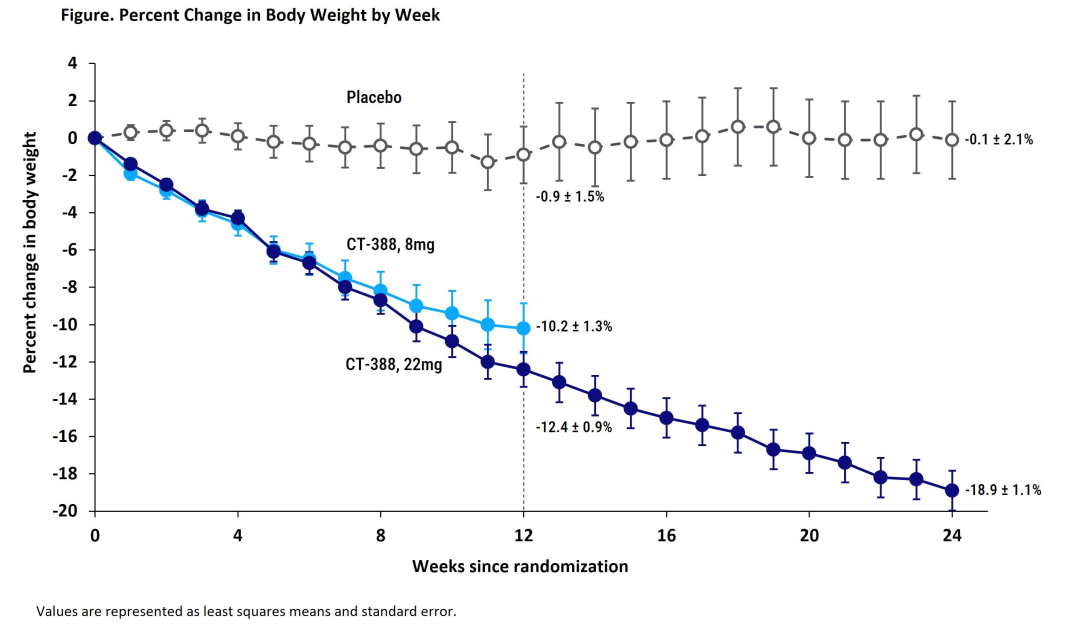
In May this year, Roche announcedPhase I Clinical Trial of CT-388 Successfully Completed:Subcutaneous injection once a week after 24 weeksCT-388 achieved an average weight loss of 18.8% (placebo-adjusted, p < 0.001); 100% of participants receiving CT-388 treatment lost >5% of their body weight, 70% of subjects lost >15%, and 45% of subjects lost >20%.Roche finds the data from this study to be highly encouraging,CT-388 has the potential to become a "best-in-class" therapy for weight loss and blood sugar reduction.
RochePlanning to initiate Phase 2 clinical studies later this year,Expected to evaluate weight loss effects, as well as other outcomes such as improvements in cardiovascular disease and type 2 diabetes.Jefferies, a renowned U.S. investment bankCT-388 is projected to reach a sales peak of $4 billion and is expected to launch in 2029.
Statement:All articles published on this official account (including original and reprinted articles) are intended to convey more information, with sources and authors clearly attributed. This official account welcomes sharing in friend circles or large groups.Unauthorized reproduction by any media or organization in any form to other platforms is prohibited.。Reprint/Business/Contribution| Contact WeChatwfj_GM