Johnson & Johnson Reports H1 2024 Revenue of $43.83 Billion Amid Strong Oncology Growth and Strategic Acquisitions

Johnson & Johnson
Healthcare Product Manufacturers, Health Service Providers
Recently, Johnson & Johnson released its Q2 financial report for 2024. The Q2 revenue was $22.45 billion, representing a year-over-year increase of 4.3%. The total revenue for the first half of the year reached $43.83 billion, marking a year-over-year growth of 3.3%. Among this, pharmaceutical business revenue in Q2 amounted to $14.49 billion, reflecting a year-over-year increase of 5.5%; while the revenue for the first half of the year was $28.05 billion, showing a year-over-year growth of 3.3%.
Johnson & Johnson achieved robust performance growth in the first half of this year and also carried out a series of mergers and acquisitions to actively expand its business territory. Johnson & Johnson forecasts operational sales of $89.4 billion in 2024, representing a 6.4% increase over the previous year.
Strong Revenue Growth in Oncology Segment
From the perspective of therapeutic areas, the oncology segment showed strong growth, surpassing immunology to become Johnson & Johnson's highest revenue-generating field, with Q2 revenue reaching $5.09 billion, a year-over-year increase of 15.7%. In contrast, the immunology sector reported Q2 revenue of $4.722 billion, marking only a 5% year-over-year growth.
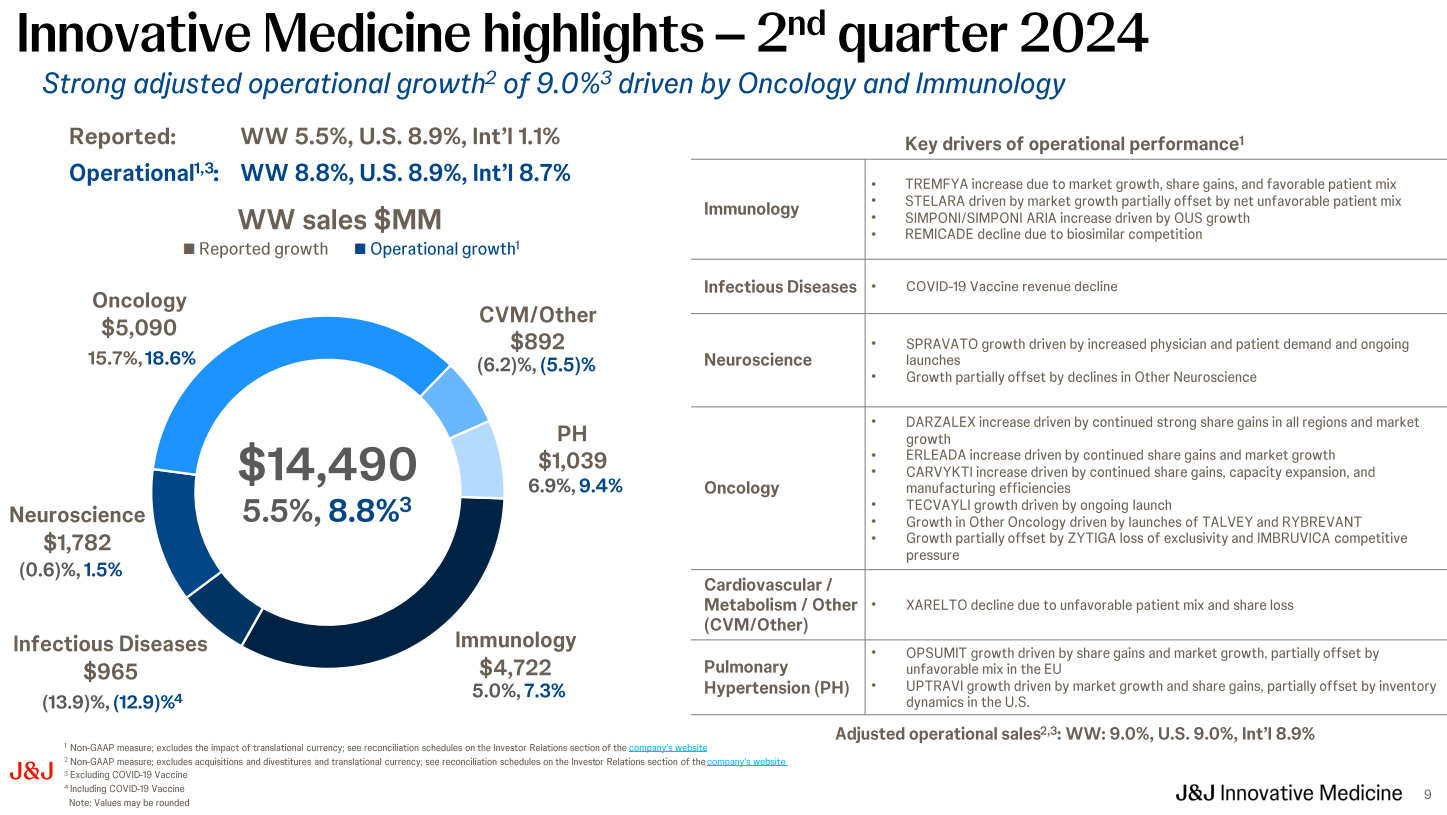
Image Source: Johnson & Johnson Official Website
Johnson & Johnson's strategy for the layout of its oncology drug pipeline is quite distinctive among pharmaceutical companies, as it continuously focuses on areas of expertise and fully explores patient needs.
In the field of multiple myeloma, Johnson & Johnson holds five key products: the proteasome inhibitor Bortezomib, the CD38 monoclonal antibody Daratumumab, the BCMA CAR-T product Carvykti, the BCMA/CD3 bispecific antibody Tecvayli (teclistamab), and the GPRC5D/CD3 bispecific antibody Talquetamab, covering frontline to end-stage treatments for multiple myeloma.
Among them, the CAR-T product Carvykti (Ciltacabtagene Autoleucel) achieved sales of $343 million in the first half of this year, representing a year-on-year increase of 81.5%; the bispecific antibody product Tecvayli achieved sales of $268 million, marking a year-on-year growth of 70.2%, and is expected to become Johnson & Johnson's next-generation pillar product in the multiple myeloma field.
In the field of solid tumors, Johnson & Johnson focuses on prostate cancer and currently has marketed products such as Abiraterone (Zytiga) and Apalutamide (Erleada), along with numerous pipeline candidates in early clinical stages, including JNJ-9401 (PSMA/CD28 bispecific antibody), JNJ-6420 (KLK2-targeted radioligand therapy), and JNJ-8343 (CD3/KLK2 bispecific T-cell engager), among others. Earlier this year, Johnson & Johnson further strengthened its position in the prostate cancer treatment market by acquiring Ambrx and obtaining the core pipeline PSMA-ADC.
In terms of specific products, Darzalex (daratumumab) has replaced Stelara (ustekinumab, Stelara) as Johnson & Johnson's top-selling product. However, the sales of both drugs exceeded $5 billion in the first half of this year, demonstrating Johnson & Johnson's ability to create blockbuster successes.
Sales of Johnson & Johnson's Major Products in the First Half of 2023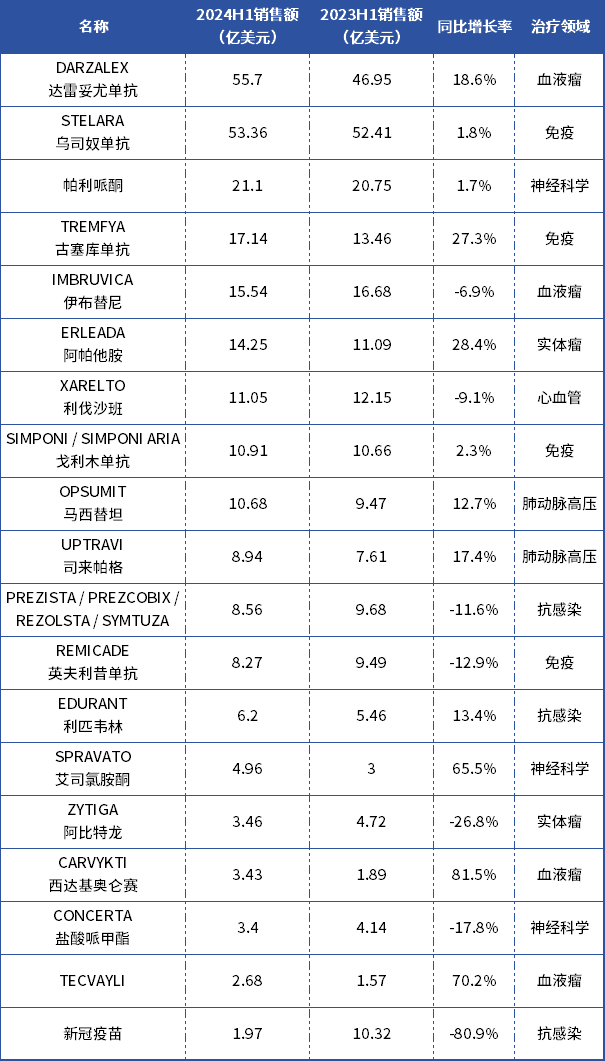
Source: Johnson & Johnson official website, compiled by Pharma Intelligence Headlines
Buy, buy, buy, continue to expand the territory
Although Johnson & Johnson is already the global pharmaceutical revenue leader, its expansion has never stopped. According to teleconference reports, Johnson & Johnson has spent nearly $35 billion on acquisitions in the past 18 months and will "seize opportunities" to seek deals to expand its product portfolio.
From several M&A deals this year, Johnson & Johnson continues to strengthen its presence in the oncology and immunology sectors within the innovative drug market.
In January, Johnson & Johnson acquired Ambrx Biopharma for $2 billion, gaining multiple ADC pipelines. Among them, ARX517 (JNJ-8177) is currently the only PSMA-targeted ADC new drug, which not only enriches Johnson & Johnson's layout in the ADC field but also is expected to enhance its competitiveness in the prostate cancer sector.
It is worth mentioning that Legend Biotech recently received an acquisition offer. Although the buyer was not disclosed, it is widely speculated outside the company that it may be Johnson & Johnson. The combination of CAR-T and bispecific antibodies has made it difficult for Johnson & Johnson to find competitors in the multiple myeloma field.
The autoimmune field is also a key area of focus for Johnson & Johnson. Stelara, once Johnson & Johnson's best-selling product, generated over $10 billion in sales in 2023 and $5.3 billion in the first half of 2024. However, with the impending competition from biosimilars, Johnson & Johnson has been compelled to seek a successor to Stelara.
In May, Johnson & Johnson carried out two consecutive deals to strengthen its bispecific antibody layout in the autoimmune field. First, it acquired Proteologix for $850 million, obtaining two bispecific antibodies: PX128 and PX130. PX128 is an IL-13/TSLP bispecific antibody intended for the treatment of moderate-to-severe atopic dermatitis and moderate-to-severe asthma, with Phase I clinical research preparations already in place; PX130 is an IL-13/IL-22 bispecific antibody intended for moderate-to-severe atopic dermatitis and is currently in the preclinical stage. Subsequently, Johnson & Johnson acquired YellowJersey Therapeutics (YJT), a subsidiary of Numab Therapeutics, for $1.25 billion, gaining global rights to the first-in-class bispecific antibody NM26, which targets two validated pathways in atopic dermatitis, IL-4Rα and IL-31, and is about to enter Phase II clinical research.
Besides innovative drugs, Johnson & Johnson also completed the acquisition of Shockwave for $13.1 billion in May to strengthen its leading position in the cardiovascular medical field. Shockwave is the world’s first company to provide intravascular lithotripsy (IVL) for coronary arteries, dedicated to offering innovative solutions for treating calcified lesions in coronary artery disease (CAD) and peripheral artery disease (PAD).
Summary
Johnson & Johnson has repeatedly ranked as the top pharmaceutical company globally by revenue and has also topped the list of the world’s most valuable pharmaceutical companies for several years. Its performance in the first half of 2024 once again demonstrated its strength and innovation capabilities as a global pharmaceutical giant. Not only does it have numerous blockbuster drugs, but its R&D pipeline is also highly distinctive. While continuously solidifying its leading position in oncology and immunology, it is also expanding into new fields through acquisitions, laying a solid foundation for sustained future growth.

Editor: Liuli
Disclaimer: The views expressed in this article are solely those of the author and do not represent the position of PharmNet. We welcome exchanges and additional input in the comment section; for reprints, please be sure to credit the author and source. If there are any issues regarding the content, copyright, or other aspects of the work, please leave a message on this platform, and we will address it promptly.