GreatBay Bio's AlfaDAX Platform Achieves 89.3% Accuracy in Aggregation Prediction for 28 Novel Molecules

GBB
AI Biomedical R&D Company

GBB's AlfaDAX Online System (https://store.greatbay-bio.com/) predicted the aggregation and precipitation of 28 innovative molecules and validated each with wet experiments.The correct rate for predicting molecules with aggregation and precipitation reaches 100%, the accuracy rate for non-aggregation and precipitation molecules reaches 78.6%, and the overall evaluation accuracy rate reaches 89.3%.
By comparing six publicly available antibody datasets, it was validated thatAlfaDAX Online SystemEffectively help customers avoid risks in advance through molecular modification and accelerate the process of new drug launches.

▲AlfaDAX Online System URL
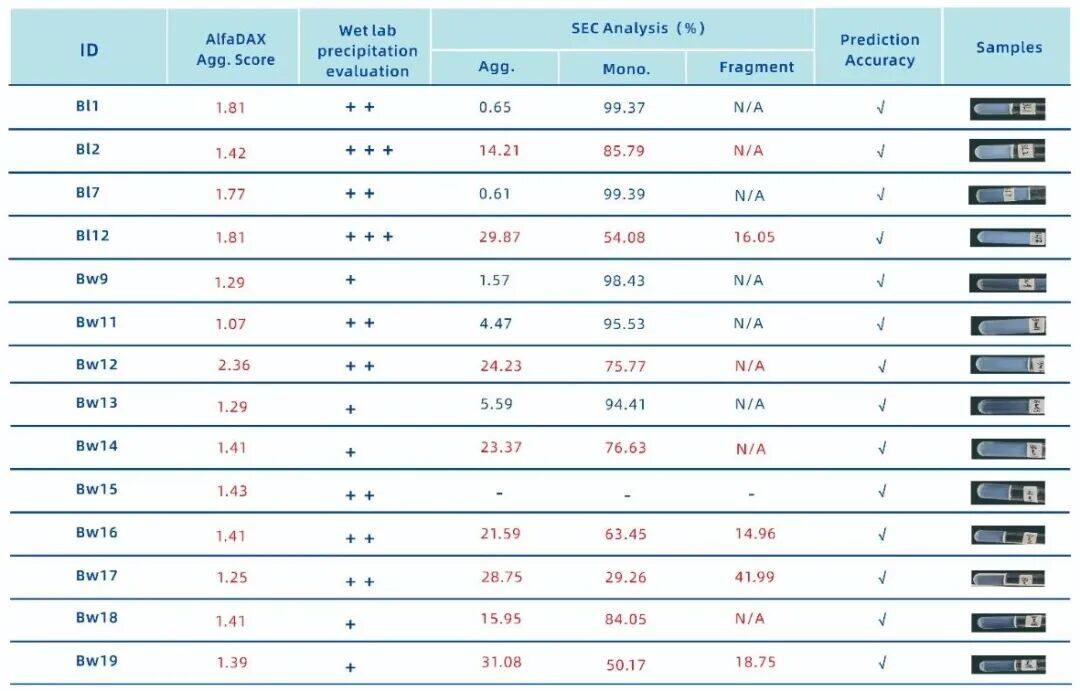
▲Figure 1:Prediction14 with aggregation and precipitationInnovative MoleculesAccuracy rate of 100%
As shown in Figure 1, after aggregation scoring by the AlfaDAX online system, 14 innovative molecules were flagged with red alerts. These 14 innovative molecules subsequently underwent turbidity evaluation and SEC testing in wet experiments, and the results showed aggregation and precipitation in all cases.AlfaDAX Online SystemPredictionMolecules with aggregation and precipitation have an accuracy rate of 100%, enabling early risk detection and effectively reducing the workload of wet lab experiments.
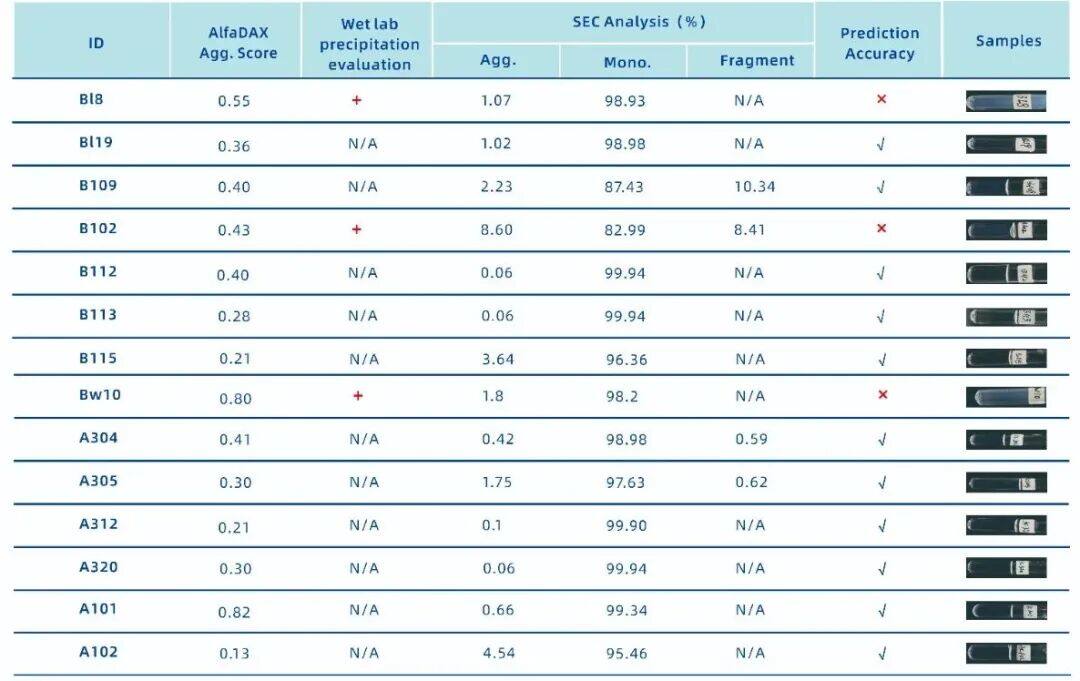
▲Figure 2:Prediction14Non-aggregating precipitateThe accuracy rate of innovative molecules reaches 78.6%.
As shown in Figure 2,AlfaDAX Online SystemIn addition, 14 innovative molecules underwent aggregation scoring, with results showing no aggregation or precipitation. Similarly, these 14 innovative molecules were also evaluated for turbidity through wet experiments and SEC testing. Among them, 11 showed no aggregation, while 3 exhibited aggregation.The AlfaDAX system, with a rigorous attitude of not missing a single good molecule, achieves an accuracy rate of 78.6% for non-aggregating precipitated molecules.
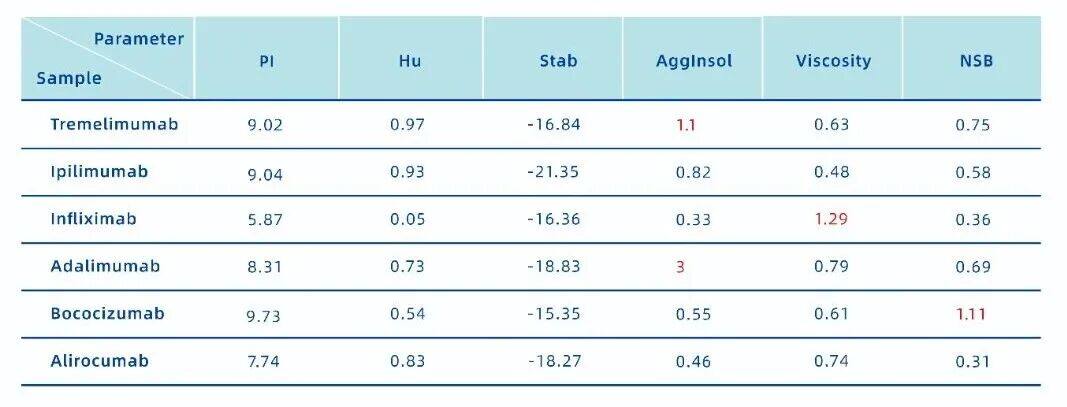
▲Figure 3: Evaluation results of 6 open drug molecules
Tremelimumab and Ipilimumab are both marketed antibodies targeting CTLA4.AlfaDAX Online System Predicts That Tremelimumab Is Prone to Aggregation, While Ipilimumab Is Not, Which Is Consistent with Reality[1]According to reports, Ipilimumab currently has a more widespread use than Tremelimumab.On March 25, 2011, the US FDA approved Ipilimumab for the treatment of advanced melanoma, applicable to patients with unresectable or metastatic melanoma, intermediate- or low-risk advanced renal cell carcinoma, and certain types of metastatic colorectal cancer. Tremelimumab is mainly used in metastatic melanoma research and needs to be combined with Durvalumab for the treatment of solid cancers such as liver cancer and lung cancer.
Infliximab and Adalimumab are both marketed antibodies for TNFα, but Infliximab has a higher viscosity.[2]If antibodies exhibit high viscosity at high concentrations, greater force, larger needles, or reduced concentration with multiple injections will be required during patient administration, increasing patient discomfort. Therefore, the FDA's maximum recommended concentration for Infliximab is 4mg/ml.[3], which greatly limits the efficacy, while the maximum recommended concentration of Adalimumab can reach 100mg/ml.[4], which is also one of the reasons why Adalimumab remains a top seller. Although fully human Adalimumab can be widely used, similar to chimeric Infliximab, it still causes relatively serious immunogenicity issues. Approximately 28% of patients develop anti-drug antibodies within three years of Adalimumab injections, affecting efficacy and raising safety concerns.[5]。As predicted by the AlfaDAX online system, Adalimuamb tends to aggregate through electrostatic attraction and is prone to forming aggregates of varying sizes under stirring conditions. These aggregates of varying sizes are the main cause of differing levels of immunogenicity.[5]。
Adalimumab, as the world's first humanized TNFα monoclonal antibody,With fewer side effects and patient drug resistance,Sales reached $280 million in the first year after its market launch. Currently, adalimumab has been approved globally for over ten indications, including rheumatoid arthritis and psoriasis. In China, it has received approval for eight indications, all of which have been included in the 2022 National Reimbursement Drug List.IfAdalimumabThe better drug-like properties, reducing immunogenicity caused by aggregation, will benefit patients more.

Bococizumab, like Alirocumab, is also an antibody targeting PCSK9.For the study of hypercholesterolemia,However, Bococizumab was halted in Phase III clinical trials, while Alirocumab successfully reached the market.Bococilizumab has a strong tendency for non-specific binding, which may affect its efficacy and lead to toxic side effects.[6], andAlfaDAX online system analysis is consistent. Bococizumab did not achieve the expected efficacy in reducing low-density lipoprotein cholesterol and showed higher immunogenicity and injection-site adverse reactions compared to other PCSK9 inhibitors, which is a typical case where non-specific binding limitations restricted drug development.
AlfaDAX Online System Predicts the Correct Rate of 28 Innovative Molecules Aggregating and Precipitating at 89.3%, Helping Clients Avoid Risks in Advance Through Molecular Modification and Accelerating the Process of New Drug Launch. Global Biopharmaceutical Colleagues Are Welcome to Experience and Provide Feedback.

▲Scan the QR code to experience the AlfaDAX online system
1.step, P., Caffry, I., Yu, Y., Sun, T., Cao, Y., Lynaugh, H., ... & Xu, Y. (2015, May). An alternative assay to hydrophobic interaction chromatography for high-throughput characterization of monoclonal antibodies. In MAbs (Vol. 7, No. 3, pp. 553-561). Taylor & Francis.
2.Thorsteinson, N., Gunn, J. R., Kelly, K., Long, W., & Labute, P. (2021, January). Structure-based charge calculations for predicting isoelectric point, viscosity, clearance, and profiling antibody therapeutics. In MAbs (Vol. 13, No. 1, p. 1981805). Taylor & Francis.
3.https://www.accessdata.fda.gov/drugsatfda_docs/label/2021/103772s5401lbl.pdf
4.https://www.accessdata.fda.gov/drugsatfda_docs/label/2023/125057s423lbl.pdf
5.Heljo, P., Ahmadi, M., Schack, M. M. H., Cunningham, R., Manin, A., Nielsen, P. F., ... & Jiskoot, W. (2023). Impact of stress on the immunogenic potential of adalimumab. Journal of Pharmaceutical Sciences, 112(4), 1000-1010.
6.Makowski, E. K., Chen, H., Lambert, M., Bennett, E. M., Eschmann, N. S., Zhang, Y., ... & Tessier, P. M. (2022, December). Reduction of therapeutic antibody self-association using yeast-display selections and machine learning. In MAbs (Vol. 14, No. 1, p. 2146629). Taylor & Francis.
END
Tel: 400 079 8808
18926497707 (Same number for WeChat)
Email: BD@greatbay-bio.com