Global First PCSK9 siRNA Drug Inclisiran Achieves Strong Commercial Performance; Nine Chinese Companies Advance Domestic Pipeline

Novartis
Drug Development and Manufacturing

SANEGENEBIO
Small Nucleic Acid Drug Developer
Disclaimer: Due to limited expertise, errors are inevitable, and some information may not be the most up-to-date. Comments pointing out any issues are welcome. This article is only an introduction to medical and health-related drugs, not a recommendation of treatment options (if involved); it does not constitute any investment advice.
On August 22, 2023, Novartis announced that the PCSK9 siRNA therapy Inclisiran had been approved by the NMPA for marketing in China as an adjunct to diet for the treatment of adult patients with primary hypercholesterolemia (heterozygous familial and non-familial) or mixed dyslipidemia, under the trade name Leqvi.,This drug has become the first small interfering RNA (siRNA) drug to be launched in China.
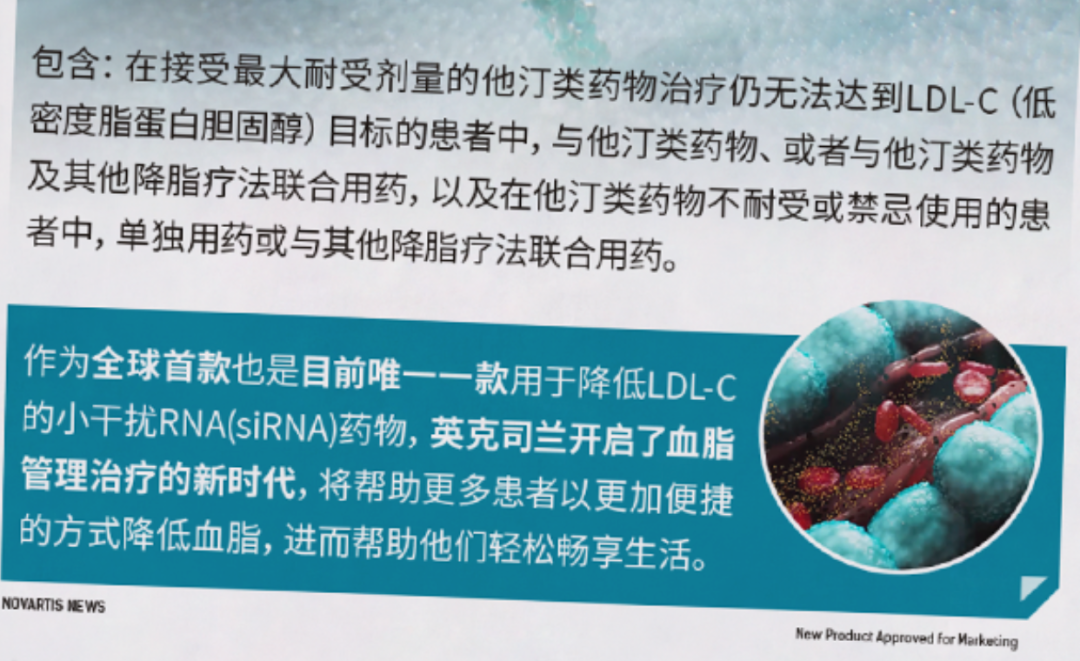
Inclisiran (trade name: Leqvio) was originally co-developed by MDCO and Alnylam. In 2019, Novartis acquired The Medicines Company (MDCO) for $9.7 billion to obtain it.Inclisiran is a first-in-class siRNA drug targeting PCSK9.Only two subcutaneous administrations per year,The drug isThe world's first and currently only PCSK9 siRNA lipid-lowering drug。Leqvio is priced at $6,500 per year in Europe and the United States, approximatelyRMB 47,000/year; Pricing in China9,988 RMB per injection, approximately 20,000 RMB per year.
In December 2020, inclisiran was first approved for marketing in the European Union for the treatment of adult hypercholesterolemia and mixed dyslipidemia.In December 2021, Inclisiran was approved by the FDA for marketing to treat hyperlipidemia under the trade name Leqvio, requiring only twice-yearly dosing. In August 2023,The product was approved in China just nine months after the submission of the new drug application.
Inclisiran can bind to the RNA-induced silencing complex (RISC) and, mediated by the antisense strand, bind to the mRNA encoding the PCSK9 protein, inhibiting the production of the PCSK9 protein. This prevents PCSK9-mediated degradation of low-density lipoprotein receptor (LDLR), increasing the number of LDLRs available to clear low-density lipoprotein from the blood, thereby reducing LDL-C levels.
Support Inclisiran initially in the EU and the USListedPivotal Phase III Clinical TrialA total of 3 trials: ORION-9, ORION-10, and ORION-11. These three clinical studies enrolled a total of 3,660 participants, of which 1,728 patients with HeFH or ASCVD received Inclisiran treatment. The study results have confirmed that only two subcutaneous injections per year are required.Inclisirancan stably and durably lower LDL-C levels.A reduction of more than 50% can be achieved.。These results have been published in The New England Journal of Medicine. [1,2,3]
ORION-8 is the open-label extension of three Phase III trials (ORION-11, ORION-10, and ORION-9) and one Phase II trial (ORION-3).To date, regardingInclisiranThe Largest-Scale Clinical StudyThe findings were presented at the European Society of Cardiology Congress 2023 (ESC 2023). In these clinical trials, patients with ASCVD or at risk of cardiovascular disease received inclisiran twice a year for three years. After up to three years of follow-up, 78.4% of patients reached their LDL-C target. Inclisiran also reduced LDL-C levels by 49.4%.Long-term safety data are consistent with previous results, confirming the established and favorable safety profile of Leqvio therapy [4].
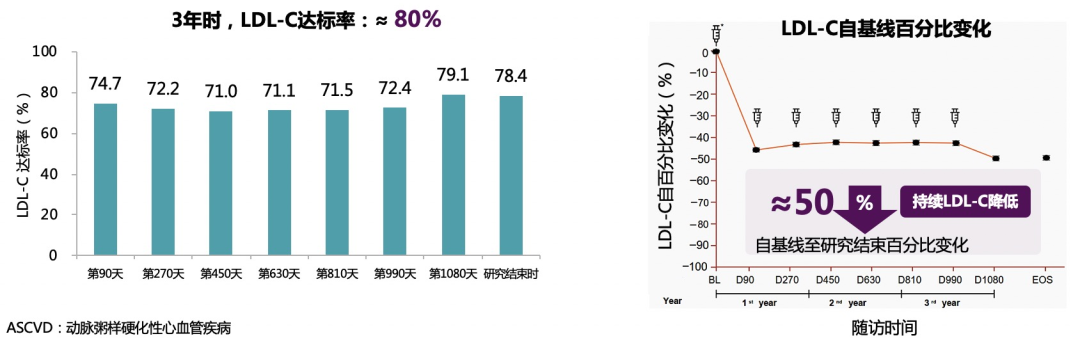
LDL-C Achievement Rate and Reduction in the ORION-8 Study
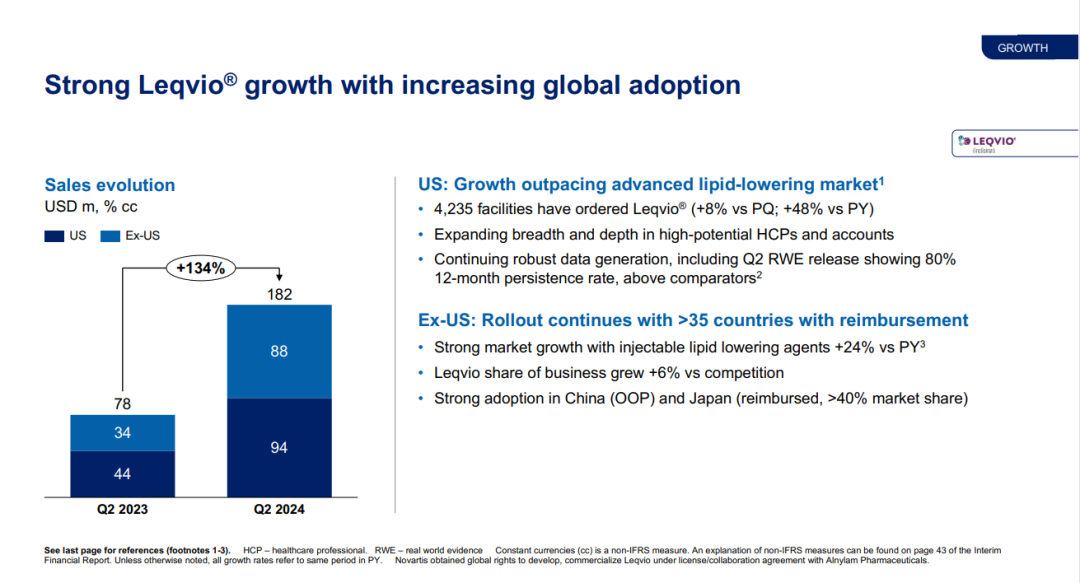
On July 18, 2024, Novartis released its financial report for the first half of the year.:2024 H1Net sales reached $24.3 billion,Revenue of 7.4 billion US dollars; including Q2Net sales of $12.5 billion, an increase of 11% year-over-year;Revenue of $4 billion, a year-on-year increase of 47%.In China, Q2 net sales reached $1.1 billion, a significant increase of 27% year-over-year, and the company raised its financial outlook for the full year 2024.
PCSK9 siRNA New Drug Leqvio Q2 2024 Sales Reach $182 Million, Up 134% Year-over-Year2024 H1 Sales Reach $333 Million, Approaching Full-Year 2023 Sales。Leqvio's performance in 2022 was $112 million, and its sales in 2023 were $355 million.Promotion continues in 35 countries outside the United States.
PCSK9 is the 9th proprotein convertase subtilisin/kexin family, a secreted serine protease mainly synthesized by the liver, which can bind to low-density lipoprotein cholesterol receptors (LDL-R) binds and degrades LDL-R, thereby reducing the clearance of LDL-C in the blood by LDL-R and increasing the level of LDL-C.
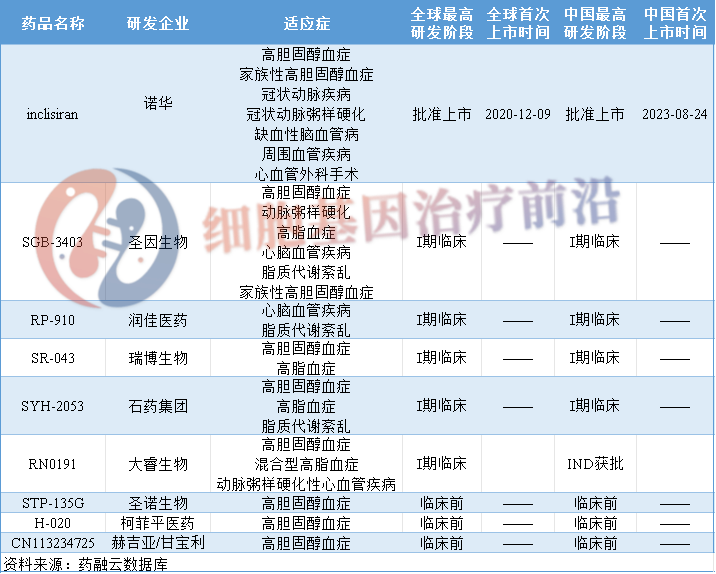
1. SANEGENEBIO: SGB-3403
SANEGENEBIO's core product SGB-3403 has entered the clinical trial stage in China and Australia, with the single-dose escalation trial proceeding steadily. SGB-3403 is an siRNA-GalNAc conjugate targeting PCSK9 in hepatocytes, delivered to liver cells using SANEGENEBIO's next-generation GalNAc conjugation technology, inhibiting the synthesis of PCSK9 protein in the liver through RNAi. SGB-3403 is clinically intended for the treatment of hypercholesterolemia, mixed dyslipidemia, and atherosclerotic cardiovascular diseases to reduce the risk of cardiovascular events.
2. SANEGENEBIO:SRSD101 Injection
On March 22, SANEGENEBIO announced that the Phase 1 clinical study of SRSD101 Injection, a specific liver-targeted PCSK9 small nucleic acid drug independently developed by the company, has successfully completed dosing for all enrolled subjects, showing good safety and tolerability with no adverse events reported so far. This is a randomized, double-blind, placebo-controlled, single ascending dose clinical study aimed at evaluating...The safety, tolerability, pharmacokinetics, and pharmacodynamics profile of SRSD101.
On December 29, 2023, Dara Bio's first self-developed RN0191 injection successfully obtained the implied permission for clinical trial application approved by the China National Medical Products Administration. As the third PCSK9 siRNA to enter synchronized clinical development in China and overseas, this product can be used to treat hypercholesterolemia, mixed hyperlipidemia, and atherosclerotic cardiovascular diseases to reduce the risk of cardiovascular events.
In June 2023, RN0191 received ethical approval in Australia to conduct its first-in-human trial. The trial is currently proceeding smoothly, with existing data indicating good tolerability and safety of RN0191, as well as dose-dependent pharmacological effects and efficacy. Additionally, significant reductions in several key lipid metabolism indicators, including lipoprotein(a), further confirm its potential dual advantage in significantly lowering both low-density lipoprotein and lipoprotein(a). This outcome provides strong support for the subsequent clinical trials of this differentiated product.
5、Ribo Life Science:RBD7022
References: