

Tumor Complete Response Rate Doubled! GSK Submits MAA for Potential Blockbuster ADC Blenrep in Combination Therapy for Relapsed/Refractory Multiple Myeloma

GSK
Pharmaceutical R&D Manufacturer
▎WuXiEdited by Kant Content Team
GSK announced today that the European Medicines Agency (EMA) has acceptedBlenrep (belantamab mafodotin), an antibody-drug conjugate (ADC) targeting B-cell maturation antigen (BCMA)Marketing Authorization Application (MAA) for the treatment of relapsed or refractory multiple myeloma (RRMM) in combination with bortezomib and dexamethasone (BorDex) or pomalidomide and dexamethasone (PomDex).

DREAMM-7 evaluated the efficacy of Blenrep in combination with BorDex, compared to the current standard treatment regimen (daratumumab plus BorDex), as a second-line and later treatment for RRMM patients. Results previously shared at an investor meeting showed,The median progression-free survival (PFS) for patients receiving Blenrep combination therapy (N=243) was 36.6 months (95% CI: 28.4-NR), nearly two years longer than the 13.4 months (95% CI: 11.1-17.5) observed in the active comparator group (N=251)., the risk of disease progression or death in patients receiving Blenrep combination therapy was reduced by nearly 60% (HR: 0.41, 95% CI: 0.31-0.53, p<0.00001), achieving the primary endpoint of this trial.
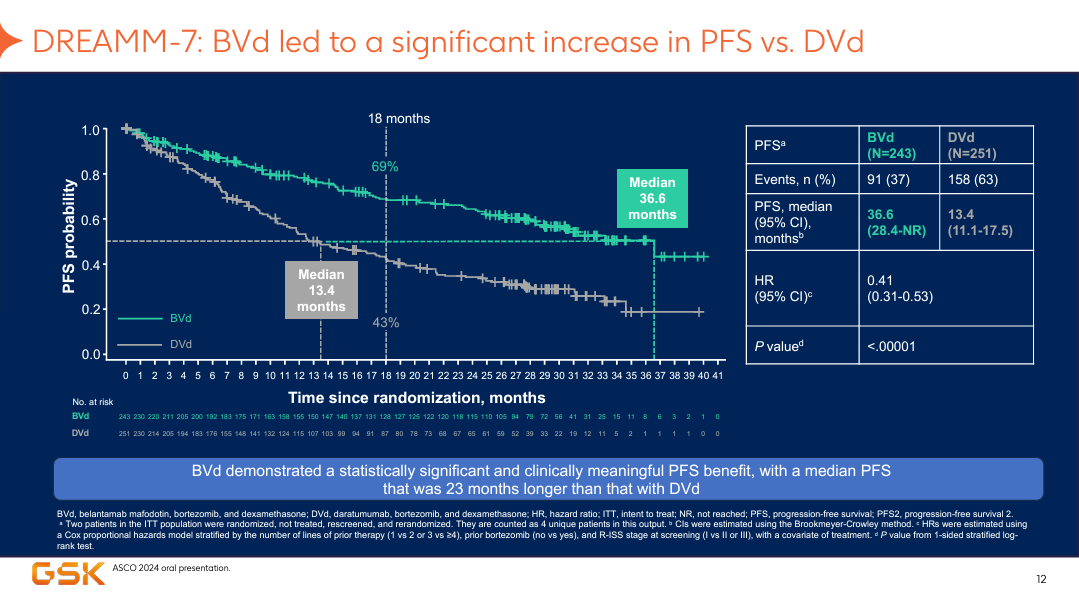
▲PFS Results of DREAMM-7 Phase 3 Clinical Trial (Image Source: Reference [2])
As for the key secondary endpoint of overall survival (OS), the median OS for both groups has not yet been reached. However, the Blenrep combination therapy has already demonstrated early and significant clinical benefits (HR: 0.57, 95% CI: 0.40-0.80, p=0.00049), and follow-up for OS is still ongoing.Notably, the Blenrep combination therapy also outperformed the active control group in terms of depth of response, with more than twice as many patients achieving complete response (CR) compared to the control group.
DREAMM-8 Phase 3 Head-to-Head Trial Evaluates Blenrep Plus PomDex vs Standard of Care Bortezomib Plus PomDex as 2L+ Therapy in RRMM Patients. Analysis Shows Median PFS Not Yet Reached (95% CI: 20.6-NR) for Patients Receiving Blenrep Combination Therapy (N=155), Compared to 12.7 Months (95% CI: 9.1-18.5) for the Active Comparator Arm (N=147). The Risk of Disease Progression or Death Was Reduced by Nearly 50% in Patients Treated with Blenrep Combination Therapy (HR: 0.52, 95% CI: 0.37-0.73, p<0.001), Meeting the Primary Endpoint of the Trial. Additionally, Blenrep Combination Therapy Demonstrated Benefit Across All Pre-Specified Subgroups.
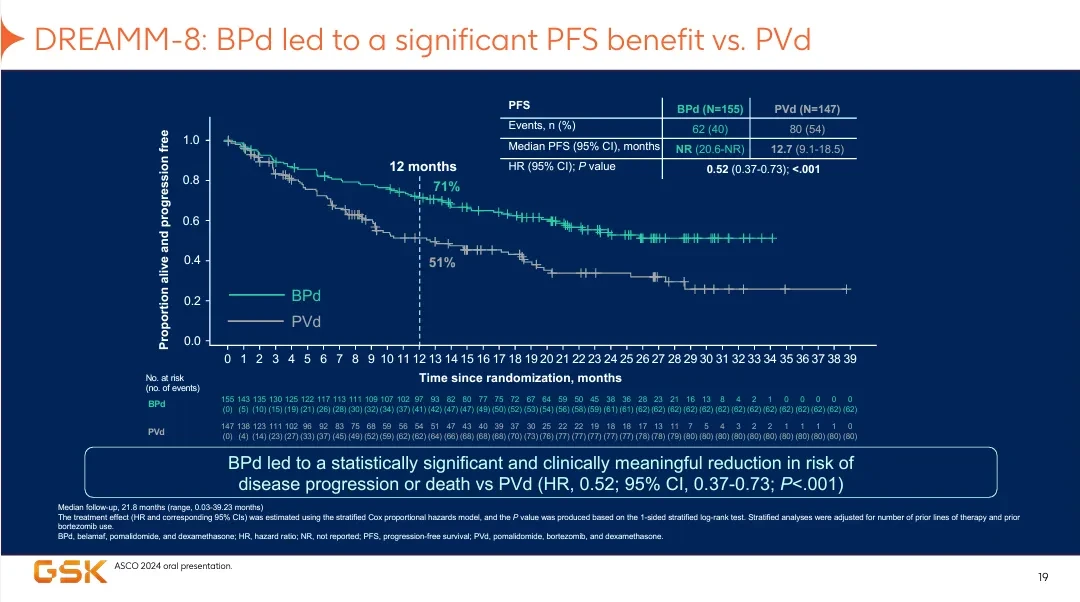
▲PFS Results of DREAMM-8 Phase 3 Clinical Trial (Image Source: Reference [1])
As for the key secondary endpoint OS, the median OS of patients in both groups has not been reached yet, but the Blenrep combination therapy has already shown a trend superior to that of the active control drug (HR: 0.77, 95% CI: 0.53-1.14), and the follow-up for OS is still ongoing. Notably, the Blenrep combination therapy also outperformed the active control group in terms of depth of response, with the proportion of patients achieving complete response being more than twice that of the control group.
Blenrep is composed of a humanized anti-BCMA monoclonal antibody and the cytotoxic drug auristatin F, conjugated through a non-cleavable linker, and can eliminate myeloma cells through multiple mechanisms of action.

▲To learn more about the application of cutting-edge technologies in the biopharmaceutical industry, please long-press and scan the QR code above to access "WuXi Live Studio" and watch live discussions and exciting replays on related topics.
Disclaimer: The content team of WuXi AppTec focuses on introducing the research progress in global biopharmaceuticals and health. This article is for information exchange purposes only, and the views expressed in the article do not represent the position of WuXi AppTec, nor does it mean that WuXi AppTec supports or opposes the views in the article. This article is not a recommendation for treatment plans. If you need guidance on treatment options, please visit a regular hospital.
Copyright Statement: This article is from the WuXi AppTec content team. Individuals are welcome to share it on their social media platforms, but unauthorized reproduction by media or institutions in any form on other platforms is prohibited. For authorization to reproduce, please reply with "reprint" on the "WuXi AppTec" WeChat Official Account to obtain reprint guidelines.


Share,PointLike,In View,Focusing on Global Biomedical Health Innovation