

AstraZeneca Inks $545M Deal for PineTree's Preclinical EGFR Degrader Targeting TKI-Resistant Tumors

PineTree Therapeutics
Developer of Disruptive Tumor Therapies

AstraZeneca
Biopharmaceutical Manufacturer
On July 23, biotechnology company PineTree Therapeutics ("PineTree") announced that it had entered into an exclusive option and global licensing agreement with AstraZeneca for a preclinical EGFR degrader candidate drug.
According to the terms of the agreement,AstraZeneca to Obtain Exclusive Global Development and Commercialization Option for PineTree's Preclinical EGFR Degrader。
As one of the main players in this transaction,PineTree Therapeutics, Inc. is a preclinical-stage biotechnology company dedicated to developing next-generation targeted protein degraders (TPD) to combat drug resistance in oncology and other fields.. The company was founded in 2019 and received a $23.5 million Series A financing in June 2022, with investors including InterVest, SK Securities, DSC Investment, J Curve Investment, Samho Green Investment, and SJ Investment Partners.
PineTree Therapeutics, Inc. is currently led by Dr. Hojuhn Song. Previously, he served as the project team leader at the Novartis Institutes for Biomedical Research, which was renamed last year to the Novartis Center for Biomedical Research. Under the leadership of Dr. Hojuhn Song, PineTree Therapeutics developed the AbReptor™ technology and TAER-TAB™ technology, and based on these, built a drug development platform called AbReptor™TPD.
According to its official website, AbReptor™ is a convertible modular multispecific antibody platform designed to degrade membrane-bound proteins and extracellular proteins. Unlike traditional inhibitors that block signaling pathways, AbReptor™ focuses on targeted degradation of membrane-bound proteins and extracellular proteins. Its mechanism of action involves co-binding surface receptors or target extracellular proteins with another proprietary receptor target.
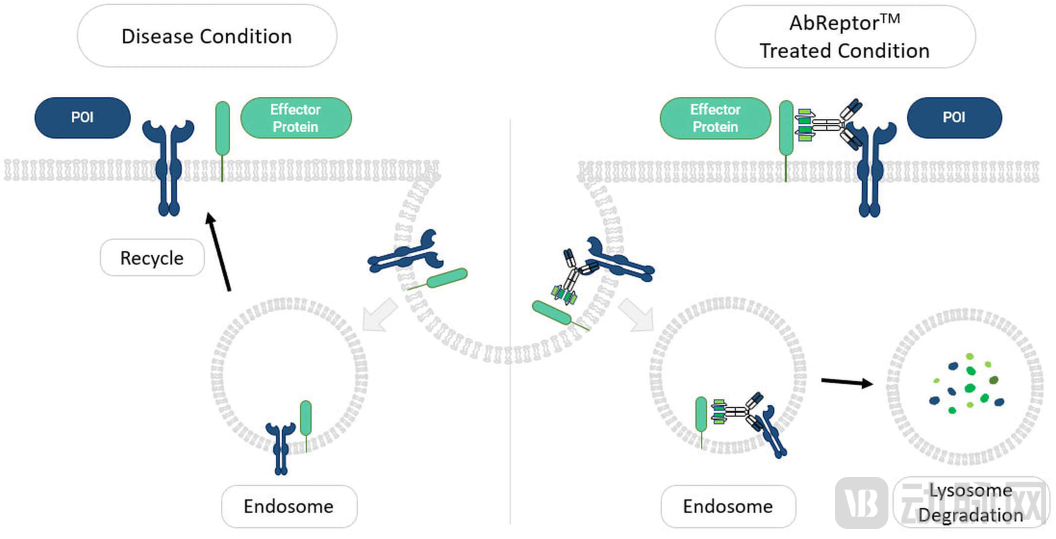
Source: PineTree Therapeutics, Inc. official website
TAER-TAB™ is a receptor degradation platform based on transformative antibodies, capable of targeting and potentially degrading drug-resistant or difficult-to-treat receptors present on various tumors as well as different types of immune and disease cells. It can enhance adoptive anti-tumor immunity and prevent tumor recurrence by generating multivalent antibodies to degrade extracellular oncogenic receptors and immuno-oncology antibodies, with the potential to address key unmet needs such as tumor drug resistance and tumor recurrence.
The core of this transaction – the preclinical EGFR degrader candidate – was developed by AbReptor™TPD.It is reported that the candidate drug has demonstrated good preclinical anti-tumor activity in TKI-resistant tumors, and its activity is enhanced when used in combination with current EGFR inhibitors.。
Regarding this transaction, Dr. Hojuhn Song, founder and CEO of Pinetree, stated in a press release: "We are pleased to announce this option and license agreement with AstraZeneca, a global leading biopharmaceutical company, to advance one of our novel receptor degrader programs into clinical trials."
In addition, Pinetree is advancing multiple preclinical candidates derived from its AbReptor™TPD platform, which have demonstrated potential therapeutic benefits in oncology and other therapeutic areas.
The introduction of PineTree's preclinical EGFR degrader this time represents another expansion of AstraZeneca's oncology business product pipeline.
According to its official website, AstraZeneca currently has 182 R&D pipelines, with projects highly focused on three major areas: anti-tumor, biopharmaceuticals, and rare diseases. AstraZeneca's anti-tumor products have lived up to expectations and have now become a significant pillar of the company’s revenue growth. According to AstraZeneca's Q1 financial report data for 2024, the company achieved a total revenue of $12.679 billion in Q1 2024, representing a year-on-year increase of 19%. In terms of disease areas, revenue from the oncology sector reached $5.108 billion, making it the highest-earning business segment.
Notably, among the TOP10 best-selling products in Q1 of 2024, five are anti-tumor therapeutic drugs. Among them, the star product, the third-generation EGFR inhibitor Tagrisso (Osimertinib), generated revenue of $1.595 billion, making it the undisputed "best-seller" in AstraZeneca's oncology sector.
And currently,AstraZeneca is also actively promoting the approval of new indications for Tagrisso and its combination with other therapies, achieving positive results.In February 2024, AstraZeneca announced that Tagrisso received FDA approval for a new indication, to be used in combination with chemotherapy as a first-line treatment for NSCLC patients. In June 2024, Tagrisso was approved in China for its fourth indication, to be used in combination with pemetrexed and platinum-based chemotherapy drugs for the first-line treatment of adult patients with locally advanced or metastatic NSCLC harboring EGFR exon 19 deletions or exon 21 (L858R) substitution mutations.
In addition, AstraZeneca is also exploring ways for Tagrisso to address tumor resistance mechanisms through the SAVANNAH and ORCHARD Phase 2 studies, the SAFFRON Phase 3 study of Tagrisso in combination with savolitinib, as well as combination therapies with other potential new drugs.
PineTree Therapeutics' preclinical EGFR degrader candidate, which has potential therapeutic benefits, could become another blockbuster product in AstraZeneca's oncology portfolio and is expected to be used in combination with Tagrisso to explore new therapies to combat tumor resistance.
In this regard, Puja Sapra, Senior Vice President of Oncology Targeted Discovery at AstraZeneca's Oncology R&D Department, stated: "Targeted protein degradation is a promising therapeutic approach. We are delighted to sign this agreement with Pinetree Therapeutics for the exclusive option to license its preclinical EGFR degrader for researching tumors expressing EGFR, including those with EGFR mutations."
May 21, 2024AstraZeneca proposed at its Investor Day event to achieve $80 billion in revenue by 2030 and sustain growth beyond 2030.AstraZeneca's revenue in 2023 was $45.8 billion, which means it aims to double its performance within seven years.
To achieve the revenue target of 80 billion US dollars, AstraZeneca has proposed three major strategic directions. One of them is to continuously pursue science and innovation by investing in disruptive innovations and leveraging the global R&D network. This means that internal R&D and external cooperation will become AstraZeneca's main strategies for expanding its innovation layout in the future. In terms of external expansion, project BD introduction and mergers and acquisitions have become the main methods for AstraZeneca to expand its existing product pipeline.
Immediately following the conclusion of the Investor Day event, AstraZeneca announced several collaborations:
May 22,Entered into a licensing agreement with HBM (02142.HK) wholly-owned subsidiary Nona Biosciences for a preclinical monoclonal antibody project to accelerate the development of tumor-targeted therapies.According to the agreement, NanoBio will receive an upfront payment of $19 million upon completion of the transaction, with the right to receive an expected near-term milestone payment of $10 million. Additionally, they could obtain up to $575 million in development, regulatory, and commercial milestone payments, as well as tiered royalties based on net sales. Furthermore, if AstraZeneca exercises its option, NanoBio will be entitled to additional relevant payments.
May 23,Participated in the $30 million Series A financing of SixPeaks, a startup company developing weight loss drugs, and reached a strategic cooperation with it.AstraZeneca will provide up to $80 million in additional non-dilutive financing to SixPeaks over the next two years, including upfront and near-term payments. As part of the collaboration, AstraZeneca has the right to acquire SixPeaks during this period.
According to the statistical data from the PharmCube database, AstraZeneca has been particularly active in BD transactions over the past five years, maintaining a pace of 3-4 small-scale acquisitions per year. Notably, in the past year, AstraZeneca has reached global licensing cooperation agreements with seven Chinese innovative pharmaceutical companies, with a total amount reaching approximately 6 billion US dollars.
Through continuous "buying spree," AstraZeneca has significantly expanded its existing portfolio in oncology, biopharmaceuticals, and rare diseases. Its current pipeline of 182 projects covers multiple disease areas including oncology, autoimmune diseases, metabolic disorders, and rare diseases. Moreover, innovative drug modalities are taking up an increasing proportion. The cell therapy market size is projected to exceed $20 billion, gene therapy and editing over $30 billion, ADC over $80 billion, and radiopharmaceuticals over $10 billion.
In addition, AstraZeneca's core pipeline includes several blockbuster products with sales peak potential exceeding $5 billion.
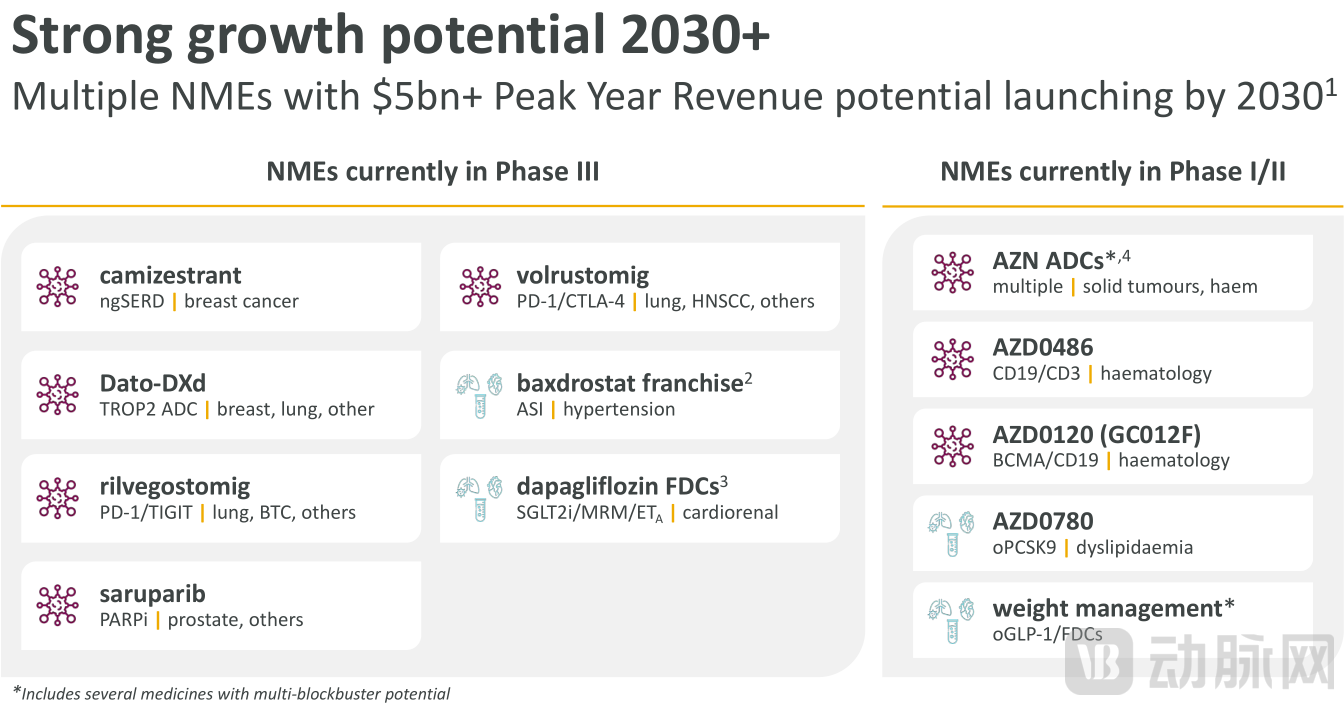 Source: AstraZeneca official website
AstraZeneca stated that it will launch 20 new molecular drugs by 2030 and expects to read data from over 40 Phase III clinical trials by the end of 2025. The results of these clinical trials, along with those published so far in 2024, are expected to bring in approximately $20 billion in potential revenue.
In 2014, AstraZeneca set itself a revenue target: by 2023, the company's annual revenue would exceed $45 billion. At that time, AstraZeneca was not favored by the industry. However, AstraZeneca reversed its困境 and achieved this revenue milestone in 2023.
Ten years later, AstraZeneca has set a new revenue target – achieving $80 billion in revenue by 2030. This time, with a robust product pipeline and continuous innovation driving growth, it remains to be seen whether AstraZeneca can once again exceed revenue expectations!