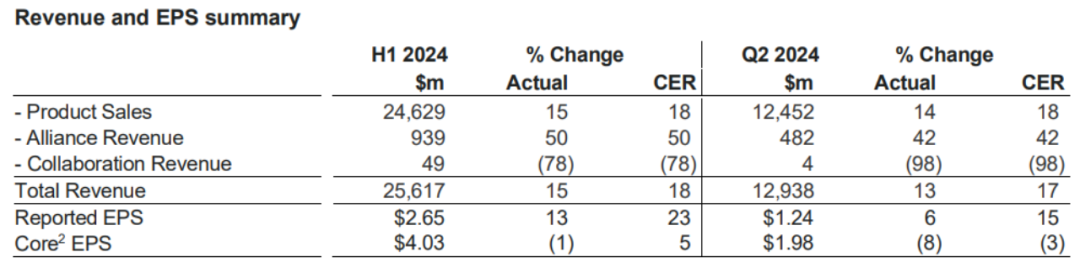
Just now, AstraZeneca announced its semi-annual report for 2024. According to the financial report data, AstraZeneca's revenue in Q2 2024 was $12.938 billion, a year-on-year increase of 17% (at constant exchange rates). The revenue for the first half of the year was $25.617 billion, a year-on-year increase of 18% (at constant exchange rates), mainly driven by growth in the fields of oncology (+22%), CVRM (Cardiovascular, Renal, and Metabolism Business Unit, +22%), R&I (Respiratory, +22%), and rare diseases (+15%) (Figure 1).
Figure 1. AstraZeneca's Revenue in the First Half of the Year
01
One More Member Added in the Field of Oncology
Oncology is AstraZeneca's strong area, with revenue of $10.4 billion in the first half of 2024, increasing by 22%. This growth was mainly driven by Tagrisso (+12%), Calquence (+22%), Imfinzi (+18%), Lynparza (+7%), and Enhertu (+49%) (Figure 2).
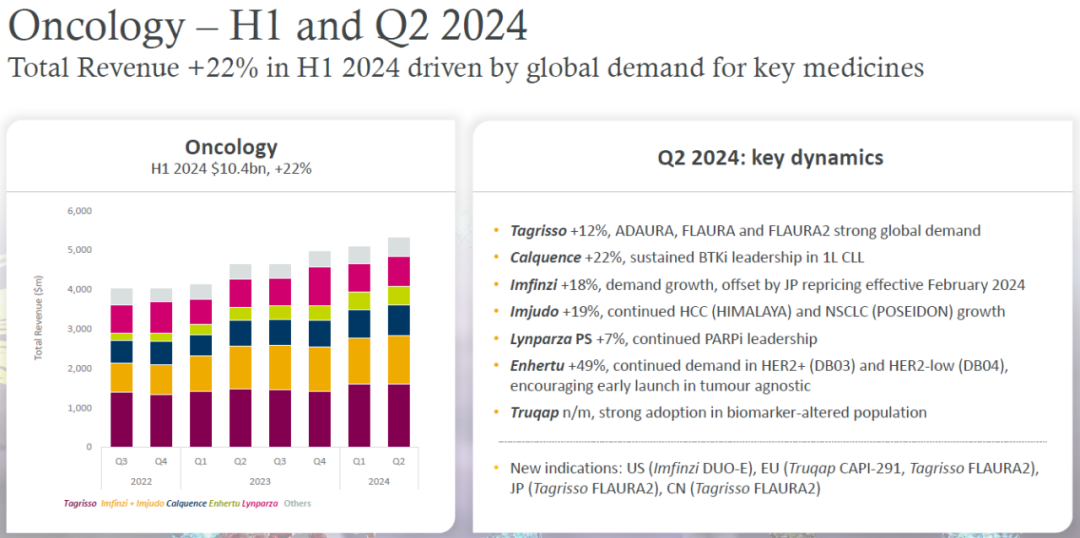
Figure 2. Revenue in the Oncology Sector and Key Drivers
Osimertinib is AstraZeneca's leading product,In the face of fierce global competition, revenue in the first half of 2024 increased by 13% year-on-year to USD 3.202 billion.Expected to exceed $6 billion for the year(Figure 3).
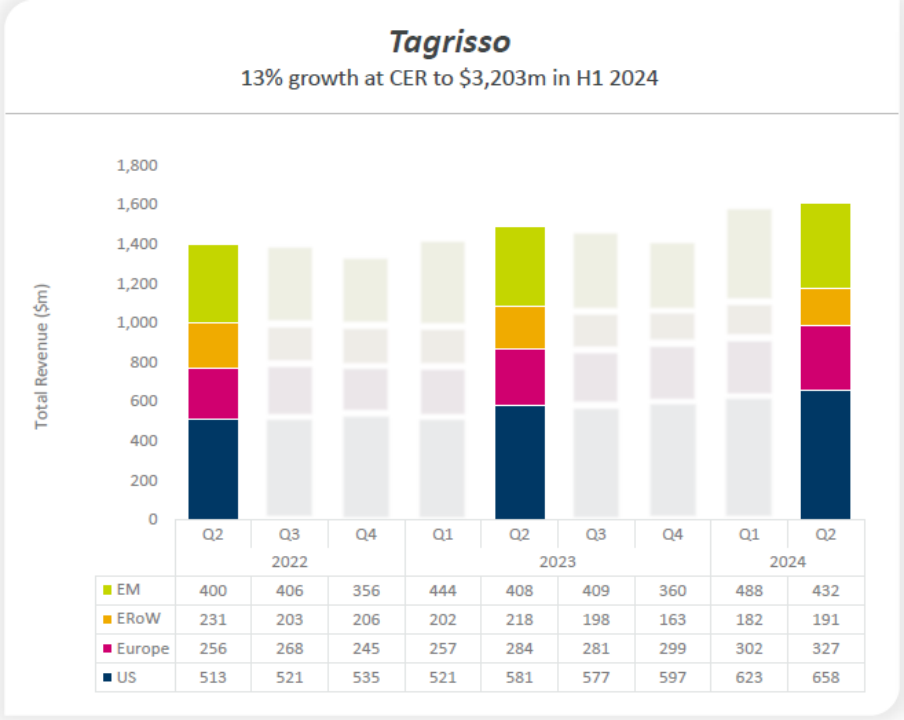
Figure 3. Osimertinib Sales Revenue
AstraZeneca continues to deepen its focus in the oncology field,RecentlyDay, AstraZenecaTotal price of $540 million introducedPinetree TherapeuticsPreclinical EGFR Degrader CandidateAccording to the terms of the agreement, AstraZeneca will have the exclusive option to globally develop and commercialize this EGFR degrader. EGFR is a classical tumor target and also a highly mutable target protein. Small molecule inhibitors targeting it have been developed up to the fourth generation. However, small molecule inhibitors tend to cause drug resistance issues. In contrast to small molecules, degraders can degrade the entire protein rather than merely inhibiting its activity, potentially addressing the drug resistance problem of small molecule drugs. Therefore, many companies are engaged in the development of EGFR degraders. Currently entering clinical trials, EGFR degraders include HSK40118 from Haisco and HJ-002-03 from Hengjing Pharmaceuticals,BeiDa/C4 Therapeutics' EGFR L858R degrader CFT8919 is also under clinical application. AstraZeneca's recent acquisition of the EGFR degrader has further boosted R&D enthusiasm in this field, with promising developments expected to follow.
02
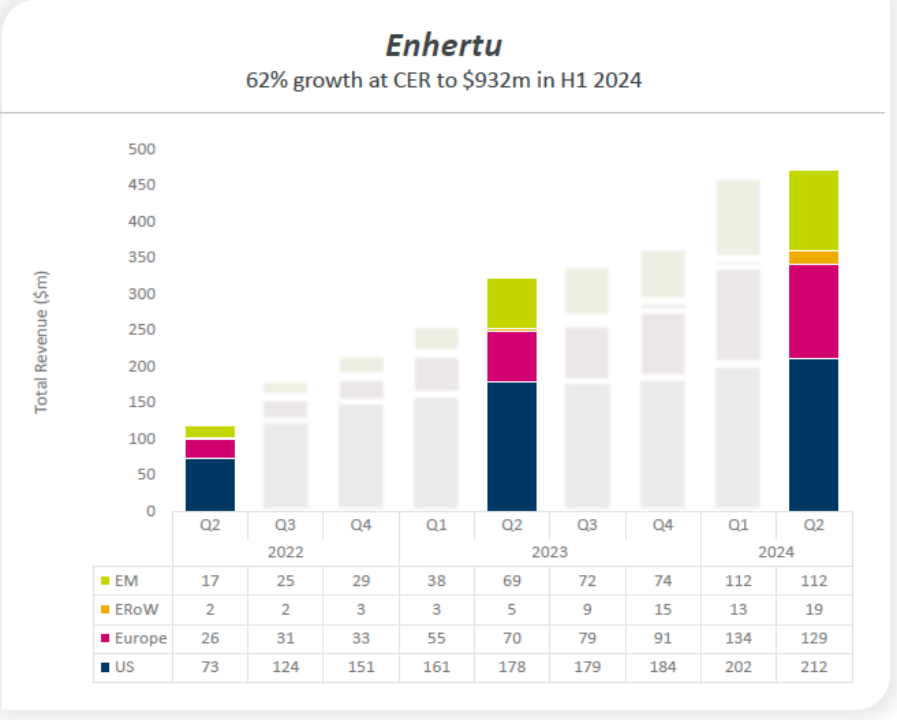
ADC Advances Rapidly AstraZeneca has long been established in the ADC field,In October 2013, AstraZeneca spent $440 million to acquire Spirogen, a pioneer in PBD ADC., acquiring Spirogen's unique pyrrolobenzodiazepine (PBD) dimer technology and making an equity investment in ADC Therapeutics, thus beginning to venture into the ADC field. In April 2019, AstraZeneca$1.35 billion upfront payment, total transaction amount $6.9 billionAstraZeneca Successfully Enters the First Tier of the ADC Field by Reaching a Cooperation Agreement with Daiichi Sankyo on DS-8201 (Enhertu)。 And Enhertu lives up to expectations, givingDaiichi Sankyo/AstraZeneca brought substantial returns, with Enhertu, managed by AstraZeneca, generating $261 million in revenue in 2023.Daiichi Sankyo is responsible forEnhertu2023Annual Total Revenue$2.566 billion,With 300 millionMoreUSD Surpasses Kadcyla for the First Time to Claim the Top ADC Drug Revenue Throne。 This YearEnhertu sales continue to grow, according to AstraZeneca's financial report,AstraZenecaResponsibleEnhertuSales in the first quarter were $460 million, and sales in the second quarter were $472 million.Total revenue in the first half of the year was $9.32 billion, a year-on-year increase of 62%, showing rapid growth.(Figure 4).
Figure 4. Sales of AstraZeneca's Enhertu
Enhertu has also achieved excellent efficacy in the field of oncology,On April 5 this year,Enhertu Receives U.S. FDA Accelerated Approval for the Treatment of Adult Patients with Unresectable or Metastatic HER2-Positive (Immunohistochemistry [IHC] 3+) Solid Tumors, these patients have received prior treatment and lack satisfactory alternative treatment options, successfully advancing into pan-tumor. In June, AstraZeneca announced that the median progression-free survival for Enhertu in HR-positive, HER2-low, and HER2-ultralow metastatic breast cancer patients who had received one or more lines of endocrine therapy was 13.2 months.,Compared with chemotherapy, Enhertu reduced the risk of disease progression or death by 22%, which will further broaden the treatment population for Enhertu.[2]。 Except forBeyond Enhertu,AstraZeneca alsoIntroduced multipleADC, includingDS-1062, CMG901, and LM-305, etc. DS-1062 was acquired by AstraZeneca in July 2020 for an upfront payment of $1 billion and a total amount of $6 billion from Daiichi Sankyo. It is an ADC candidate drug targeting Trop-2, which has reached the primary endpoint of PFS in the Phase III clinical trial TROPION-Breast01 for HR+/HER2-low or negative breast cancer. CMG901 is a globally pioneering ADC targeting Claudin18.2 developed by KYM (a joint venture established by Keymed Biosciences (70% ownership) and Lepu Biopharma (30% ownership)), and it consists of an anti-Claudin 18.2 monoclonal antibody, a cleavable linker, and the cytotoxic small molecule monomethyl auristatin E (MMAE). February 23 last year,AstraZeneca引进CMG901,预付6300万美元,并有超过11亿美元的潜在额外研发和销售相关里程碑付款。GlobalExclusive rights to research, develop, register, manufacture, and commercialize。 LM-305 is a novel GPRC5D-targeted ADC with first-in-class molecular potential independently developed by Limei Pharmaceuticals based on its exclusive ADC platform. It consists of an anti-GPRC5D monoclonal antibody, a protease-cleavable linker, and a cytotoxic payload monomethyl auristatin E (MMAE). It has currently received IND approval for clinical trials in both the United States and China. On May 12 last year, AstraZeneca$55 millionAdvance Payment, as well as a global exclusive licensing agreement for LM-305 with potential development and commercial milestone payments of up to $545 million.[3]。
On May 20 this year,AstraZeneca also announced plans to invest $1.5 billion in Singapore to produce ADC drugs.AstraZeneca is making bold advances into the ADC field.
03
Nuclear Medicine Emerging
Nuclear Medicine Sub-sectorRadiopharmaceutical Conjugates (RDC) have become a promising approach in cancer treatment. RDCs are a class of drugs obtained by conjugating radioactive isotopes with antibodies, peptides, or small molecule drugs. RDC can achieve precise targeting by using molecules such as antibodies, peptides, or small molecules to deliver radioactive isotopes directly to cancer cells.。 Compared with traditional radiotherapy, this method has many potential advantages, including minimizing damage to healthy cells and enabling people to reach tumors that cannot be accessed by external radiation. In recent years, the research and development of nuclear medicine has been very active, with NovartisPluvictoThe success has further ignited global R&D enthusiasm, with multiple pharmaceutical companies placing heavy bets, including Novartis, Eli Lilly, BMS, and AstraZeneca. On March 19 this year, AstraZeneca announced that it would acquire Fusion Pharmaceuticals for a total transaction value of approximately $2.4 billion.This acquisition complements AstraZeneca's leading oncology portfolio, adding an RDC pipeline.Including Fusion's most advanced FPI-2265,This is a potential new therapy for patients with metastatic castration-resistant prostate cancer (mCRPC). FPI-2265 targets prostate-specific membrane antigen (PSMA), a protein highly expressed in mCRPC, and is currently in Phase II trials. FPI-2265 delivers the radioactive isotope actinium-225 (225Ac), an α-radiotherapeutic drug. Compared with β-rays, α-rays have larger particle mass, higher potency, and a shorter range. Targeted α-therapy can achieve higher treatment efficacy with a smaller impact on normal tissues [4].On June 4, AstraZeneca announced the completion of its acquisition of Fusion.
Final Words
In May this year, AstraZeneca set a target of $80 billion in total revenue by 2030, and AstraZeneca is working towards this goal with steady sales growth in recent years.
References1.Astrazeneca:H1 and Q2 2024 Results2.Enhertu demonstrated a median progression-free survival of 13.2 months in HR-positive, HER2-low and HER2-ultralow metastatic breast cancer following one or more lines of endocrine therapy
3. Lixun Pharmaceuticals: Lixun Pharmaceuticals announces a global exclusive licensing agreement with AstraZeneca for the novel GPRC5D-targeted antibody-drug conjugate LM-305.

4.AstraZeneca to acquire Fusion to accelerate the development of next-generation radioconjugates to treat cancer
Co-build Biomedical Innovation Ecosystem!How to Join BiG Membership?