

Pfizer's One-Time Gene Therapy Durveqtix Receives Conditional EU Approval for Hemophilia B

Pfizer
Pharmaceutical R&D Developer
▎WuXiEdited by Kant Content Team
Today, the European Commission (EC) announced the approval of a one-time gene therapy developed by Pfizer.Durveqtix(fidanacogene elaparvovec)Conditional marketing authorization for the treatment of adult patients with severe and moderately severe hemophilia BThese patients have no FIX inhibitors in their bodies and no antibodies against the AAVRh74 variant were detected.

Hemophilia B is a life-threatening degenerative disease, in which patients lack clotting factors due to genetic mutations.IX. Patients with this disease are prone to bleeding in the joints, muscles, and internal organs, resulting in pain, swelling, and joint damage. Current treatments include lifelongMultiple regular intravenous infusions per week or monthFactor IX may require more than a hundred treatments per year to temporarily replace or supplement low levels of the clotting factor.
This EU approvalDurveqtixMainly based on the results of the single-group, open-label Phase 3 clinical trial BENEGENE-2, which aimed to evaluateDurveqtixTreatment of moderate to severe hemophilia B (defined as a clotting factorIXEfficacy and safety in male subjects (18-65 years) with cyclic activity ≤2%, with a total of 45 patients enrolled in this trial.
Analysis shows that the BENEGENE-2 trial met its primary endpoint, namely, compared with the FIX prophylactic treatment regimen,Durveqtix significantly reduced the frequency of bleeding.The annualized bleeding rate (ABR) was 1.44 for patients in the Durveqtix group and 4.50 for patients receiving prophylactic therapy (p=0.0084), representing a 68% reduction. Additionally, 60% of patients in the Durveqtix group remained free of bleeding events during the individual observation period (range: 2-4 years), compared to only 29% of patients who received routine prophylactic treatment during the lead-in period.After receiving Durveqtix treatment, the patient's consumption of preventive coagulation factor IX decreased by 92.4%.
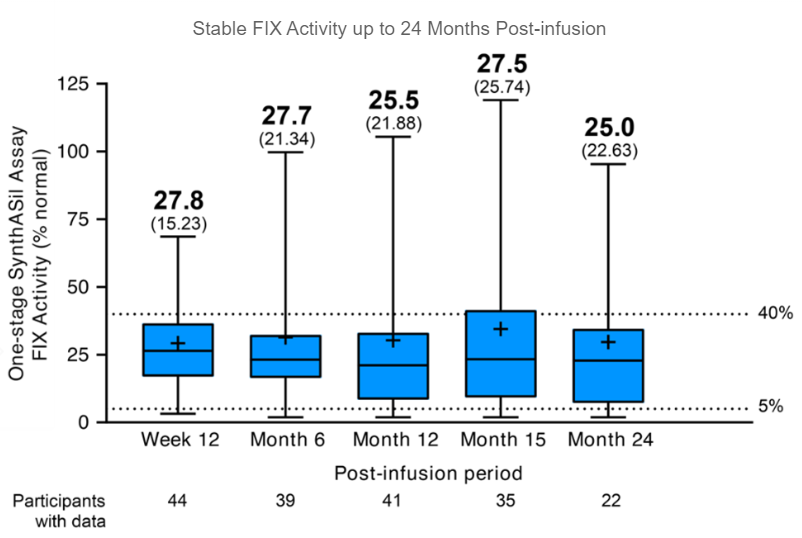
▲ InIn the trial, patients receivedDurveqtixAfter infusion, FIX activity in the body remained stable (Image source: Reference [4]).
DurveqtixOverall, the treatment was well-tolerated, and the safety results were consistent with those from the previous Phase 1/2 trials. The most common adverse reactions reported in the study (incidence ≥5%) wereLiver TransaminaseIncrease, but can be treated with corticosteroids.Not ReportedThrombotic events, related to treatment or infusionNo related serious adverse events were observed in the patient.FIX Inhibitor。Patients receiving Durveqtix treatment will undergo 15 years of follow-up, including 6 years in the pivotal clinical trial and an additional 9 years as part of another study, to monitor the long-term efficacy and safety of this gene therapy.
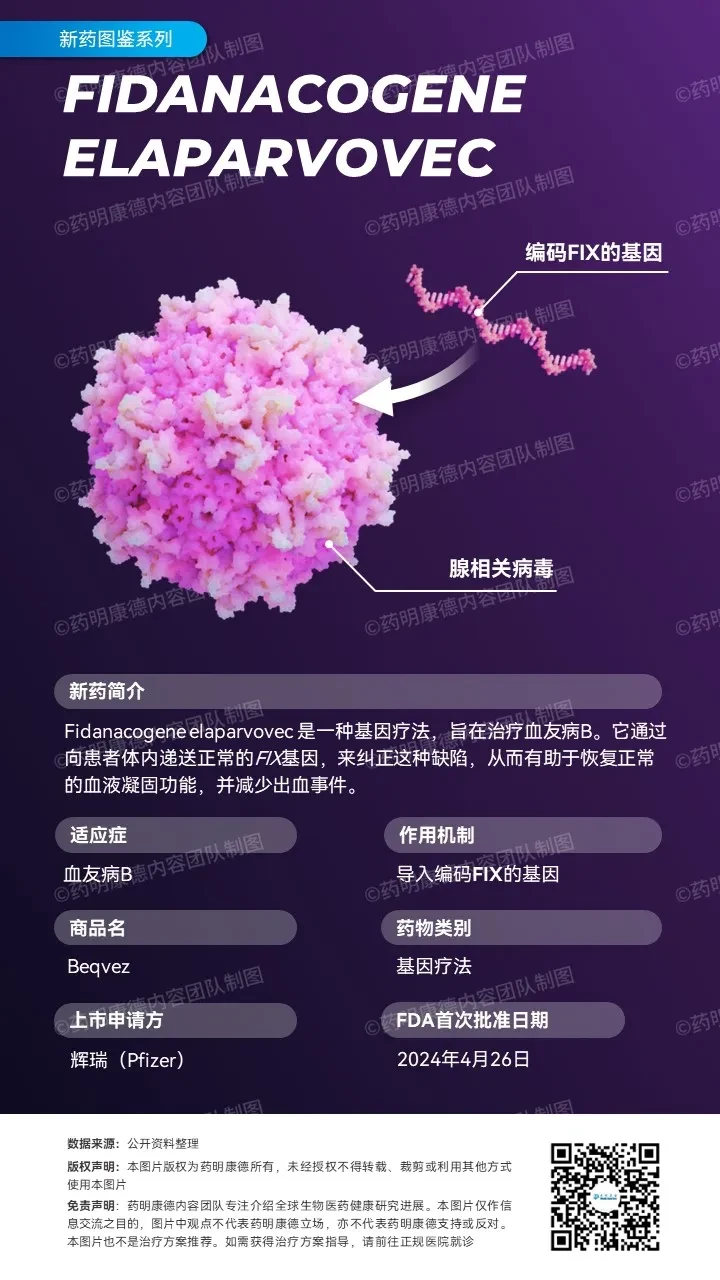
Durveqtix is a novel gene therapy that contains a bioengineered adeno-associated virus capsid and a transgene encoding a high-activity FIX variant.For patients with hemophilia B, the goal of this gene therapy is to enable them to produce their own FIX protein through a one-time treatment, rather than requiring regular intravenous infusions of FIX as with the current standard treatment. In December 2014, Pfizer acquired this therapy from Spark Therapeutics for a $20 million upfront payment. Health Canada approved it in January this year.ApprovalThe therapy was launched in the U.S. in April this year, with approval from the FDA.ApprovalThis gene therapy, marketed under the brand name Beqvez.
BesidesDurveqtix,Pfizer currently has a gene therapy, giroctocogene fitelparvovec, in Phase 3 clinical trials.. The company announced the other dayGiroctocogene fitelparvovec inFor the treatment of adult patients with moderate to severe hemophilia APhase 3 trial AFFINE met primary and key secondary endpoints,After receiving a single dose infusion, patients showed a significant reduction in mean total ABR compared to pre-infusion (1.24 vs 4.73; one-sided p-value = 0.0040).In addition,The average ABR after treatment also showed a statistically significant decrease, dropping from 4.08 before infusion to 0.07 after infusion, with a reduction of 98.3% (one-sided p-value <0.0001).In addition, Pfizer is also conducting a phase 3 trial to examine its investigational tissue factor pathway inhibitor monoclonal antibody marstacimab for the treatment of patients with hemophilia A and B who have (or do not have) clotting factor inhibitors. Currently, the US FDA and EMA are reviewing the marketing authorization application for marstacimab.

The currently approved hemophilia gene therapies on the market include those developed byBioMarin Pharmaceutical develops,Received EU marketing authorization in August 2022ApprovalOfRoctavian(valoctocogene roxaparvovec),ThisIs the first approved gene therapy for the treatment of hemophilia A, which was then approved by the U.S. FDA in June 2023Approval。Roctavian uses an AAV5 viral vector to deliver a transgene expressing Factor VIII. The therapy was announced in June this year.Long-term ResearchThe results showed,Patients Show Long-Term Sustained Bleeding Control and Factor VIII (FVIII) Expression Four Years After Roctavian Infusion.In Year 4, 73.6% (81 of 110 subjects) within the trial experienced zero bleeding episodes.
And developed by CSL Behring,Hemgenix(etranacogene dezaparvovec) was in 2022ObtainFDA Approves First Gene Therapy for Adult Patients with Hemophilia B, which was then approved by the EU in February 2023.Approval。HemgenixUsing an AAV5 vector to deliver a transgene expressing the Factor IX Padua variant, which is 5-8 times more active than normal Factor IX, can achieve normal blood clotting function at lower expression levels.

Image Source: 123RF
Currently, new molecular therapies for hemophilia under research includeBelief BioMed Independently DevelopedBBM-H901。ThisIt is a recombinant AAV gene therapy carrying an optimized human FIX gene expression cassette.This medication delivers the gene encoding human FIX into patients with hemophilia B through intravenous administration, enabling sustained expression to increase and maintain the patient's coagulation factor levels over the long term, used to prevent bleeding. The results published this June revealed...DataDisplay,InDuring the long-term follow-up of 3.0-4.5 years, 9 subjects showed sustained and stable high expression of FIX, with no bleeding events occurring, an ABR of 0, and complete cessation of exogenous FIX product replacement therapy.Belief BioMed stated in the press release,Plan to submit the marketing application for BBM-H901 injection this year。ASC Therapeutics'The second-generation gene therapy for hemophilia A, ASC618, completed the first patient dosing in a Phase 1/2a clinical trial in December of last year.ASC618 utilizes a transgene delivered by an AAV vector, containing a proprietary codon-optimized B-domain deleted modified chimeric Factor VIII gene and a liver-specific promoter. Preclinical studies have shown that this gene therapy can produce therapeutic levels of Factor VIII protein at a lower dose.In addition, RocheDeveloped by its subsidiary Spark TherapeuticsHemophilia A Gene TherapyThe phase 3 trial of SPK-8011 is currently recruiting patients.This therapy uses an AAV vector to express a transgene for codon-optimized Factor VIII.
And developed by Be BiopharmaPotential "first-in-class" autologous B-cell therapy (BCM) BE-101 also received approval in June this year.FDA Approves IND Application in the United States.BE-101 aims to target humansFIXGene insertion into primary human B cells to express active FIX for the treatment of hemophilia B.In preclinical studies, a single administration of BE-101 has been shown to provide active and sustained levels of FIX.The company plans to initiate a Phase 1/2 clinical trial in the second half of this year to evaluate the safety and preliminary efficacy of BE-101 in adult patients with moderate to severe hemophilia B.

▲To learn more about the application of cutting-edge technologies in the biopharmaceuticals industry, please long-press and scan the QR code above to access "WuXi Live Studio" and watch live discussions and exciting replays on related topics.


Share,PointLike,In view,Focusing on Global Biomedical Health Innovation