

Drug Design Enters the Quantum Computing Era: Tencent and AceMapAI Announce Breakthrough Collaboration

Tencent
Internet Comprehensive Service Provider

AceMapAI
AI Drug Discovery Developer
Recently, AceMapAI (Suzhou) Life Science Technology Co., Ltd., in collaboration with Tencent Quantum Laboratory, China Pharmaceutical University, and Ningbo Institute of Technology, officially published a paper titled "A Hybrid Quantum Computing Pipeline for Real World Drug Discovery." In this research case, the team innovatively constructed a classical + quantum hybrid programming framework and applied it to two real-world drug design processes: preclinical animal experiments and clinically validated trials. The team observed significant potential and commercial value of quantum computing in drug design applications. The research team believes that as the hardware capabilities of quantum computers improve, quantum computing will bring tremendous transformative opportunities to the industry in the future. (Paper link:https://www.nature.com/articles/s41598-024-67897-8)
This research achievement in applying quantum computing to drug design not only establishes a new milestone for AceMapAI in the field of new drug development but also brings new hope to the entire pharmaceutical industry. As quantum computing gradually matures and becomes more widely applied, it will provide more efficient and precise solutions for future drug development, driving continuous innovation and growth in the pharmaceutical sector.
Before this collaboration, AceMapAI, as an AI-driven innovative drug pipeline R&D team, had a core work background of using computational technology to drive the complete closed-loop process of drug development, from target discovery, structural design, drug synthesis, to experimental validation. In the design work of new drug R&D, it is necessary to rely heavily on AI and computational tools to meet related challenges.
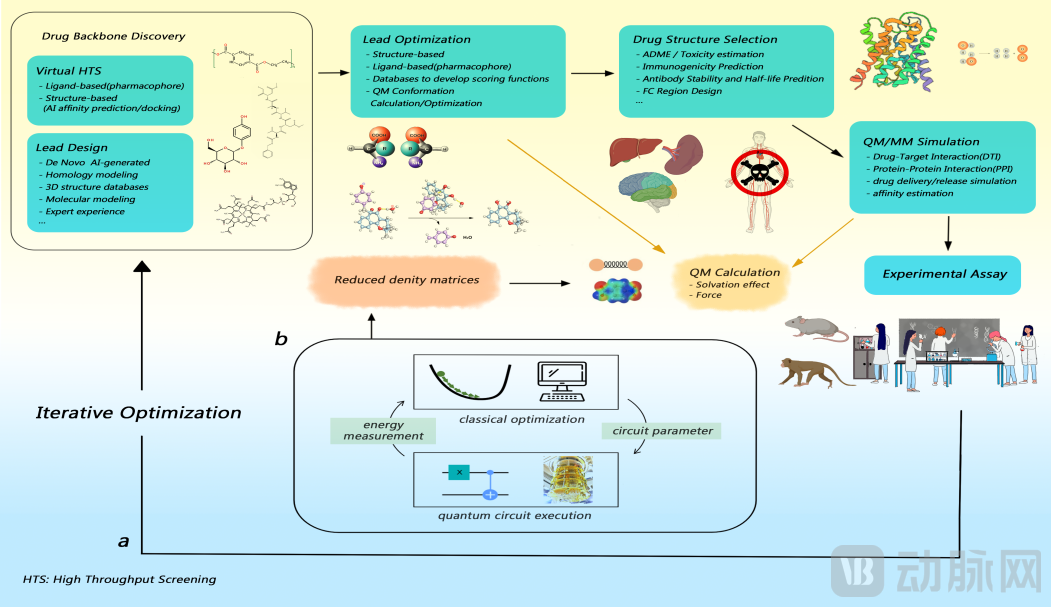
When designing based on the structure of a target (typically a protein with relevant regulatory effects on a disease), the team first utilizes protein structure data, computational tools, and AI methods to screen or de novo generate drug structures. After completing the basic structural design, optimization is carried out based on the biological characteristics of the selected target and the tissue/organ environment. Finally, QM/MM (quantum mechanics/molecular mechanics) methods are used to computationally simulate the interactions between the drug and biological systems. After completing all computational design tasks, the evaluated drug structures are synthesized (or extracted) and experimentally validated and confirmed for specific issues.
However, in this process, there is a key issue that directly imposes severe constraints on the overall time consumption of the workflow – drug structure optimization and the QM/MM stage – which requires the use of computational chemistry methods to evaluate various properties of drug structures. With the continuous advancement of the computer industry and AI technology, the industry has gradually started adopting approximation and AI learning methods to accelerate solving this problem, with some initial results observed. However, these methods are highly dependent on the specific application scenarios of the problem. To theoretically find a universal and feasible solution for this issue in engineering practice, it is necessary to adopt an approach that...The processing of high-dimensional information has a natural matching characteristic.A new type of solution, quantum computers have become a possible direction.
AceMapAI, a company dedicated to applying cutting-edge computing technologies to drug design, has its CEO Li Xiaoran believing that in the upcoming era of potential massive transformation brought by quantum computing, AceMapAI must adopt a proactive and open attitude to collaborate with the finest teams worldwide. This collaboration aims to explore the greatest possibilities of AI + quantum computing in the biological field. Therefore, AceMapAI's research team, after thorough communication with researchers from Tencent Quantum Lab, China Pharmaceutical University, and Ningbo Institute of Technology, jointly initiated this case study.
This research project aims to explore the potential of quantum computing in areas such as molecular dynamics simulations of drug molecules, descriptions of electron structures in chemical reaction zones, drug screening, and optimization, while also verifying its feasibility in practical drug design. It is anticipated that quantum computing will demonstrate significant potential in applications within the biopharmaceutical field.
Before conducting this research with Tencent Quantum Lab, the team also noticed that there are many debates within the industry regarding the practical application capabilities of quantum computing. After thorough discussions with various researchers, the collaboration goal for this research case was established:
1. A real-world drug design problem must be selected, and the problem must be rigorously tested through experiments in the pharmaceutical field to validate the effectiveness of the drug design. Only then can it be verified whether the potential errors in quantum computing fall within an acceptable range for biological systems.
2. It is necessary to conduct a horizontal comparative test between classical chips and real quantum computers for the same problem, in order to observe the absolute accuracy and performance of quantum computing, understand the gap compared with classical chips, and identify potential performance advantages.
3. Use Python (the most used programming language in the AI industry) as the main programming code, and ultimately open-source the code along with the experimental results to provide a performance testing benchmark and test dataset for subsequent researchers to compare.
In this study, the team utilized high-performance superconducting quantum chips (with an average gate operation fidelity of 99.95% (single-qubit) and 99.37% (two-qubit)) to construct a two-qubit quantum computer and adopted the key programming tool TenCirChem to complete a hybrid programming framework for quantum and classical computers.
For performance comparison, the pure classical computer used AceMapAI's GPU server, configured with Intel(R) Xeon(R) Gold 5220 CPUs (72 cores, 144 threads total, 2.20 GHz base frequency), and 6 NVIDIA A100-PCIe GPUs.
In order to achieve the experimental objectives, the research team also selected two specific cases for analysis: prodrug design (Prodrugs) and KRAS G12C mutation inhibitors. They innovatively adapted to the characteristics of the quantum hybrid computing architecture, completing the relevant calculations and result verification.
In the end, some very imaginative results were obtained:
1. In terms of computational accuracy, the error generated by quantum hybrid computing is found to be acceptable in practical drug design scenarios.Specifically, quantum hybrid computers have already achieved the task objectives of classical computers in solving the Schrödinger equation. More importantly, their computational errors fall within the allowable error range for specific biological systems.
2. Performance analysis results show that, in these two cases, the time consumption increase of the hybrid quantum-classical chip algorithm is relatively small compared to pure classical chips.Hybrid quantum computing will eventually demonstrate computational speeds close to top-tier traditional chips in such tasks as the number of atoms increases. Therefore, it is reasonable to believe that in future experiments, hybrid quantum computing solutions will be capable of achieving commercially viable goals when applied at an appropriate scale.
3. In this collaboration, the research team built an open-source hybrid chip programming framework and provided a performance parameter comparison benchmark for quantum computing versus classical computing.This framework not only provides subsequent researchers with highly valuable references and a tool stack but also significantly simplifies the process of applying quantum computing in drug design, reducing its difficulty of use. As research partners who similarly classify quantum computing as a computational paradigm can utilize this programming framework to adapt to their own quantum hardware, comparing and analyzing the computational power gaps and development speeds of current different quantum computers. The team hopes that this framework will be sufficiently flexible, integrating the advantages of quantum computing and classical computing, and in the future, provide researchers in drug design, AI, and quantum computing with an entirely new tool for reference.
AceMapAI believes that in the current stage of drug design, quantum computing has become an important and innovative tool for production. It is believed that in the near future, with further improvements in hardware performance, quantum computers will bring more innovative and revolutionary results to this field. Subsequently, AceMapAI will further strengthen its cooperation with Tencent Quantum Lab and jointly complete the commercial operation of quantum computing.
The team will spare no effort to leverage the unique advantages of computing, increase investment in AI + quantum computing in drug discovery, and continuously optimize algorithms and hardware. We will always adhere to delivering biotech products that are rationally designed and experimentally validated. Ultimately, we aim to build a world-leading innovative drug R&D platform that integrates BT and IT, gather top talents and technical resources, and accelerate the commercialization process of drug discovery.